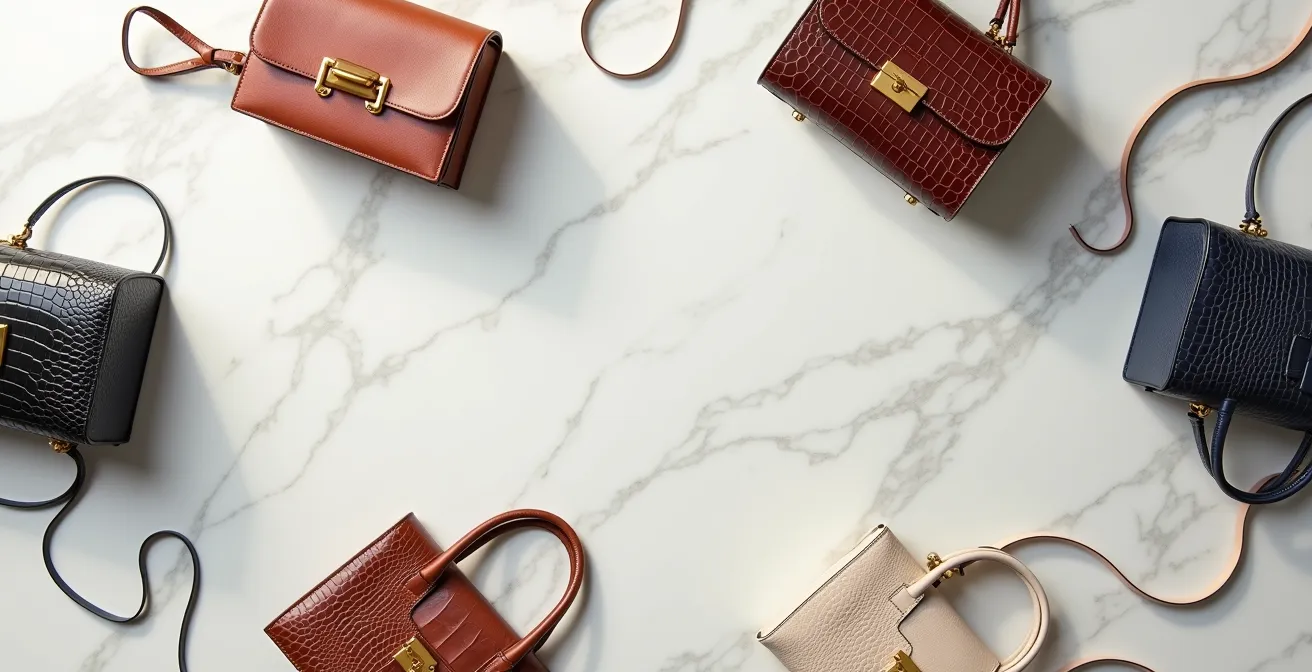
The highest resale returns come not from owning an iconic handbag, but from managing it like a tangible financial asset across its entire lifecycle.
- Scarcity is the primary driver of value; limited editions and rare colors consistently outperform mass-produced classics on the secondary market.
- Meticulous preservation and authentication are non-negotiable, as condition and provenance directly translate into financial premiums, or “Condition Alpha.”
Recommendation: Shift your focus from brand names to asset management—prioritize strategic acquisition, risk mitigation through proper care and insurance, and a precisely timed market exit.
For the discerning fashion enthusiast, the line between a luxury purchase and a strategic investment has never been more blurred. Many will advise you to buy the “holy trinity” of investment bags—an Hermès Birkin, a Chanel Classic Flap, or a Louis Vuitton Speedy—and call it a day. The common wisdom suggests that sticking to classic colors and simply keeping the bag in “good condition” is enough to secure its value. This approach, however, treats a high-value collectible as a mere accessory rather than the sophisticated asset it truly is.
But what if the key to maximizing returns wasn’t just in the *what*, but in the *how* and *when*? The true art of handbag investment lies in adopting a portfolio manager’s mindset. This means moving beyond basic advice to master the entire asset lifecycle: from identifying scarcity and performing meticulous due diligence before acquisition, to actively managing depreciation through material choice and preservation, and ultimately, executing a perfectly timed exit strategy. This perspective transforms a beautiful object into a vehicle for generating significant financial alpha.
This guide will deconstruct the strategies used by expert resellers to treat designer handbags as a serious asset class. We will explore how to identify true investment-grade pieces, protect them from value-eroding mistakes, and navigate the market to secure the highest possible return on your investment.
Summary: Mastering the Art of Handbag Investment
- Why Limited Edition Colors Fetch Higher Resale Prices?
- How to Spot a Super-Fake Bag Using Stitch Count?
- Lambskin vs Caviar Leather: Which Survives Daily Use?
- The Hanging Mistake That Deforms Your Designer Bag Straps
- When to Sell: The Seasonal Window for Maximum Profit
- When to Appraise Your Collectibles: A 3-Year Cycle
- Why You Only Need 2 Trendy Items to Refresh Your Look?
- How to Insure High-Value Personal Assets Correctly?
Why Limited Edition Colors Fetch Higher Resale Prices?
In the world of high-finance collectibles, the core driver of value is not just brand prestige, but engineered scarcity. While a classic black Chanel flap is a liquid asset, it’s the limited-run, seasonal, or milestone-edition colors that offer the potential for explosive value arbitrage. These pieces are not just bags; they are rare artifacts. The demand from collectors who missed the initial retail window creates a hyper-competitive secondary market where prices are dictated by rarity, not the original price tag. This is the fundamental principle of investment-grade collecting.
The most extreme example of this phenomenon is the Hermès Himalaya series. Its distinctive white-to-grey gradient, reminiscent of the snow-capped mountains, is a result of a painstaking dyeing process, and its production is severely limited. This has elevated it from a mere handbag to a legendary asset class. The value appreciation is staggering, with a 2022 Diamond Himalaya Birkin 30 selling for $450,000 in a private sale. Even standard Himalaya models, which retail in the $55,700-$62,700 range, can command auction prices up to five times their initial cost. The peak was demonstrated by a record-breaking €252,000 sale in September 2022, confirming that for top-tier investors, color rarity is the ultimate alpha generator.
An investor’s strategy, therefore, should involve monitoring for specific indicators of future value. These include connections to brand milestones (like anniversary collections), early adoption by style icons, and—most critically—extremely low production volumes. An item with fewer than 100 units produced globally is far more likely to appreciate than a seasonal piece produced in the thousands. It’s a calculated hunt for scarcity.
How to Spot a Super-Fake Bag Using Stitch Count?
In asset management, due diligence is paramount. For designer handbags, this means authentication, and the frontline of defense against sophisticated counterfeits—or “super-fakes”—is in the details that machines cannot perfectly replicate. One of the most telling indicators is the stitching. Authenticators don’t just look at the leather; they analyze the stitch count, angle, and material with forensic precision. Heritage brands like Hermès pride themselves on the saddle stitch, a manual technique that creates a distinct, durable, and slightly angled line that is nearly impossible for a machine to copy with the same tension and texture.
The angle and consistency of the stitching are dead giveaways. A genuine hand-sewn saddle stitch will have a slight, consistent angle (typically 35-45 degrees), whereas a machine stitch is often perfectly perpendicular. Furthermore, the number of stitches per inch (SPI) is a brand-specific signature. A Chanel bag, for example, should have between 9 and 11 SPI, while many fakes either overdo it with 12+ stitches for a “perfect” look or fall short with fewer than 8, betraying poor quality.
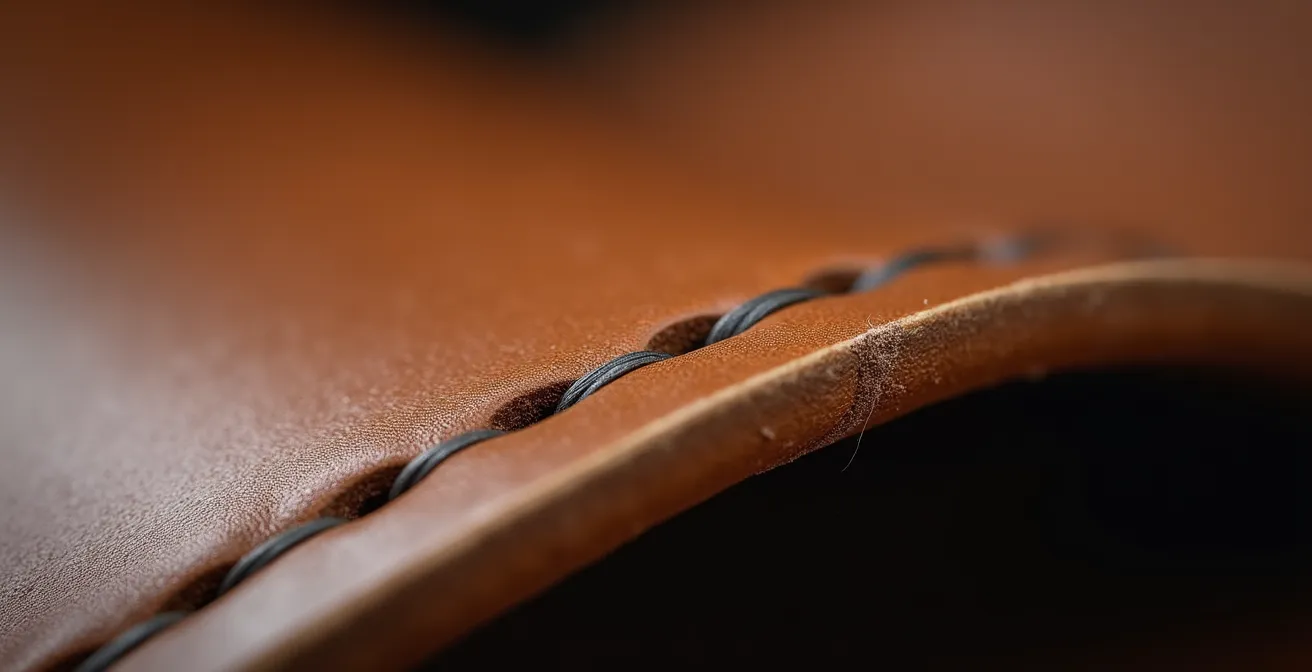
This macro view reveals the slight, natural irregularities and the angled entry of an authentic saddle stitch—hallmarks of a hand-crafted piece. The thread itself is another clue; luxury houses use high-quality waxed linen or silk-blend threads that have a matte, textured finish, unlike the cheap, shiny polyester thread common in replicas. Spotting these subtleties is a critical risk mitigation skill for any serious collector.
To systematize your authentication process, it helps to compare the key characteristics side-by-side. The following breakdown, based on an analysis of replica manufacturing tells, clarifies what to look for.
| Feature | Authentic Luxury Bag | Super-Fake Replica |
|---|---|---|
| Stitches Per Inch (SPI) | 9-11 for Chanel, 8-10 for Hermès | Often 12+ (too perfect) or under 8 (poor quality) |
| Thread Material | Waxed linen or silk blend | Polyester with artificial sheen |
| Stitch Angle | Consistent 35-45° angle for saddle stitch | Perpendicular or inconsistent angles |
| Termination Points | Clean backstitch or hidden knots | Visible knots, loose threads, or glue marks |
| Spacing Consistency | Slight natural variations (0.5mm tolerance) | Machine-perfect or wildly inconsistent |
Lambskin vs Caviar Leather: Which Survives Daily Use?
Choosing the right material is a strategic decision that directly impacts an asset’s long-term value and liquidity. For Chanel collectors, the primary debate is between Lambskin and Caviar leather. Lambskin is buttery soft, with a luxurious, smooth finish that beautifully showcases quilting. It has a delicate, high-fashion appeal. Caviar, on the other hand, is a treated calfskin with a pebbled, grainy texture. It is famously robust, resistant to scratches, and holds its structure exceptionally well over time. From an investment perspective, this is not a question of aesthetics, but of depreciation management.
A bag intended for frequent use (3+ times a week) is better served by Caviar leather. Its durability ensures it maintains a “like new” appearance, a key factor for maximizing resale value, with some models retaining up to 92% of their retail price. However, this durability comes at the cost of the luxurious feel that some collectors prize. For a special occasion piece used sparingly, Lambskin can be the superior investment. While more fragile, a pristine lambskin bag can develop a unique patina that is highly sought after, sometimes commanding a 10-15% premium over its Caviar counterpart, especially in classic black with gold hardware combinations.
To make a truly informed decision, one must calculate the Total Cost of Ownership (TCO). A recent analysis of Chanel Classic Flaps showed that a lambskin model might require professional cleaning every 18-24 months at a cost of $300-$500 per session. Over a decade, this adds $1,500-$2,500 in maintenance costs, eroding the net return. This financial modeling is essential for any serious investor choosing between these two iconic materials.
Your Action Plan: Investment-Based Leather Selection
- For bags used 3+ times weekly: Choose Caviar leather to maintain ‘like new’ appearance and maximize resale value.
- For special occasion bags (under 10 uses annually): Select Lambskin for luxury appeal and potential patina premium.
- Calculate 10-year TCO: Add purchase price + (estimated maintenance cost × frequency) – expected resale value.
- Consider hardware stress points: Caviar’s rigidity may cause more wear on clasps, while Lambskin’s softness can affect strap attachment points over time.
- Document condition quarterly: Photograph wear patterns to track the depreciation rate for each leather type and inform your selling decision.
The Hanging Mistake That Deforms Your Designer Bag Straps
After acquisition, the focus shifts to preservation. A handbag’s condition is the single most controllable factor influencing its resale value, and achieving a premium for a pristine piece—what we can call “Condition Alpha”—is a direct result of meticulous care. The most common and value-destroying mistake owners make is improper storage. Hanging a designer bag by its straps, especially a heavier model or one with a delicate chain strap, exerts constant, focused pressure on the leather, hardware, and anchor points. Over time, this leads to irreversible stretching, creasing, and deformation.
This seemingly innocuous habit can have devastating financial consequences. Experts estimate that the difference in value between a bag with pristine straps and one with stretched or deformed ones can be a staggering 20-30% decrease in its final sale price. For a bag valued at $10,000, that’s a $3,000 loss caused by a simple storage error. This is a perfect example of how passive neglect directly erodes an asset’s worth. Proper archival storage is not an affectation; it is a fundamental risk mitigation strategy.

The correct method, as shown, is to store the bag upright or flat on a shelf, inside its dust bag. It should be lightly stuffed with acid-free tissue paper to maintain its shape, with straps and chains carefully tucked inside or wrapped in felt to prevent them from denting the leather. Hardware should also be wrapped to prevent oxidation and scratches. This mimics the archival practices of museums and is the professional standard for preserving the structural and aesthetic integrity of a high-value handbag.
When to Sell: The Seasonal Window for Maximum Profit
The final phase of the asset lifecycle is the exit strategy. Selling a designer handbag is not a passive act; it is an exercise in market timing. Just as with stocks or real estate, the luxury resale market is subject to seasonal trends and event-driven spikes that create optimal windows for liquidation. Listing a bag at the right moment can significantly increase the final sale price, maximizing your return on investment. The most prominent trend is the holiday season surge.
Consignment platforms consistently see a spike in both traffic and prices in the run-up to the winter holidays. Data from The RealReal reveals that designer bag prices surge by an average of 26% during the November to January period, as buyers search for statement gifts. A strategic seller will anticipate this and submit their items for consignment in early autumn to ensure they are photographed, authenticated, and listed online just as this wave of demand begins to crest. Waiting until December is too late; the key is to be ahead of the curve.
Beyond seasonality, a savvy investor must also monitor for brand-specific events. A brand re-launching an iconic style, for instance, can cause the value of vintage originals to skyrocket. This was perfectly illustrated by the Dior Saddle Bag revival. Bonhams auction house documented a vintage ostrich Saddle bag that failed to sell for £300 before Dior’s 2018 relaunch campaign. Just six months after the new models hit stores, that same vintage bag sold for nearly £2,000—a 566% increase. This demonstrates how brand marketing creates immediate, high-value selling windows that last only a few months.
Checklist for a Profitable Exit: Your Platform-Specific Timing Strategy
- Consignment platforms (The RealReal, Fashionphile): Submit your items between September 1st and 15th to capture peak holiday season visibility.
- Auction houses (Christie’s, Sotheby’s): For high-value pieces, enter them into spring auctions by the January 31st deadline for the lucrative March-April sales.
- Peer-to-peer marketplaces (Vestiaire, Rebag): List your bag immediately following official brand price increases, which typically occur in January and June, to capitalize on the new price floor.
- Monitor brand announcements: Set up Google Alerts for “[Your Bag Model] + discontinued” to be the first to know when supply is officially cut off.
- Track celebrity moments: If a major celebrity is photographed with your bag model, creating a viral moment, list it within 72 hours to ride the wave of search interest.
When to Appraise Your Collectibles: A 3-Year Cycle
Managing a portfolio of tangible assets requires regular valuation. Unlike stocks, whose values are updated in real-time, the worth of a designer handbag can quietly and dramatically appreciate without the owner’s knowledge. Relying on the original purchase price for insurance or resale purposes is a common but costly mistake. A structured appraisal cycle is essential to accurately track an asset’s growth and ensure it is properly protected. For most investment-grade handbags, a formal re-appraisal every three years is the recommended baseline.
This three-year cycle is not arbitrary. It is designed to keep pace with the aggressive pricing strategies of luxury brands. Chanel, for instance, is known for its bi-annual price hikes, which have a direct and immediate impact on the resale value of existing bags. As Credit Suisse reports, the value of Chanel bags appreciated by a staggering 24.5% in 2021 alone. An appraisal from 2020 would therefore be dangerously out of date, leaving the owner underinsured and undervaluing their asset for a potential sale. A regular appraisal updates the “fair market value,” which is critical for both insurance claims and setting a competitive resale price.
While a three-year cycle is a good rule of thumb, certain events should trigger an immediate re-appraisal. These are market signals that the value of your specific asset may have shifted significantly, and waiting for the next scheduled valuation could be a costly oversight. Key triggers include:
- The brand announces a retail price increase of over 10%.
- Your specific bag model is officially discontinued by the brand.
- A similar piece breaks a record at a major auction house like Sotheby’s or Christie’s.
- The bag sustains any damage, even minor scratches to hardware, which requires a new condition assessment.
- Your insurance policy is approaching its annual renewal date.
Why You Only Need 2 Trendy Items to Refresh Your Look?
In a handbag portfolio, classic, investment-grade pieces like a Birkin or a Classic Flap are the “blue-chip stocks”—stable, reliable, and appreciating steadily. However, a well-rounded portfolio also has room for a few high-growth “satellite” investments. These are the trendy, of-the-moment items that can offer rapid, outsized returns if chosen correctly. The strategy is not to chase every fad, but to identify one or two emerging pieces per year that show signs of becoming a “future classic.” This approach allows you to stay culturally relevant while making shrewd, high-risk, high-reward bets.
The key is distinguishing a fleeting fad from a piece with long-term potential. A perfect case study is The Row’s Margaux bag. Initially seen as a trendy “quiet luxury” item, it quickly earned the reputation of “the next Birkin.” Its value retention climbed 14% in 2024 to an impressive 73%, and the resale platform Fashionphile recorded a 126% increase in its value for pristine examples. The indicators were all there for a savvy investor: a minimalist design rooted in the brand’s core DNA, craftsmanship rivaling heritage houses, and organic adoption by industry tastemakers rather than a blitz of paid influencer marketing.
Identifying these future classics requires a disciplined analytical framework. You must look beyond the hype and evaluate the item’s fundamentals. Does the design solve a real-world problem or is it purely an aesthetic statement? Is its production limited or is it being mass-marketed? A piece that evolves the brand’s heritage and shows steady price appreciation over its first six months is a far better bet than one that sees an immediate, explosive spike followed by a plateau. This table outlines the key indicators to watch for.
| Criteria | Future Classic Signs | Fleeting Fad Warning |
|---|---|---|
| Design Origin | Evolution of brand’s heritage codes | Departure from brand identity |
| Functionality | Solves a real user problem | Pure aesthetic statement |
| Early Adopters | Industry insiders, editors | Paid influencer campaigns |
| Production | Limited but ongoing production | One-season capsule |
| Price Trajectory | Steady appreciation over 6 months | Immediate spike then plateau |
| Resale Performance | Maintains 80%+ value after 1 year | Drops below 50% within 6 months |
Key Takeaways
- Treat your handbag collection as a financial portfolio, focusing on the entire asset lifecycle from acquisition to liquidation.
- The greatest financial returns are found in scarcity (limited editions) and pristine condition (“Condition Alpha”).
- Active management, including regular appraisals and a timed exit strategy, is essential to maximizing your return on investment.
How to Insure High-Value Personal Assets Correctly?
The final pillar of handbag asset management is risk mitigation. After investing time and capital into acquiring, authenticating, and preserving a valuable piece, leaving it uninsured or underinsured is a critical failure of portfolio management. Many collectors mistakenly believe their standard homeowner’s or renter’s insurance provides adequate protection. In reality, most of these policies have strict sub-limits for high-value collectibles like jewelry, art, and designer goods.
Typically, a standard homeowner’s policy will cap coverage for theft of such items at a mere $1,500. For a handbag worth $10,000 or more, this is grossly insufficient, leaving the owner exposed to a near-total loss in the event of theft, fire, or other disasters. Furthermore, these basic policies often do not cover common risks like “mysterious disappearance” (losing the item) or accidental damage. To properly protect your asset, you need a specialized form of coverage.
The correct solution is to add a “Scheduled Personal Property” rider or floater to your existing policy, or to take out a standalone policy from a firm specializing in collectibles. This approach insures the item for its full, appraised “agreed value,” not a depreciated replacement cost. This means if your $15,000 bag is lost, you receive a check for $15,000. As experts in the field note, this specialized coverage is essential for true peace of mind. As explained by the specialists at Distinguished Insurance Programs in their guide on the topic:
Scheduled Personal Property riders provide coverage on an agreed-value basis, which benefits clients… the standard policy has low limits and won’t cover ‘mysterious disappearance,’ whereas a scheduled policy covers the full appraised value against a wider range of risks.
– Distinguished Insurance Programs, Luxury Items: Handbag and Couture Coverage Guide
Securing the right insurance is the final, non-negotiable step in protecting your investment. To put these strategies into practice, your immediate next step should be to contact your insurance agent to discuss scheduling your high-value personal assets for their full appraised value.