
Brittle nails aren’t just a sign you need more biotin; they are a critical signal of deeper systemic stress and nutrient imbalances within your body.
- High-dose biotin can paradoxically worsen skin issues by creating a functional Vitamin B5 deficiency.
- Chronic stress forces your body to sacrifice the health of hair and nails to prioritize essential survival functions.
Recommendation: Focus on managing stress, ensuring a balanced protein intake, and understanding nutrient interactions rather than relying on single-vitamin supplements.
The frustrating cycle of brittle, splitting, or peeling nails often sends people straight to the supplement aisle. The common advice echoes through health forums and magazine articles: you’re probably dehydrated, aging, or, most frequently, deficient in biotin. While these factors can play a role, they represent a superficial understanding of a much more complex diagnostic signal. As a dermatologist and nutritionist, I see nails not as a cosmetic concern, but as a clear window into your body’s internal state of affairs.
Treating brittle nails as a simple biotin deficiency is like trying to fix a faulty engine by only changing the spark plugs. It might offer a temporary fix, but it ignores the root cause. The real story is often written in the language of systemic stress, nutrient competition, and metabolic priorities. Your body is constantly making decisions about where to allocate resources. When under stress—be it from a demanding job, poor sleep, or even an imbalanced diet—it enters a state of triage. In this state, functions deemed “non-essential” for immediate survival, like growing strong hair and nails, are the first to be deprioritized.
This article moves beyond the platitudes to decode what your nails are truly telling you. We will explore how a popular supplement could be backfiring, how stress silently sabotages your hair three months down the line, and why the form of a nutrient matters more than the dose. By understanding these interconnected systems, you can move from merely masking symptoms to addressing the core imbalances and rebuilding your health from the inside out.
To help you navigate this holistic approach, this guide breaks down the key factors influencing your nail, hair, and skin health. We will examine the science behind these connections, providing a clear path to understanding and restoring your body’s natural balance.
Summary: Decoding the Signals From Your Nails and Hair
- Why Taking Biotin Supplements Might Cause Acne Breakouts?
- How Telogen Effluvium Causes Hair Loss 3 Months After Stress?
- Collagen Cream vs Powder: Which Actually Reaches the Dermis?
- The Shampooing Mistake That Strips Your Scalp Barrier
- Restoring Nail Health: The 3-Week Break From Gel Polish
- Protein vs Carbs: What Ratio Prevents the 3 PM Slump?
- Ashwagandha or Magnesium: Which Is Better for Evening Anxiety?
- How to Repair a Damaged Skin Barrier in 2 Weeks?
Why Taking Biotin Supplements Might Cause Acne Breakouts?
The most common knee-jerk reaction to brittle nails is to start taking high doses of biotin. While biotin is essential for keratin production, more is not always better. In fact, it can create a significant, unintended problem: acne. This paradox stems from a principle of competitive uptake in your intestines. Biotin (Vitamin B7) and pantothenic acid (Vitamin B5) are absorbed using the same pathway, the Sodium-dependent Multivitamin Transporter (SMVT). When you megadose biotin, you can effectively saturate this transporter, preventing your body from properly absorbing Vitamin B5.
Case Study: The High-Dose Biotin and B5 Interference
A comprehensive analysis revealed that approximately 30% of individuals taking high-dose biotin (5,000-10,000 mcg daily) report some form of skin reaction. The study identified that the shared intestinal transporter (SMVT) for biotin and pantothenic acid (B5) becomes saturated by biotin megadoses. This creates a functional B5 deficiency, a vitamin critical for supporting the skin barrier and regulating sebum production, leading to breakouts in susceptible individuals.
This functional B5 deficiency is a serious issue for skin health. Vitamin B5 is crucial for fat metabolism and plays a key role in maintaining the skin barrier function and regulating oil production. Without enough B5, the skin’s barrier can weaken, and sebum can become thicker, leading to clogged pores and inflammatory acne. Ironically, while you’re trying to strengthen your nails, you may be actively compromising your skin. In fact, some clinical research shows that B5 supplementation can reduce facial acne lesions by over 60% after 12 weeks, highlighting its importance for clear skin.
Instead of blindly supplementing with biotin, consider a balanced B-complex vitamin or focus on dietary sources like eggs, nuts, and whole grains. This ensures you’re supporting your body’s systems holistically rather than creating a new problem.
How Telogen Effluvium Causes Hair Loss 3 Months After Stress?
Have you ever experienced a period of intense stress—a job loss, an illness, or a major life change—only to notice significant hair shedding a few months later? This delayed reaction is a classic sign of Telogen Effluvium, a condition that perfectly illustrates the body’s system of nutrient prioritization under duress. Your hair follicles cycle through phases of growth (anagen), transition (catagen), and rest (telogen). Normally, about 85-90% of your hair is in the growth phase. However, a significant physiological or emotional stressor can trigger a shock to your system.
In response to high levels of the stress hormone cortisol, your body prematurely pushes a large number of hair follicles from the growth phase into the resting phase. This is a survival mechanism; the body diverts energy and resources away from “non-essential” activities like growing hair to focus on managing the perceived threat. The hair doesn’t fall out immediately. It stays in the telogen (resting) phase for about three months before it is finally shed to make way for a new hair. This is why the hair loss appears long after the stressful event has passed, often leaving people confused about the cause.

Just as stress impacts the hair growth cycle, it similarly affects nail health. High cortisol can inhibit the production of keratin, leading to slower growth, brittleness, and the formation of horizontal ridges known as Beau’s lines, which mark the timing of the systemic stress. This demonstrates that weak nails and hair shedding are often two symptoms of the same root cause: systemic stress that forces your body to make difficult choices about resource allocation.
Managing Telogen Effluvium involves addressing the original stressor and ensuring the body has the nutritional building blocks (especially protein and iron) to resume a healthy growth cycle once the stress has subsided.
Collagen Cream vs Powder: Which Actually Reaches the Dermis?
The beauty industry is saturated with collagen-infused creams and serums promising to restore youthful skin and strong nails. However, from a physiological standpoint, this approach is fundamentally flawed. The idea that a large protein molecule like collagen can be applied topically, penetrate the outer skin layer (epidermis), and rebuild the deeper layer (dermis) or the nail matrix is largely a marketing myth. The collagen molecules in creams are simply too large to be absorbed effectively. At best, they act as humectants, sitting on the surface to help the skin retain moisture, but they do not contribute to internal structural integrity.
True rebuilding must come from within. When you ingest collagen powder or hydrolyzed collagen supplements, your digestive system breaks the protein down into smaller peptides and amino acids. These building blocks are then absorbed into your bloodstream and distributed throughout the body, where they become available for your cells (fibroblasts in the skin, and matrix cells in the nail bed) to synthesize new collagen and keratin. This is the only way to provide the raw materials needed to strengthen the nail plate from its origin.
The following table, based on a recent comparative analysis of delivery methods, clarifies the stark difference in efficacy.
| Method | Absorption Rate | Impact on Nail Matrix | Key Benefits |
|---|---|---|---|
| Collagen Powder (Oral) | Broken down to amino acids, absorbed in intestines | Direct – provides building blocks for keratin synthesis | Systemic benefits, supports nail growth from within |
| Topical Cream | Limited to skin surface | None – cannot reach nail matrix | Surface hydration only |
| Hydrolyzed Collagen Supplements | Up to 90% bioavailability | High – smaller peptides readily absorbed | Enhanced nail strength and growth rate |
Choosing a hydrolyzed collagen supplement can be particularly effective, as the collagen is already broken down into smaller, more easily absorbed peptides, maximizing the bioavailability of these crucial building blocks for your nails, hair, and skin.
The Shampooing Mistake That Strips Your Scalp Barrier
Many people are careful about choosing a gentle, sulfate-free shampoo to avoid stripping the natural oils from their scalp and damaging their hair. This protective layer of sebum, known as the acid mantle, is crucial for maintaining a healthy scalp microbiome and preventing moisture loss. The mistake of over-washing or using harsh surfactants disrupts this delicate barrier, leading to dryness, irritation, and even weakened hair follicles. This same principle of barrier stripping applies with equal, if not greater, force to your nails.
Every day, our hands are exposed to far harsher substances than our hair. Frequent hand washing with alkaline soaps, the use of alcohol-based hand sanitizers, and exposure to cleaning chemicals all systematically dismantle the protective barrier of the nail plate and surrounding skin. The nail plate is about ten times more porous than skin, meaning it absorbs and loses water rapidly. This constant cycle of hydration and dehydration, exacerbated by stripping cleansers, leads directly to delamination (peeling), brittleness, and weakness. A dermatological study on patients with chronic brittle nails confirmed this link, finding that 68% of participants showed significant improvement in nail flexibility after switching to a protective routine with pH-neutral cleansers and regular oil application.
Therefore, the biggest “shampooing mistake” for your nails is ignoring the impact of daily cleansing habits. Protecting your nails requires the same mindset as protecting your scalp: minimize exposure to harsh detergents and actively replenish lost lipids and moisture. This means wearing gloves for household chores, choosing gentle, pH-neutral hand soaps, and, most importantly, rehydrating after every wash.
Just as you would use a conditioner after shampooing, you should apply a penetrating oil or a thick balm to your nails and cuticles after hand washing to lock in moisture and reinforce their natural defense.
Restoring Nail Health: The 3-Week Break From Gel Polish
Gel manicures provide a durable, glossy finish that is hard to resist, but their convenience comes at a significant cost to nail health. The damage occurs during both application and removal. The UV light used to cure the polish can be damaging to the surrounding skin, while the removal process is particularly aggressive. Soaking nails in pure acetone for 10-15 minutes severely dehydrates the nail plate, and the subsequent scraping and buffing required to remove the gel can thin the keratin layers, leading to extreme brittleness, peeling, and white spots.
This is why taking a “nail holiday” is not just a suggestion but a clinical necessity for recovery. A break of at least three weeks is required to allow the damaged portion of the nail to grow out and to restore the nail plate’s lipid balance and hydration. This period should not be passive; it is an active recovery phase. During this time, all polish should be avoided, including regular lacquer, to allow the nail to “breathe” and to facilitate the absorption of treatments.
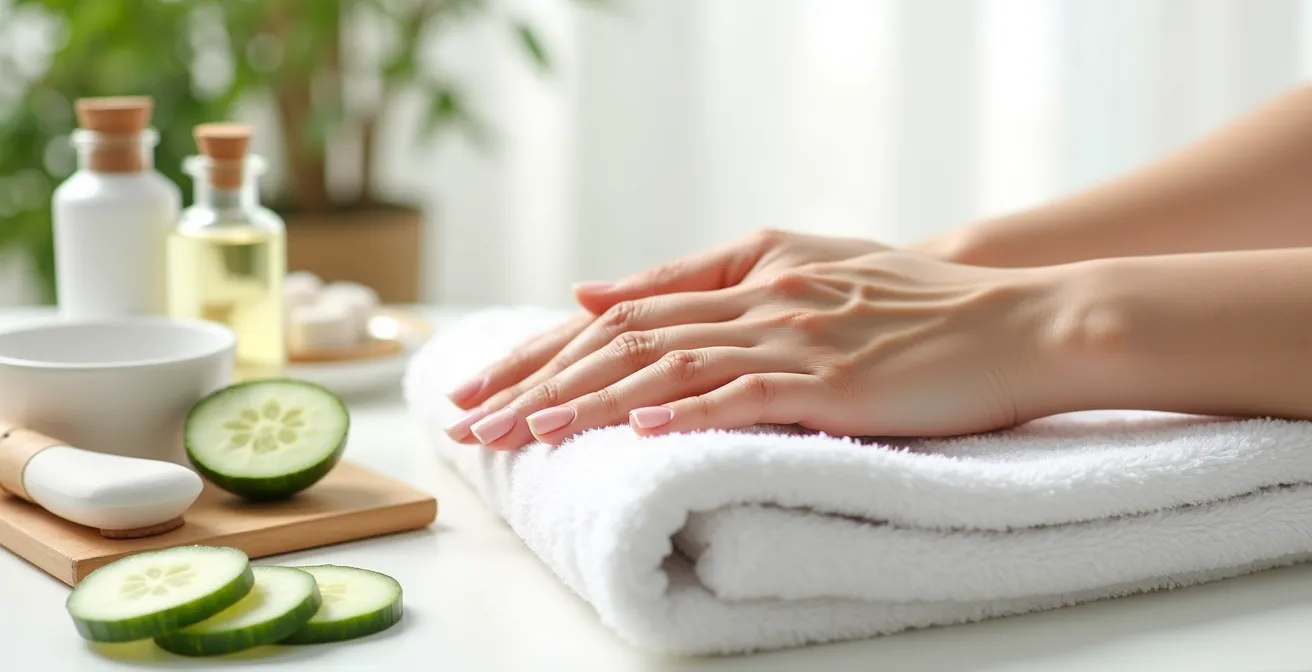
The focus during this break should be on intensive hydration and protection. Daily application of a high-quality, penetrating nail oil, such as jojoba or avocado oil, is critical. These oils have a molecular structure similar to the body’s own sebum and can penetrate the nail plate to restore flexibility. Massaging the oil into the cuticles also stimulates blood flow to the nail matrix, promoting healthier, stronger growth from the base. This dedicated ritual transforms a simple break into a powerful restorative treatment.
After the three-week reset, if you choose to return to manicures, consider opting for less damaging alternatives or spacing out gel applications to give your nails a regular recovery window.
Protein vs Carbs: What Ratio Prevents the 3 PM Slump?
The afternoon energy slump is a common complaint, often attributed to a carbohydrate-heavy lunch. While balancing macronutrients is key for stable blood sugar and sustained energy, the role of protein extends far beyond preventing sleepiness. It is the primary building block for virtually every structure in your body, including the keratin that forms your hair and nails. When your dietary intake is insufficient, your body initiates a process of nutrient prioritization that has direct and visible consequences.
Your body is a master of triage. It will always prioritize using available protein for life-sustaining functions: creating enzymes, building hormones, and repairing vital tissues. The production of hair and nails is considered a “cosmetic” or non-essential function. As a result, when protein is scarce, these areas are the first to suffer. Research has shown that when intake falls below the recommended level, the body diverts protein away from the nail matrix, resulting in slower growth, increased brittleness, and weakness within a matter of weeks.
Case Study: The Impact of Protein Prioritization
Research tracking adults on varied protein intakes found that when dietary protein falls below 0.8g/kg of body weight, the body prioritizes essential functions like enzyme production over ‘cosmetic’ functions. Participants consuming less than the recommended amount showed visible nail changes, including slower growth and increased brittleness, within 4-6 weeks. Importantly, rectifying the issue was not immediate; improvements only became visible 3-6 months after protein intake was corrected, which is the time it takes for a completely new, healthy nail to grow out.
Therefore, brittle nails can be a direct, physical manifestation of inadequate protein intake over the preceding months. To ensure your body has enough resources for both essential functions and structural integrity, most experts recommend adults consume 0.8-1.2 grams of protein per kilogram of body weight daily. This ensures there are enough amino acids to go around, preventing the body from having to sacrifice your nail health.
Prioritizing a high-quality protein source at every meal—such as lean meat, fish, eggs, legumes, or tofu—is one of the most effective long-term strategies for building resilient nails from the inside out.
Ashwagandha or Magnesium: Which Is Better for Evening Anxiety?
The connection between stress and nail health is not just a vague concept; it’s a direct biochemical pathway. Chronic stress leads to elevated cortisol, which, as we’ve seen, can disrupt growth cycles. Managing that stress is therefore a primary strategy for improving nail health. For evening anxiety—that “wired and tired” feeling that prevents restful sleep—both Ashwagandha and Magnesium are excellent interventions, but they work in different ways and are suited for different types of stress.
Ashwagandha is an adaptogenic herb that excels at modulating the body’s stress response. It is particularly effective for individuals with HPA (Hypothalamic-Pituitary-Adrenal) axis dysregulation, where the body is stuck in a state of high alert. By helping to lower cortisol levels, Ashwagandha directly counteracts the hormone that inhibits healthy nail and hair growth. It helps the body “adapt” to stress, restoring a sense of calm and promoting restorative sleep.
As Nutritionist Kara Carper, M.A. of the Weight & Wellness Center notes, the impact of a key mineral deficiency can be profound:
A deficiency in magnesium delivers a double blow: it increases stress and simultaneously impairs the body’s ability to build strong nails.
– Kara Carper, M.A., Nutritionist Wisdom Weight & Wellness Center
Magnesium, on the other hand, is a mineral that functions as a relaxation agent for the nervous system and muscles. It is often depleted during times of stress. A deficiency can manifest as muscle tension, poor sleep, and even sugar cravings. For nail health, magnesium is critical because it acts as a cofactor in hundreds of enzymatic reactions, including protein synthesis—the very process that builds keratin. Without adequate magnesium, the body cannot efficiently use the protein you consume to build strong nails.
| Supplement | Best For | Nail Health Benefits | Recommended Dose |
|---|---|---|---|
| Ashwagandha | Wired and tired feeling, HPA axis dysregulation | Reduces cortisol which inhibits nail growth | 300-600mg daily |
| Magnesium | Muscle tension, poor sleep, sugar cravings | Critical cofactor in protein synthesis for keratin production | 200-400mg daily |
The choice isn’t always either/or; many individuals benefit from taking both. Ashwagandha addresses the hormonal stress signal, while magnesium provides a crucial building block and promotes physical relaxation, creating a comprehensive approach to managing the systemic stress that undermines nail integrity.
Key Takeaways
- Nail health is an indicator of systemic balance, not an isolated cosmetic issue. It reflects your body’s internal stress levels and nutritional status.
- Systemic stress and nutrient competition (like biotin vs. B5) are often more significant culprits for brittle nails than simple, single-vitamin deficiencies.
- True, lasting repair comes from within by ensuring adequate protein and cofactors like magnesium, and is protected from without by maintaining the nail’s natural barrier.
How to Repair a Damaged Skin Barrier in 2 Weeks?
The concept of “skin barrier repair” has become central to modern dermatology. It involves restoring the outermost layer of the epidermis, the stratum corneum, which is a matrix of lipids and skin cells that locks in moisture and protects against external irritants. The core principles are simple: cleanse gently, hydrate intensely, and protect consistently. These exact same principles are the key to repairing a damaged nail barrier, as the nail plate, while tougher, is fundamentally a specialized extension of the skin.
Repairing the nail barrier requires a dedicated, multi-faceted approach. A two-week “reset” can make a significant difference by removing stressors and providing intensive nourishment. The first week focuses on complete detoxification: removing all polish and avoiding unnecessary water exposure. The primary treatment is performing twice-daily soaks with a penetrating oil like jojoba, which restores the lipid content and flexibility of the nail plate. The second week involves re-introducing a protective layer, such as a breathable, hydrating base coat, while continuing nightly oil treatments to support the new, healthier nail growth emerging from the matrix.
This focused protocol interrupts the cycle of damage and allows the nail’s natural structure to recover. To translate these principles into a concrete plan, an audit of your current habits and a structured implementation plan are essential.
Your Nail Barrier Repair Audit: A 5-Step Action Plan
- Points of Contact: List all sources of daily damage your nails encounter. Include frequent hand washing, use of alcohol-based sanitizers, polish removal with acetone, and household chores without gloves.
- Collect & Inventory: Take a close look at your nails. Inventory their current condition: note areas of peeling, splitting, white spots, or unusual ridges. This is your baseline.
- Analyze for Coherence: Confront your daily habits with your goal. Does your routine (e.g., no gloves while washing dishes) align with the goal of strong, healthy nails? Identify the biggest inconsistencies.
- Identify the Keystone Habit: From your list, pinpoint the single most damaging habit to tackle first. For many, this is forgoing gloves or the overuse of hand sanitizer. This is your priority target.
- Build Your Integration Plan: Create a simple, daily protocol. For example: “I will apply a protective balm before any water exposure and perform a 5-minute jojoba oil soak every night before bed.”
Begin by observing your symptoms not as isolated problems, but as connected data points. A holistic assessment of your diet, stress levels, and daily habits is the first and most critical step toward achieving lasting health for your skin, hair, and nails.