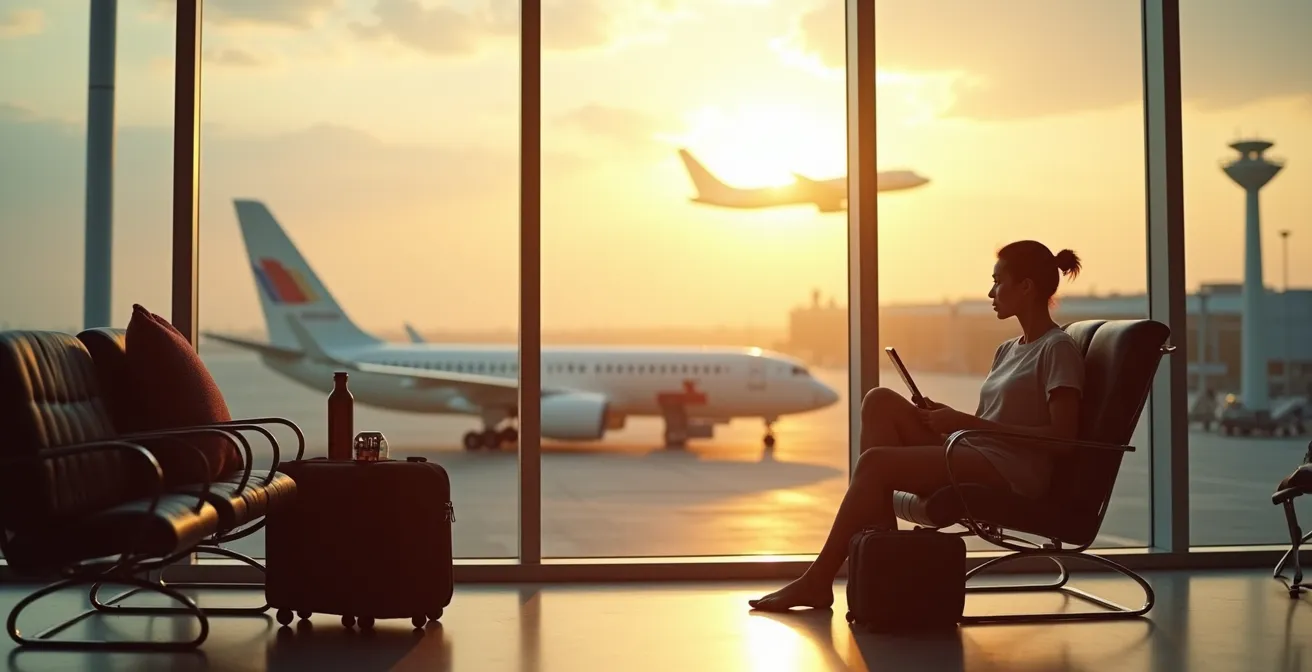
In summary:
- Treat in-flight comfort as a series of strategic countermeasures against physiological stressors like extreme dehydration and circulatory risks.
- Proactively manage your body’s clock by timing sleep according to your destination, not your departure city.
- Your seat choice and simple, no-gear exercises are more critical for reducing fatigue and health risks than any gadget.
- Extend your strategic planning to pre-flight financial decisions to minimize stress and maximize purchasing power upon arrival.
The prospect of a 14-hour flight in an economy seat is enough to fill even the most seasoned traveler with a sense of dread. The common advice is well-known: wear loose clothing, drink some water, and try to get some sleep. We collect an arsenal of neck pillows, eye masks, and noise-canceling headphones, hoping these gadgets will provide a shield against the inevitable discomfort of being confined to a metal tube at 35,000 feet.
But these are merely tactics, not a strategy. They address the symptoms, not the root causes of in-flight misery. The true challenge of ultra-long-haul travel isn’t just boredom or cramped legs; it’s a direct assault on your body’s core systems. The environment actively works against your hydration, circulation, and natural sleep cycles. This guide re-frames the problem: what if surviving a long flight wasn’t about finding the perfect pillow, but about understanding and systematically neutralizing the specific physiological stressors you face?
This is the approach of a travel logistics expert. It’s about moving beyond passive endurance and into active management of your in-flight environment and your body. By understanding the ‘why’ behind the discomfort, you can deploy targeted countermeasures that genuinely work. This article will deconstruct the primary challenges of long-haul flights and provide a strategic protocol to not just survive, but to arrive at your destination feeling controlled, prepared, and surprisingly refreshed.
This guide provides a comprehensive framework for mastering the ultra-long-haul flight. Below, you will find a detailed breakdown of the key strategies we will cover, from managing your body’s internal environment to making smart logistical choices before you even leave for the airport.
Summary: Your Strategic In-Flight Master Plan
- Why Cabin Air Pressure Dehydrates You Faster Than the Desert?
- Window vs Aisle: Which Is Better for Sleeping on Long Hauls?
- Neck Pillow vs Foot Hammock: Which Actually Reduces Fatigue?
- The Inactivity Mistake That Can Cause Blood Clots
- When to Sleep Onboard: Matching Your Destination Time Zone
- When to Buy Foreign Currency Before a Trip?
- How to Block Blue Light 2 Hours Before Bed Effectively?
- How Does a Strong Dollar Affect Your International Purchasing Power?
Why Cabin Air Pressure Dehydrates You Faster Than the Desert?
The single greatest physiological stressor on a long-haul flight is not the cramped seating, but the profound dehydration caused by the cabin environment. The air at 35,000 feet is almost completely devoid of moisture. To make it breathable, aircraft systems warm and circulate this air, resulting in a cabin humidity level of around 10-20%, a condition drier than the Sahara Desert, which averages 25% humidity. This desert-like air actively pulls moisture from your body through your breath and skin with every passing minute.
This isn’t just about feeling thirsty; it’s a systemic issue. Mild dehydration thickens your blood, increases fatigue, and can cause headaches and irritability. It’s a critical factor that amplifies all other in-flight discomforts. Furthermore, as research from the Mayo Clinic confirms, this dehydration has a direct domino effect on your post-flight wellness, significantly worsening the effects of jet lag. The study found that every 1% of body water lost can increase the time it takes to recover from jet lag by about 20%.
Therefore, hydration is not a passive activity but your primary strategic countermeasure. You must have a deliberate protocol. Start hydrating 24 hours before your flight, aiming for at least two extra glasses of water. During the flight, a good rule of thumb is to drink 240-250ml (about 8 ounces) of water every hour. Avoid diuretics like caffeine and alcohol, which accelerate fluid loss. To enhance your body’s ability to absorb the water you drink, consider packing electrolyte powders. Finally, combat external dehydration by regularly applying moisturizer and lip balm.
Window vs Aisle: Which Is Better for Sleeping on Long Hauls?
Your seat selection is the first and most critical strategic decision you’ll make for in-flight comfort. The choice between a window and an aisle seat isn’t a matter of preference; it’s a commitment to a specific survival strategy. Each comes with distinct biomechanical advantages and disadvantages that dictate your ability to sleep and move for the next 14 hours. The goal is to align your choice with your personal priority: uninterrupted sleep or freedom of movement.
The window seat is a fortress. It offers a solid surface to lean against, stabilizing your head and neck and reducing the muscle strain that leads to waking up. It also grants you control over the window shade and protects you from being disturbed by passing carts and passengers. This makes it the superior choice for “Fortress Builders” who prioritize sleep above all else. Its major drawback is the need to disturb your seatmates for bathroom breaks, which can create social anxiety and limit your willingness to hydrate properly.
The aisle seat, in contrast, is for “Free Rangers.” Its primary benefit is freedom. You can get up to stretch, visit the lavatory, or access the overhead bin without asking permission. It also offers the subtle advantage of being able to stretch one leg into the aisle periodically. However, this freedom comes at the cost of sleep quality. You are exposed to constant foot traffic and bumps, and you lack a stable surface for your head, making deep sleep difficult. The choice is a trade-off between privacy and access.
This comparative analysis from a recent travel comfort study breaks down the strategic calculus of choosing your seat.
| Aspect | Window Seat | Aisle Seat |
|---|---|---|
| Sleep Quality | Better – wall support, no disturbance | Worse – frequent interruptions |
| Movement Freedom | Limited – must disturb others | Excellent – easy bathroom access |
| Leg Room | Standard only | Can stretch into aisle |
| Privacy | Maximum control | More exposed |
| Best For | Fortress Builders who prioritize sleep | Free Rangers valuing movement |
Neck Pillow vs Foot Hammock: Which Actually Reduces Fatigue?
The travel gadget market is flooded with products promising in-flight bliss. However, from a biomechanical perspective, only a few address the real sources of fatigue. The debate between a neck pillow and a foot hammock isn’t about which is “better,” but about understanding that they solve two completely different physiological problems. Using them strategically can significantly reduce overall body strain.
A high-quality, wrap-around neck pillow’s primary function is to protect the cervical spine. When you doze off in a seated position, your head tends to fall to the side or forward, causing lateral flexion strain on your neck muscles and ligaments. A good pillow provides support to prevent this, allowing your neck and shoulder muscles to relax fully. It’s a tool for preventing a specific type of musculoskeletal pain that accumulates over hours.
A foot hammock, on the other hand, targets the lower body and lumbar region. By elevating your feet, even slightly, it accomplishes two things. First, it changes the angle of your hips and reduces pressure on your lower back (lumbar spine). Second, it helps prevent blood from pooling in your lower legs (edema), a common issue that causes swelling and discomfort. As travel comfort research demonstrates, both accessories serve distinct and complementary biomechanical functions. The neck pillow focuses on the upper spine, while the foot hammock addresses the lower spine and circulation.
Even without gear, you can apply these principles. Here are some effective no-gear alternatives:
- Roll the airline-provided blanket tightly and place it in the curve of your lower back for lumbar support.
- Fold the standard airline pillow in half and secure it with your seatbelt (when the sign is off) to create a firmer, more supportive neck rest.
- Use a rolled-up jacket or sweater as a makeshift footrest to achieve slight elevation.
- Stack a few in-flight magazines under your feet for a similar effect.
The Inactivity Mistake That Can Cause Blood Clots
Beyond dehydration, the most serious health risk on a long-haul flight is the threat of Deep Vein Thrombosis (DVT). This condition occurs when a blood clot forms in a deep vein, usually in the legs, due to prolonged inactivity. Sitting in a cramped position for hours slows blood flow, allowing clots to develop. In a worst-case scenario, a piece of the clot can break off, travel to the lungs, and cause a life-threatening pulmonary embolism. This is not a rare occurrence; data indicates the risk of DVT increases up to fourfold on flights longer than four hours.
The primary countermeasure is movement. While getting up to walk the aisle is ideal, you can also perform a highly effective routine of “stealth” exercises right from your seat. These subtle movements are enough to contract your leg muscles, which act as a pump to keep blood circulating effectively. You should aim to complete this routine at least once every hour. Another powerful tool is a pair of graduated compression socks. These specialized socks apply gentle pressure to your legs and ankles, with the pressure decreasing as it moves up the leg. This gradient helps your veins and leg muscles move blood more efficiently, preventing swelling and reducing the risk of clots.
The image above illustrates the woven technology of compression fabric, designed to create a pressure gradient that promotes healthy circulation. For travelers on a budget or those without pre-existing risk factors, a diligent in-seat exercise routine is a non-negotiable minimum. For others, combining exercises with compression socks provides a robust defense against circulatory complications.
Your In-Seat Anti-DVT Action Plan
- Calf Raises: While seated with feet flat, lift your heels as high as you can, keeping your toes on the floor. Hold for 5 seconds, then lower. Repeat 10-15 times.
- Ankle Circles: Lift your feet off the floor and rotate each ankle in a large circle, 10 times clockwise and 10 times counter-clockwise. This promotes circulation in the lower leg.
- Quadriceps Sets: Tighten the muscles on the top of your thigh (quadriceps) as if trying to press the back of your knee down. Hold for 5 seconds, then release. Repeat 10 times for each leg.
- Gluteal Squeezes: Squeeze your buttock muscles together, hold for 5 seconds, and release. Repeat 10-15 times to activate the large muscles that assist in blood return.
- Shoulder Blade Squeezes: To combat upper body stiffness, pull your shoulder blades together and down. Hold for 5 seconds and release. This also encourages better posture.
When to Sleep Onboard: Matching Your Destination Time Zone
The single biggest mistake travelers make is sleeping whenever they feel tired. A strategic approach to sleep is your most powerful weapon against jet lag. Your goal is to align your body’s internal clock (circadian rhythm) with your destination’s time zone as quickly as possible. This process begins the moment you board the plane. Before you even sit down, set your watch and all your devices to your destination’s time. From that point forward, that is the only time that matters.
Your sleep strategy now depends entirely on your direction of travel and arrival time. Research highlighted by flight timing analysis shows clear patterns. For an eastbound flight (e.g., Los Angeles to Paris), you are “losing” time. If it’s nighttime at your destination, you should try to sleep as soon as possible after the meal service. This maximizes rest and helps your body adjust forward in time.
For a westbound flight (e.g., New York to Tokyo), you are “gaining” time. The key here is to force yourself to stay awake for the first part of the flight, especially if it’s daytime in Tokyo. Aim to stay up for the first 5-6 hours, then sleep during the second half of the flight. This prevents you from arriving exhausted in the middle of the local afternoon, which would ruin your first night’s sleep. A simple rule: if your flight lands in the morning or early afternoon, prioritize in-flight sleep. If it lands in the evening, prioritize staying awake to ensure you can sleep soundly on your first night.
When to Buy Foreign Currency Before a Trip?
While mastering your physical well-being in the air is paramount, a true travel logistics expert extends that strategic mindset to financial preparations. The question of when and where to buy foreign currency is a classic pre-travel dilemma, and making the wrong choice can result in unnecessary fees and stress. The key is to balance convenience with cost, and the optimal strategy often involves a multi-pronged approach rather than a single transaction.
The worst option, almost universally, is exchanging money at the departure airport. Currency exchange kiosks in airports are notorious for offering poor exchange rates and high commission fees, preying on last-minute travelers. The second-worst option is often your bank back home. While seemingly safe, many major banks offer unfavorable rates for non-major currencies and may also charge service fees.
A better strategy is to arrive with a small amount of local currency for immediate needs like a taxi or a bottle of water. This can be ordered from your home bank a week or two in advance. For the bulk of your spending, the best approach is to use a no-foreign-transaction-fee credit card for all purchases where cards are accepted. For cash, withdraw money from a local ATM at your destination airport or in the city. While your bank may charge a fee, the exchange rate you get from the ATM network (like PLUS or Cirrus) is typically much closer to the interbank rate, making it far more favorable than any currency exchange booth.
How to Block Blue Light 2 Hours Before Bed Effectively?
Your strategic sleep plan, as outlined earlier, depends on your ability to fall asleep when the schedule demands it. One of the biggest saboteurs of this plan is blue light. Light, particularly in the blue-green spectrum, is the primary signal that tells your brain to be awake. It suppresses the production of melatonin, the hormone that regulates sleep. The screens on your phone, tablet, and the in-flight entertainment system are all major sources of blue light.
To effectively prepare your body for sleep onboard, you must create a period of “digital twilight.” Approximately two hours before your scheduled in-flight sleep time, you need to begin actively blocking blue light. The most effective method is to simply stop using all screens. Read a book, listen to a podcast, or just rest with your eyes closed. This is the gold standard for allowing your melatonin levels to rise naturally.
If you must use a device, enable its built-in “night mode” or “blue light filter.” These settings shift the screen’s color temperature towards the warmer end of the spectrum, reducing the most disruptive wavelengths. However, these software filters are not a perfect solution. A more robust approach is to use blue-light-blocking glasses. These amber- or red-tinted glasses are specifically designed to filter out the offending light from all sources, including cabin lights and other passengers’ screens, providing a more complete shield for your brain’s sleep signals. Combining these techniques gives your body the best possible chance of falling asleep on command, a critical skill for any long-haul traveler.
Key takeaways
- Strategic Hydration: Your body loses moisture at an accelerated rate in the dry cabin air. A proactive hydration protocol is your first line of defense against fatigue and jet lag.
- Movement is Non-Negotiable: Prolonged inactivity poses a serious circulatory risk. A simple routine of in-seat exercises is essential to prevent blood clots and stiffness.
- Time Zone Alignment: The success of your trip depends on syncing to your destination’s clock. Begin adjusting your sleep schedule from the moment you board the aircraft.
How Does a Strong Dollar Affect Your International Purchasing Power?
The final piece of your strategic travel plan extends beyond the flight itself to the financial landscape of your destination. Understanding the basics of currency strength, particularly if you are traveling from the United States during a period of a strong dollar, can transform your trip. A “strong dollar” means that one U.S. dollar can be exchanged for a larger amount of foreign currency than before. This is not just an abstract economic concept; it has a direct and powerful impact on your travel budget.
In essence, a strong dollar gives you a raise in purchasing power. Everything you buy in the foreign country—from hotel rooms and meals to tours and souvenirs—becomes cheaper for you. A 10% increase in the dollar’s strength against the Euro, for example, is like getting a 10% discount on your entire European vacation. This can make previously expensive destinations suddenly affordable or allow for a more luxurious experience within your original budget.
This dynamic should influence your travel planning. When the dollar is strong, it’s an opportune time to visit countries where the effect is most pronounced (e.g., in Europe or Japan). It also means you should prioritize using your U.S. dollar-based funds (via no-fee credit cards or ATM withdrawals) rather than pre-purchasing large amounts of currency, as your money goes further when converted at the current, favorable rate. Being aware of this financial tailwind is the final step in moving from a simple tourist to a savvy, strategic traveler who maximizes every aspect of their journey.
Now that you have a complete strategic framework, the next logical step is to apply these principles to your upcoming travel. Begin by assessing your flight details and planning your hydration, sleep, and financial strategy well in advance.