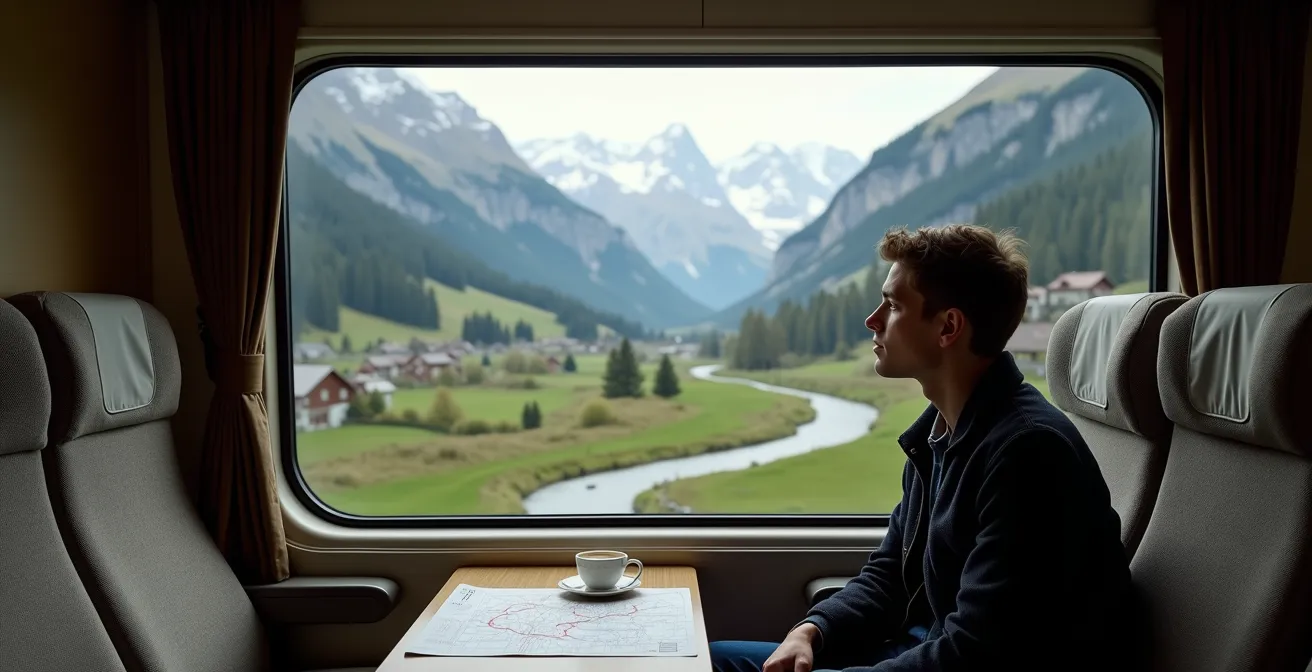
Planning a European rail odyssey isn’t about buying a pass; it’s about mastering a few key systems to unlock ultimate freedom and savings.
- The best value comes from strategically choosing between a rail pass for flexibility and deeply discounted point-to-point tickets for fixed plans.
- Mastering “luggage logistics,” from packing smart to using station lockers, is non-negotiable for a stress-free journey.
Recommendation: Before booking anything, decide on your travel style (fixed vs. flexible) and always check mandatory reservation requirements for your target countries.
The idea of a multi-country European rail trip evokes a certain romance: watching breathtaking landscapes glide by from a comfortable seat, sipping coffee as you cross invisible borders, and arriving directly in the heart of historic cities. It’s the embodiment of slow travel, a chance to connect with the continent in a way that flying simply can’t offer. Yet, for many aspiring adventurers, this dream quickly collides with a logistical nightmare of confusing passes, varying reservation systems, and the daunting prospect of living out of a suitcase for weeks.
The common advice is often an oversimplification: “Just buy a Eurail pass and pack light.” While not entirely wrong, this generic tip ignores the nuances that separate a frustrating, expensive trip from a seamless, cost-effective one. It fails to address the critical questions: When is a pass a waste of money? How do you manage luggage when your hotel is a ten-minute walk and a fifty-stair climb from the platform? What are the hidden rules that can leave you stranded despite holding a valid ticket?
But what if the key wasn’t just following advice, but mastering the systems behind it? This guide is built on that very principle. We will move beyond the basics to give you a strategic framework for planning your journey. This isn’t just about getting from A to B; it’s about understanding the logistics of ticketing, packing, and cross-border travel so you can make smarter, more confident decisions. By mastering these hidden systems, you can unlock a more authentic, flexible, and deeply rewarding European adventure.
This comprehensive guide will walk you through the entire process, from the fundamental reasons to choose the train to the intricate details of booking and budgeting. We will explore packing strategies designed specifically for rail travel, demystify the great pass-versus-ticket debate, and reveal the common pitfalls that even seasoned travelers can fall into.
Summary: Your Roadmap to Mastering European Train Travel
- Why Taking the Train Saves 80% CO2 Compared to Flying?
- How to Pack for a Train Trip Where You Carry Your Own Bags?
- Eurail Pass vs Point-to-Point: Which Is Cheaper for 3 Cities?
- The Rail Pass Mistake That Leaves You Stranded on the Platform
- Sleeper Cabin vs Couchette: Is the Privacy Worth the Cost?
- The Conversion Fee Mistake That Adds 3% to Your Vacation Bill
- Why Imported Bamboo Might Be Less Green Than Local Oak?
- How to Survive a 14-Hour Flight in Economy Class?
Why Taking the Train Saves 80% CO2 Compared to Flying?
Your first strategic decision in planning a European tour is choosing your mode of transport, and the environmental case for train travel is overwhelming. It’s not just a minor improvement; it’s a game-changer for responsible tourism. The core reason lies in the fundamental efficiency of steel wheels on steel rails compared to the brute force required for aviation. While a flight burns massive amounts of kerosene to defy gravity, a train uses far less energy per passenger to glide across the land.
The numbers are stark. According to a recent analysis, train travel is responsible for an 86% CO2 reduction compared to flying the same route. This single choice has a more significant positive impact on your trip’s carbon footprint than almost any other. It transforms your journey from a carbon-intensive liability into a more sustainable exploration. To understand this impact in the real world, consider the success of Spain’s high-speed rail network.
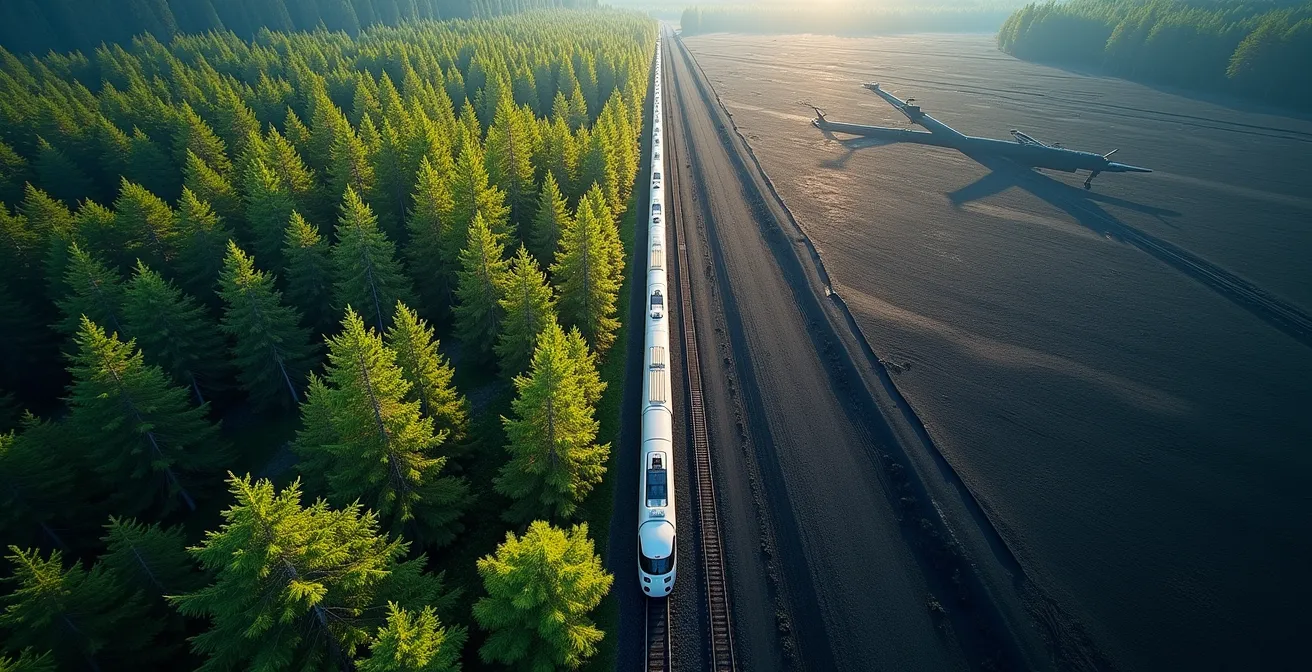
As the visual metaphor above suggests, the choice is between two very different environmental paths. The Barcelona-Madrid high-speed line provides a powerful case study. Since its opening, air passenger numbers on the route have plummeted by roughly 60%. This massive shift to rail resulted in emission savings equivalent to the annual output of over 183,000 British households in a single year. Choosing the train isn’t just a romantic notion; it’s a quantifiable contribution to preserving the very landscapes you’re traveling to see.
How to Pack for a Train Trip Where You Carry Your Own Bags?
On a train trip, you are your own porter. This is the fundamental rule of “luggage logistics.” There are no check-in counters to whisk your bags away; you are responsible for carrying them onto the train, hoisting them into an overhead rack, and navigating crowded stations with stairs and turnstiles. This reality demands a more strategic approach than simply “packing light.” It requires a system that prioritizes mobility and accessibility above all else.
The first step is choosing the right bag. A hybrid backpack-suitcase with wheels is often the ideal choice, offering the flexibility to roll it on smooth station floors and carry it on your back over cobblestones or up flights of stairs. Inside, packing cubes are non-negotiable. They not only compress your clothes but also allow you to organize items by category, so you don’t have to explode your entire suitcase to find a clean pair of socks. A key strategy is to have a small, accessible daypack with your essentials: passport, tickets, water, snacks, and electronics. This stays with you at your seat while your main bag is stowed.
A major tool in your logistics arsenal is the station luggage locker. For day trips or long layovers between connections, stashing your main bag gives you the freedom to explore a city unencumbered. However, facilities and costs vary widely across Europe, making a little advance knowledge crucial.
| Station | Storage Type | Hours | Daily Cost | Payment |
|---|---|---|---|---|
| Paris Gare du Nord | Staffed facility | 6:15-23:00 | €11 | Card/Cash |
| Brussels Midi | Automated lockers | 24/7 | €13.50 | PIN system |
| Zurich HB | Self-service | 4:15-1:15 | CHF 12-15 | Card |
| Rome Termini | Both options | 6:00-23:00 | €6-8 | Cash/Card |
| Berlin Hauptbahnhof | 24/7 lockers | Always open | €4-8 | Contactless |
Action Plan: Your Train Station Locker Strategy
- Point of Contact: Upon arrival, look for the universal pictogram: a suitcase inside a square, sometimes with a key symbol. This will guide you to the luggage storage area.
- Early Arrival: In popular tourist destinations, lockers are a finite resource. They often fill up by midday, so plan to arrive in the morning to secure a spot.
- Sizing and Cost: Choose the appropriate locker size for your bag. Be prepared for costs ranging from €5 to €15 for a 24-hour period, depending on the city and size.
- Payment Methods: While cards are increasingly accepted, it’s wise to have coins. In Germany, for example, many automated luggage lockers still require cash.
- Duration Limits: Most major stations allow storage for a maximum of 72 hours. Plan your layovers accordingly to avoid any issues retrieving your luggage.
Eurail Pass vs Point-to-Point: Which Is Cheaper for 3 Cities?
This is the million-dollar question for any European rail planner, and the answer is: it depends entirely on your travel style. There is no universally “cheaper” option. The choice between a Eurail Pass and individual “point-to-point” tickets is a classic trade-off between flexibility and cost. Understanding this dynamic is central to building a budget-friendly itinerary. A rail pass offers the freedom to be spontaneous, while point-to-point tickets reward those who can commit to a plan.
Point-to-point tickets are ideal for travelers with a fixed itinerary—for example, a simple trip covering just three cities like Paris, Brussels, and Amsterdam. Major European rail operators release tickets several months in advance, using a dynamic pricing model similar to airlines. Booking early can yield incredible discounts. For instance, price comparisons show that a last-minute ticket from Nice to Paris can cost €99-€142, but that same ticket can be found for as little as €29 when booked two months in advance. For a 3-city trip, buying three such advance-fare tickets will almost always be cheaper than a rail pass.

So, when is a Eurail Pass worth it? The pass shines on longer, more complex journeys with multiple stops, especially in countries with expensive standard fares like Germany or Switzerland. It’s for the traveler who wants the liberty to wake up and decide “I’m going to Prague today!” without worrying about the cost of a last-minute ticket. As the experts at Eurail themselves explain, the pass is about convenience for the explorer.
If you’re simply traveling from A to B and can commit to a specific time, a Eurail Pass probably isn’t for you. But if you’re planning a longer journey with multiple stopovers and changes, the flexibility and convenience of a Eurail Pass is unrivalled.
– Eurail Official, Eurail Pass Worth It Guide 2024
The decision requires a simple cost-benefit analysis. Roughly map out your desired route, check the cost of advance point-to-point tickets, and compare that total to the price of the appropriate rail pass. If the costs are similar, the pass’s added flexibility might be the deciding factor.
The Rail Pass Mistake That Leaves You Stranded on the Platform
You’ve done the research, purchased your Eurail Pass, and activated it for today’s journey. You arrive at the station, brimming with excitement, only to be told you cannot board the train. This nightmare scenario, which I call the “Platform Paradox,” is the single most common and costly mistake first-time pass holders make. It stems from a critical misunderstanding: a rail pass is not the same as a train ticket. It is the right to travel, but it is not always the right to a specific seat.
On many European trains, especially high-speed (like TGV, Frecciarossa) and overnight services, a seat reservation is mandatory, even for pass holders. This reservation is a separate transaction that secures your physical spot on a particular train at a particular time. It comes with a supplemental fee, which can range from a few euros to over €30 for popular routes. Forgetting this step, or being unaware of it, is how travelers get left behind on the platform, watching their planned train depart without them.
The rules and procedures for making these reservations vary maddeningly from country to country, adding another layer of logistical complexity. This is where system mastery becomes crucial. As one traveler noted in a detailed review of their Eurail experience, some countries make it particularly challenging. In nations like France, Italy, and Spain, reservations are compulsory for almost all fast trains. In Portugal, the situation is even more complex, as reservations for certain trains cannot be made online and must be secured in person at a station. This can be “mind-bogglingly inconvenient” if you’re on a tight schedule.
The solution is diligent planning. Before your trip, use an app like Rail Planner or a website like The Man in Seat 61 to check the specific reservation requirements for every single leg of your journey. Book mandatory reservations as far in advance as possible, especially during peak season, as the quota of seats allocated to pass holders can sell out. Never assume your pass is all you need.
Sleeper Cabin vs Couchette: Is the Privacy Worth the Cost?
The overnight train is one of the most efficient and romantic forms of travel, combining transport and accommodation into one. It allows you to cover vast distances while you sleep, saving a precious day of travel time and the cost of a hotel room. When booking, you’ll typically face a choice between a “sleeper” and a “couchette.” While they both offer a place to lie down, they represent two very different experiences, and the decision boils down to a balance of privacy, comfort, and budget.
A couchette is the social, budget-friendly option. You book a single bunk (a “berth”) in a shared compartment of either four or six people. Bedding is basic—usually a pillow, sheet, and blanket. You’ll be sharing the space with strangers, and compartments are rarely gender-segregated. It’s a functional, no-frills way to get from A to B horizontally. Think of it as a rolling hostel dorm room. It’s perfect for solo travelers on a tight budget or groups who can book a whole compartment for themselves.
A sleeper cabin, by contrast, is a private hotel room on wheels. These compartments are sold for one, two, or sometimes three passengers. They offer proper beds with duvets and pillows, a washbasin within the cabin, and often include a small welcome kit and breakfast. The door locks from the inside, providing significantly more security and privacy. For couples, families, or anyone who values a guaranteed good night’s sleep, the extra cost of a sleeper is often a worthwhile investment in comfort and peace of mind.
Whichever you choose, you’re making a smart environmental choice. For example, a journey from Vienna to Rome by night train saves 120kg of CO2 per passenger compared to taking a flight. The question is simply what price you put on privacy. A couchette might cost €30 for a berth, while a two-person sleeper cabin could be €100 or more per person. If you’re a light sleeper or traveling with valuables, the added expense for a private, lockable room can be worth every cent.
The Conversion Fee Mistake That Adds 3% to Your Vacation Bill
Mastering the logistics of a European rail trip extends beyond the train tracks; it follows you to every café, shop, and ticket machine. One of the most insidious and avoidable costs is the “Dynamic Currency Conversion” (DCC) trap. This seemingly helpful service offers to charge your credit card in your home currency (e.g., US Dollars) instead of the local currency (e.g., Euros). It feels convenient, but this convenience comes at a steep, hidden price.
When you agree to be charged in your home currency, you are not getting the official bank exchange rate. Instead, you are allowing the merchant’s payment processor to invent their own, less favorable exchange rate. This rate typically includes a markup of 3% or more over the standard wholesale rate your own bank would have given you. In essence, you are paying a hefty fee for a simple currency conversion that your credit card company would have handled for a much lower cost (or for free, if you have a no-foreign-transaction-fee card).
This choice will be presented to you constantly: on ATM screens when you withdraw cash and on card terminals when you pay for a meal or a souvenir. The screen will ask something like, “Charge in EUR or USD?” It might even show you the exact amount in your home currency to tempt you with certainty. The rule to live by is simple and absolute: always choose to pay in the local currency. Decline the conversion offer every single time. Let your own bank handle the conversion.
While 3% might not sound like much on a single transaction, it adds up significantly over a multi-week, multi-country trip. A 3% fee on a €2,000 travel budget is €60 lost for no reason—money that could have paid for a high-speed train reservation, a nice dinner, or entrance to a world-class museum. Avoiding this mistake is pure financial efficiency and a hallmark of a savvy traveler.
Why Imported Bamboo Might Be Less Green Than Local Oak?
When making sustainable choices, the obvious answer isn’t always the right one. We often hear that bamboo is a “green” material because it grows quickly. But if that bamboo is grown in Asia, processed, and then shipped across the world to Europe, its total carbon footprint from transportation can negate its fast-growth benefits. In many cases, using sustainably harvested local oak, which doesn’t require intercontinental shipping, could be the more environmentally sound choice. This illustrates a deeper principle of sustainability: you must consider the entire lifecycle, not just a single attribute.
This “bamboo vs. oak” paradox serves as a perfect metaphor for making sustainable choices during your European rail journey. We’ve established that train travel is far greener than flying. But within the world of rail, there are also more nuanced decisions to be made. Is the sleek, ultra-modern high-speed train, consuming immense amounts of electricity to connect two capital cities in three hours, inherently “greener” than a combination of two slower, regional trains that take five hours to cover the same distance?
The high-speed train offers incredible efficiency and is a vital tool for shifting traffic from planes. However, the slower regional journey might use less energy per kilometer, support the economic viability of smaller towns along the route, and offer a more intimate, scenic view of the countryside. It encourages a deeper, more distributed form of tourism. The “greenest” choice depends on what you are optimizing for: speed and efficiency, or local impact and reduced energy intensity.
This doesn’t mean you should avoid high-speed trains—they are a modern marvel and a cornerstone of Europe’s sustainable transport network. Rather, it’s an invitation to think more critically. As a savvy traveler, you can mix and match. Use the high-speed lines for the long-haul jumps between countries, and then embrace the charming, slower regional trains to explore the areas in between. This approach balances efficiency with a more mindful, locally-focused travel style.
Key Takeaways
- The environmental argument for trains is undeniable, but true mastery lies in navigating the complex logistics of ticketing and packing.
- A Eurail Pass grants the right to travel, but a mandatory seat reservation for most high-speed and night trains is what actually gets you on board.
- Smart financial habits, from choosing the right ticket type to avoiding currency conversion fees, are essential for keeping your travel budget on track.
How to Survive a 14-Hour Flight in Economy Class?
For most international visitors, the grand European rail adventure doesn’t begin at a charming Parisian station, but in a cramped economy seat on a 14-hour transatlantic or intercontinental flight. This journey isn’t about romance; it’s about survival. Arriving in Europe exhausted, dehydrated, and jet-lagged is a terrible way to start a trip. By applying a bit of logistical strategy to your flight, you can hit the ground running and be ready for your first train.
Your survival strategy begins with hydration. The air in a plane cabin is drier than a desert, and dehydration exacerbates jet lag. Decline the coffee and alcohol, and instead, make water your best friend. Bring a large, empty reusable bottle through security and have the flight attendants fill it up. Drink consistently throughout the flight. Second, focus on circulation. Sitting for long periods is unhealthy and uncomfortable. Wear compression socks to aid blood flow and reduce the risk of swelling or clotting. Get up to walk the aisle at least once an hour when the seatbelt sign is off.
Sleep is the holy grail of long-haul flights. Create a personal sleep sanctuary to maximize your chances. A high-quality neck pillow, a comfortable eye mask, and noise-canceling headphones are a non-negotiable trinity. Plan your sleep schedule. Try to align your rest with the nighttime hours of your destination to start adjusting to the new time zone before you even land. Choosing your seat wisely can also make a difference; an aisle seat provides the freedom to get up without disturbing others, while a window seat offers a surface to lean against.
Now, contrast this “survival” ordeal with the experience that awaits you. You’ve endured the cramped space, the recycled air, and the battle for armrests. But from this point forward, your journey transforms. You will trade the confinement of an aluminum tube for the panoramic windows of a train. You will swap the stress of security lines for the simple act of stepping from a platform into a carriage. Having survived the flight, you are now ready to truly start living and exploring Europe, one rail line at a time.
Now that you’ve arrived, the entire continent is at your feet. The next logical step is to apply the logistical lessons from this guide and start building the framework of your own unforgettable rail journey across Europe.
Frequently Asked Questions About European Rail Passes
What’s the difference between a pass and a reservation?
A Eurail pass gives you the right to unlimited travel on the rail networks included in your pass. However, it does not guarantee you a seat on a specific train. A reservation is a separate ticket that confirms your specific seat on a particular high-speed or overnight train. For many popular routes, this reservation is mandatory and must be purchased in addition to your pass.
Can I use my pass immediately after purchase?
No, you must activate your pass before your first journey. This can be done online through the Rail Planner app or at a major train station’s ticket office. For “flexi” passes, where you have a set number of travel days within a period, you must also activate each individual travel day in the app before you board your first train of that day.
How many trips can I take in my home country with a Global Pass?
If you are a European resident using a Global Pass, you are limited to one outbound journey to leave your country of residence and one inbound journey to return. These two trips must be used within your total number of travel days. You should use them strategically to get to a border or airport to begin and end the main part of your European exploration.