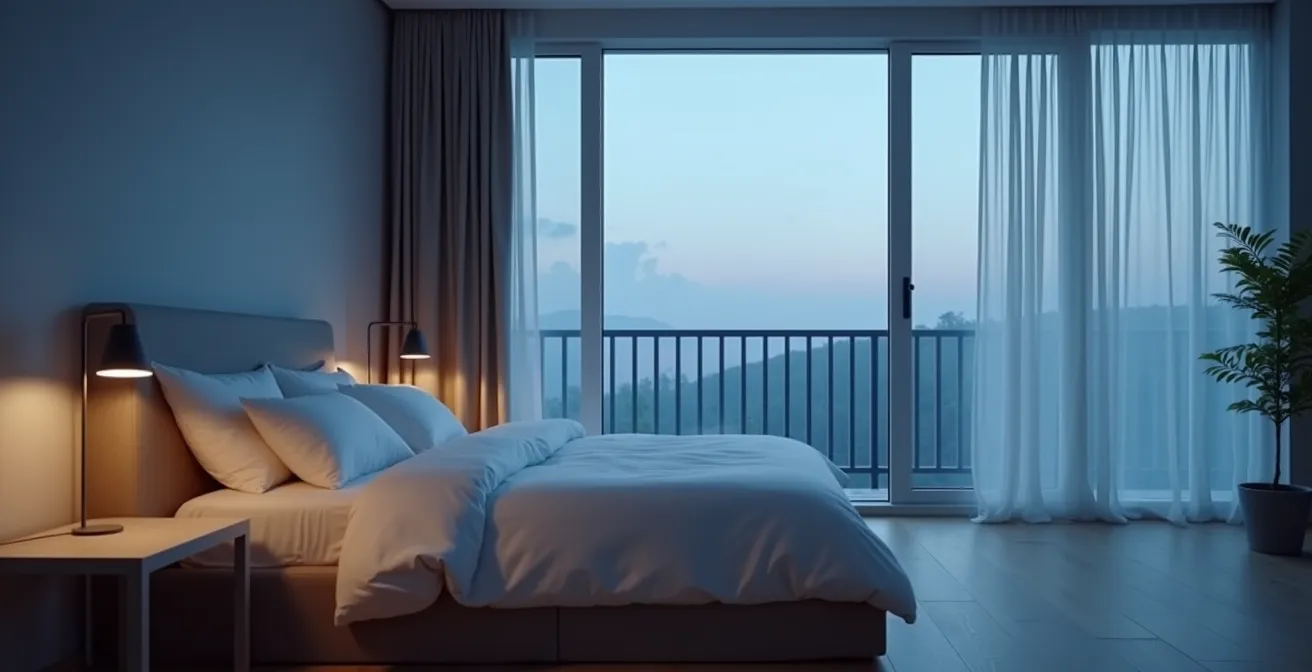
The key to physical recovery isn’t just sleeping longer; it’s about biologically engineering a higher percentage of deep sleep.
- Your body’s core temperature drop is a non-negotiable trigger for entering deep sleep (NREM Stage 3).
- Light exposure and caffeine timing directly manipulate the hormones and neurotransmitters that control your sleep architecture.
Recommendation: Treat your sleep like a training protocol. Systematically control environmental triggers—temperature, light, and physical support—to maximize your body’s innate repair cycles.
Waking up sore and unrefreshed after a full eight hours is a frustrating paradox for many athletes and manual laborers. You’ve put in the time, but your body feels like it’s been short-changed on recovery. The common advice is predictable: maintain a consistent schedule, avoid late-night snacks, and maybe try some chamomile tea. While well-intentioned, this advice often misses the fundamental point. It treats sleep as a passive state of rest rather than an active, highly regulated biological process crucial for physical repair.
The real issue isn’t the quantity of your sleep, but its quality—specifically, the percentage of time spent in deep sleep. This is where the magic of recovery happens: muscle tissue is repaired, glycogen stores are replenished, and a hormonal cascade, including the release of Human Growth Hormone (HGH), is initiated. But if the underlying biological triggers are misaligned, your body can’t efficiently enter or sustain this critical phase. Instead of just following a generic list of “sleep tips,” what if the real key was to actively manage your physiology? What if you could precisely control the environmental and chemical signals that dictate your sleep architecture?
This guide moves beyond the platitudes to offer an analytical blueprint. We will dissect the biological mechanisms that govern deep sleep and provide actionable protocols to modulate your physiology for maximum recovery. We’ll explore how thermoregulation, light exposure, and physical support are not just comfort factors, but powerful levers for enhancing your body’s natural restorative power.
This article provides a structured approach to understanding and manipulating the key factors that influence your deep sleep. Below, you will find a breakdown of the specific biological systems and environmental triggers we will address to build your personalized recovery protocol.
Summary: The Biological Blueprint for Physical Recovery
- Why a Hot Room Prevents You From Entering Deep Sleep?
- How to Block Blue Light 2 Hours Before Bed Effectively?
- Memory Foam vs Hybrid: Which Supports Spinal Alignment Better?
- The 2 PM Coffee Mistake That Ruins Your REM Cycle
- Optimizing the Bedroom: Removing Electronics for a Sanctuary Effect
- How to Schedule a Smart Thermostat for Winter Savings?
- The Monitor Glare That Causes Chronic Headaches
- How to Prevent the 3 PM Energy Crash Through Diet?
Why a hot room prevents you from entering deep sleep?
A warm bedroom directly inhibits your body’s ability to initiate deep sleep by disrupting its natural thermoregulation process. To enter the deep, restorative stages of non-REM (NREM) sleep, your core body temperature must drop by approximately 2 to 3 degrees Fahrenheit. This temperature decrease is a critical biological signal for your brain to transition from light sleep into the slow-wave activity that defines deep sleep. When the ambient temperature of your room is too high, it creates thermal stress, forcing your body to work harder to shed heat instead of focusing on cellular repair.
This process is governed by the homeostatic drive for sleep. Throughout the day, your body builds a need for sleep, and as evening approaches, your internal clock (suprachiasmatic nucleus) signals the pineal gland to release melatonin. Melatonin not only promotes drowsiness but also helps facilitate this crucial drop in core temperature. A hot environment effectively counteracts melatonin’s cooling effect, keeping your body in a lighter, less restorative sleep stage. For optimal physical recovery, adults require a significant portion of their nightly rest to be deep sleep; research shows adults typically need about 1.5 to 1.8 hours of deep sleep per night.
To support this physiological process, creating a cool sleep environment is non-negotiable. This doesn’t just mean turning down the thermostat; it involves a multi-faceted approach to managing your bedroom’s microclimate. Using breathable bedding materials like cotton or bamboo prevents heat from being trapped close to the skin. Similarly, taking a warm bath 90 minutes before bed can seem counterintuitive, but it triggers a rapid cooling effect as your body temperature drops post-bath, signaling to your brain that it’s time for deep rest. This strategic manipulation of your body’s thermoregulation is a cornerstone of building a robust sleep architecture.
How to block blue light 2 hours before bed effectively?
Effectively blocking blue light requires creating a “digital sunset” that signals to your brain’s suprachiasmatic nucleus it’s time to begin melatonin production. Exposure to blue-wavelength light, particularly from screens and overhead LED lighting, powerfully suppresses melatonin, the key hormone that regulates your sleep-wake cycle. This suppression delays the onset of sleepiness and fundamentally degrades your sleep architecture, reducing the time spent in both deep and REM sleep. The effect is so potent that it contributes to widespread sleep issues; data from the CDC indicates that over 14% of American adults consistently struggle with falling asleep.
A truly effective strategy goes beyond simply using a phone’s “night mode.” While these settings reduce blue light, they don’t eliminate it. The most effective approach is a combination of environmental and behavioral changes starting at least two hours before your desired bedtime. This involves not only ceasing all screen use but also modifying your home’s lighting environment. Switching from bright, cool-toned overhead lights to dim, warm-toned lamps (under 2700K) mimics the natural transition of a sunset. This change in ambient light provides a powerful, consistent signal to your internal clock.

For those who cannot completely avoid screens, the use of scientifically-validated blue-light-blocking glasses is the next best intervention. Look for amber or red-tinted lenses that are specifically designed to block the entire spectrum of blue light (400-495 nm). Wearing these glasses for the final two hours before bed allows you to read or move about your home without disrupting your melatonin cascade. This creates a protective bubble, ensuring your brain receives the correct environmental cues for sleep, regardless of artificial light sources.
Memory foam vs hybrid: which supports spinal alignment better?
The choice between a memory foam and a hybrid mattress for spinal alignment depends almost entirely on your dominant sleep position and body weight. For athletes and laborers, maintaining a neutral spine during sleep is critical for muscle recovery and preventing next-day pain. A misaligned spine can lead to chronic tension, inhibit fluid exchange in the spinal discs, and disrupt the deep sleep necessary for tissue repair. There is no single “best” mattress; the optimal choice is the one that best counteracts the gravitational forces specific to your sleeping posture.
The distribution of sleep positions among adults heavily influences this decision. With a majority of people being side sleepers, the unique properties of each mattress type become clear. Research indicates that approximately 54% of adults are side sleepers, while 38% sleep on their back and only 7% sleep on their stomach. For side sleepers, the hips and shoulders create significant pressure points. Memory foam excels here, contouring deeply to cushion these areas and allowing the spine to remain straight. However, for heavier individuals or stomach sleepers, this same conformity can be a flaw, allowing the hips to sink too far and creating a hammock-like curve in the lumbar spine.
A hybrid mattress, which combines a pocketed coil support core with foam comfort layers, offers a more balanced approach. The coils provide a more responsive, “on top” feeling with robust support that prevents excessive sinking, which is ideal for back and stomach sleepers. The foam layers still offer pressure relief, but with less of the deep “hug” of an all-foam mattress. The following table breaks down the biomechanical advantages of each type based on common sleeping positions.
| Sleep Position | Memory Foam Benefits | Hybrid Benefits | Spinal Alignment Score |
|---|---|---|---|
| Side Sleepers (54% of adults) | Superior pressure relief at hips/shoulders | Responsive support with contouring | Memory Foam: 9/10 |
| Back Sleepers (38% of adults) | Firm lumbar support | Balanced support with breathability | Tie: 8/10 |
| Stomach Sleepers (7% of adults) | Can be too soft, causing spine curve | Better firmness prevents sinking | Hybrid: 8/10 |
Ultimately, the goal is to find a surface that fills the gaps between your body and the mattress, supporting the natural curves of your spine. For side sleepers, memory foam often achieves this best. For back and especially stomach sleepers, a hybrid’s firmer support core is generally superior for preventing spinal strain.
The 2 PM coffee mistake that ruins your REM cycle
Consuming caffeine after 2 PM is a common mistake that systematically degrades your sleep architecture, particularly by suppressing deep sleep, not just REM. While the title mentions the REM cycle, caffeine’s primary mechanism of action is as an adenosine antagonist. Adenosine is a neurotransmitter that builds up in your brain throughout the day, creating “sleep pressure.” The higher the adenosine level, the stronger your drive to sleep becomes. Deep, slow-wave sleep is the primary phase during which the brain clears out this accumulated adenosine, effectively “resetting” your sleep drive for the next day.
Caffeine works by blocking adenosine receptors in the brain, tricking it into feeling alert and awake. The problem is caffeine’s long half-life, which is typically 5-6 hours but can be much longer in individuals who are “slow metabolizers.” An afternoon coffee at 2 PM means a significant amount of caffeine may still be active in your system at 10 PM, chemically inhibiting your ability to enter and sustain deep sleep. This disrupts the natural progression of the sleep cycle, which research shows the body cycles through 4-6 times per night. By artificially suppressing adenosine pressure, you are robbing your body of the primary signal it needs to initiate its most restorative phase.
This leads to waking up feeling unrefreshed, as your brain was not able to perform its nightly cleanup. The solution is to implement a strict caffeine curfew. For most people, stopping all caffeine intake at least 8-10 hours before bedtime is a crucial step. This allows enough time for your body to metabolize the stimulant and for adenosine to build to a level sufficient to trigger deep, restorative sleep. For those sensitive to caffeine, this cutoff may need to be even earlier, around noon.
Action Plan: Calibrating Your Caffeine Cutoff
- Stop all caffeine intake by 2 PM, establishing a minimum 8-hour window before sleep.
- If you are a known slow metabolizer (e.g., via genetic testing for the CYP1A2 gene), adjust your cutoff time to noon.
- Replace afternoon coffee with a non-caffeinated alternative or a short 20-minute “nappuccino” (a quick nap after a coffee shot) if an energy boost is essential.
- Switch to herbal teas, water, or decaffeinated beverages exclusively after your designated cutoff time.
- Track your deep sleep percentage using a wearable device for two weeks to identify your personal optimal cutoff time for peak recovery.
Optimizing the bedroom: removing electronics for a sanctuary effect
Creating a sleep sanctuary involves more than just tidiness; it’s about systematically removing all sources of electronic stimulation to allow your nervous system to downshift into a parasympathetic (rest-and-digest) state. The presence of electronics in the bedroom—even if they are turned off—disrupts sleep through several mechanisms. Beyond the well-documented effects of blue light, electronic devices emit low-level electromagnetic fields (EMFs) and often have standby lights that can subtly interfere with the deep darkness required for optimal melatonin production.
More importantly, the mere presence of a phone, tablet, or television in your line of sight acts as a powerful psychological cue for wakefulness and engagement. Your brain associates these devices with work, social interaction, and entertainment—all activities that activate the sympathetic (fight-or-flight) nervous system. This creates a state of low-grade hyperarousal that is diametrically opposed to the state of calm relaxation needed to fall asleep and, critically, to transition into deep NREM sleep. Removing them from the bedroom eliminates this cognitive and neurological interference.
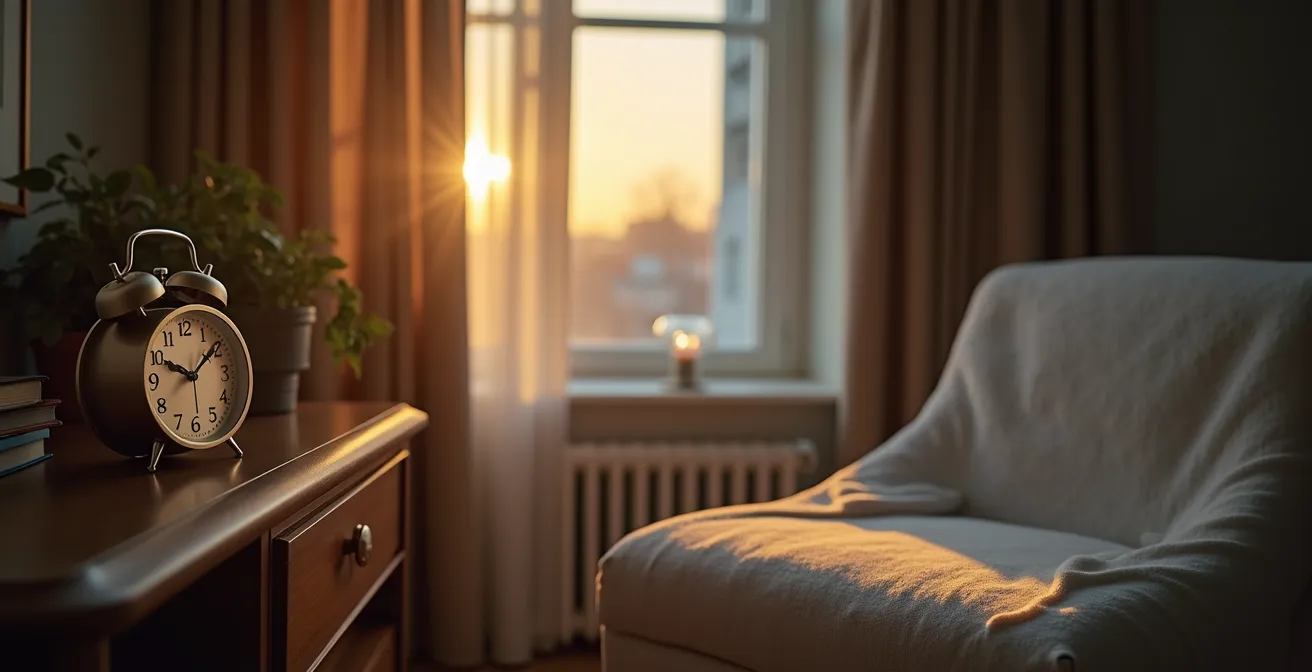
The goal is to transform the bedroom into a space dedicated to only two things: sleep and intimacy. This means replacing your smartphone alarm with a simple, non-illuminated analog clock. Charge all devices in another room overnight. If you enjoy reading before bed, switch to a physical book under a warm-toned lamp instead of an e-reader. This disciplined approach sends a powerful and unambiguous signal to your brain: this room is for rest. By creating this clear boundary, you facilitate a faster and more efficient descent into the deep, restorative stages of sleep that are essential for physical and mental recovery.
Sleep is the greatest legal performance-enhancing drug that most people are probably neglecting.
– Dr. Matthew Walker, Why We Sleep
How to schedule a smart thermostat for winter savings?
While often marketed for energy savings, a smart thermostat’s greatest benefit for physical recovery is its ability to precisely orchestrate the nightly temperature drop that facilitates deep sleep. Instead of focusing on savings, athletes should program their thermostat to create a dynamic temperature schedule that mirrors and supports the body’s natural circadian rhythm. The goal is to automate the ideal thermoregulation environment, ensuring your body can easily shed heat to enter deep sleep and then gently warm up to promote a natural awakening.
An optimal schedule involves programming a gradual temperature decline to begin about 60-90 minutes before your intended bedtime. For most individuals, the ideal temperature for sleep is around 18°C (65°F). The thermostat should be set to reach and maintain this temperature throughout the core sleep period, typically from around 10 PM to 5 AM. This steady, cool environment minimizes thermal stress and allows the body to dedicate its resources to the hormonal cascade of recovery, including the release of growth hormone that peaks during slow-wave sleep.
About 60 minutes before your desired wake-up time, the schedule should initiate a gradual increase in temperature. This slight warming mimics a natural dawn and supports the body’s morning cortisol rise, a key hormone for promoting wakefulness and alertness. This automated process helps you wake up feeling more refreshed and avoids the grogginess associated with being jolted awake by an alarm in a cold room. By using wearable technology to monitor your sleep stages, you can fine-tune this schedule. A recent Nature Medicine study tracking thousands of participants over several years highlights the power of long-term sleep data in revealing health patterns, and this same principle can be applied on an individual level to perfect your temperature schedule for peak performance.
The monitor glare that causes chronic headaches
While monitor glare is a known cause of headaches and eye strain, its more insidious effect on physical recovery is the chronic activation of the sympathetic nervous system. The constant, high-contrast visual input from a bright screen, especially in a dim room, creates a state of sustained neurological stress. This “screen-induced stress” keeps your nervous system in a state of hypervigilance, making it difficult to transition into the relaxed, parasympathetic state required for deep sleep hours later. The headaches are a symptom of a deeper problem: your nervous system is being prevented from fully disengaging.
The solution is a multi-pronged approach to screen management during the workday. The “20-20-20 rule”—looking at something 20 feet away for 20 seconds every 20 minutes—is not just for eye strain; it’s a micro-break for your nervous system, allowing it to momentarily reset. Furthermore, the physical setup of your workstation is critical. Positioning your monitor at the correct distance (20-26 inches) and angle (10-20 degrees below eye level) reduces physical strain on the neck and eyes, which are direct contributors to tension and stress. Using a monitor with Flicker-Free technology is also a key consideration, as imperceptible screen flicker is a major source of neurological fatigue.
Integrating regular movement is another powerful tool to counteract screen-induced stress. A 2024 study in *Scientific Reports* showed that regular physical activity boosted deep sleep duration. While this refers to structured exercise, the principle applies on a micro-scale: taking 5-minute movement breaks every hour helps to discharge the accumulated nervous system activation from screen time. This active management of your daily neurological load is just as important as your evening wind-down routine. By reducing the “stress debt” you accumulate during the day, you arrive at bedtime with a nervous system that is prepared and able to descend into deep, restorative sleep.
Key Takeaways
- Master Your Temperature: A cool room (around 18°C/65°F) is a non-negotiable biological trigger for initiating deep sleep.
- Control Your Light: Aggressively block blue light for 2 hours before bed to allow for natural melatonin production.
- Support Your Spine: Choose a mattress that maintains a neutral spinal alignment based on your primary sleep position to prevent pain and facilitate recovery.
How to prevent the 3 PM energy crash through diet?
The dreaded 3 PM energy crash is more than an inconvenience; it’s a biological signal of blood sugar instability that can directly sabotage your sleep quality later that night. This afternoon slump is typically caused by a lunch high in refined carbohydrates and sugars, leading to a rapid spike in blood glucose followed by an insulin-driven crash. This metabolic rollercoaster is a form of stress on the body, triggering the release of cortisol, which can interfere with the natural circadian rhythm and disrupt your sleep architecture hours later.
Preventing this crash requires designing your lunch with metabolic stability in mind. The goal is to create a meal that provides sustained energy release, not a quick burst. This is achieved by building your meal around three core macronutrients: lean protein, healthy fats, and complex carbohydrates. A portion of 25-30g of protein (from sources like chicken, fish, or legumes) promotes satiety and provides the building blocks for muscle repair. Healthy fats (from avocado, nuts, or olive oil) slow down the absorption of glucose, preventing the sharp spike and subsequent crash.
Complex carbohydrates (from quinoa, sweet potatoes, or whole grains) provide a slow, steady release of glucose and also support the production of serotonin, a precursor to melatonin. By avoiding processed foods and sugary drinks at lunch, you maintain stable blood sugar and energy levels throughout the afternoon, reducing the body’s need to release stress hormones. This daytime metabolic regulation creates a more stable internal environment, setting the stage for a smoother transition into sleep at night. Disrupted sleep, in turn, impairs the brain’s ability to function, as Nature Communications research demonstrates that slow-wave sleep disruption impairs the brain’s synaptic plasticity, affecting learning and memory. This creates a vicious cycle where poor diet leads to poor sleep, which leads to poor cognitive function and further poor choices.
To truly master your physical recovery, you must adopt a systematic, analytical approach. Treat your sleep not as a passive event, but as the most critical training session of your day. By controlling these key environmental and biological inputs, you can actively engineer a more restorative sleep architecture and unlock your body’s full potential for repair and growth.