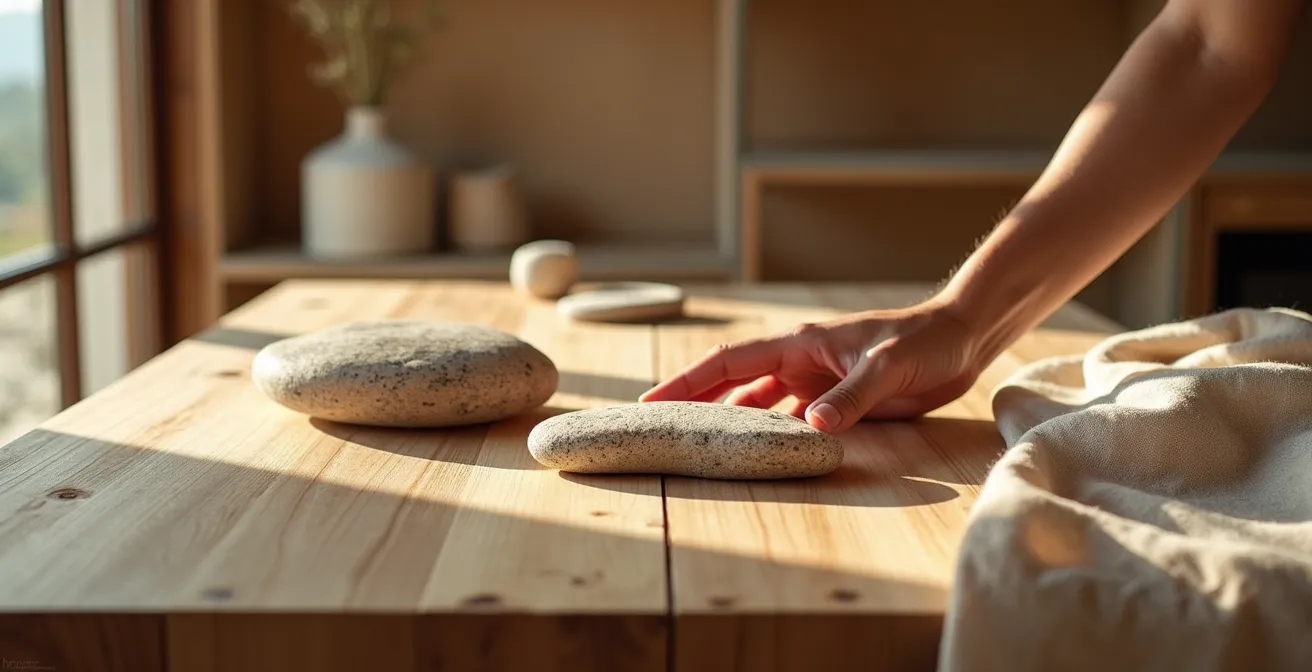
Creating a truly calming home for a sensitive person requires a conscious “haptic calibration” of every surface, going far beyond simple aesthetics.
- Unfinished wood and raw materials lower stress by engaging the brain’s innate affinity for natural, non-repeating patterns.
- Specific choices in fabrics (like hemp for moisture management) and finishes (oil over varnish) directly impact sensory input and skin comfort.
Recommendation: Begin by auditing one room for its “textural predictability” and replacing one high-contact, synthetic surface with a low-VOC, natural alternative.
For a highly sensitive person (HSP), home should be a sanctuary, a place to decompress from the world’s relentless sensory barrage. Yet, too often, our own living spaces contribute to the overwhelm. The cool, unyielding gloss of a laminate floor, the synthetic feel of a polyester throw, or the faint chemical smell from a new piece of furniture can create a low-level hum of sensory static that drains our energy without us even realizing why.
The common advice often circles around decluttering, choosing calming colors, or adding a few houseplants. While helpful, these suggestions overlook our most direct and intimate connection to our environment: the sense of touch. We are haptic beings, and the textures we interact with daily send constant signals to our nervous system. For a system already on high alert, these signals can either soothe or agitate.
What if the key to a truly restorative home wasn’t just in what we see, but in what we feel? This is the core of haptic design. It’s not about merely adding “natural” elements; it’s about a deliberate haptic calibration of your environment. It’s about understanding the specific neuro-sensory effects of each texture—the warmth of raw stone, the breathability of linen, the grounding grain of unfinished wood—to create a supportive space that actively calms, rather than just passively exists.
This guide moves beyond generic biophilic principles to provide a detailed framework for making these sensory-informed choices. We will explore the science behind why certain textures feel calming, compare specific materials for different applications, and offer actionable steps to transform your home into a true sensory haven.
This article delves into the specific, tangible choices you can make to curate a haptically harmonious home. Explore the detailed comparisons and scientific insights in the sections below to start your journey toward a calmer living space.
Contents: A Haptic Approach to Home Design
- Why Touching Unfinished Wood Lowers Blood Pressure?
- Linen vs Hemp: Which Is Better for Sensitive Skin Bedding?
- Polished vs Raw Stone: Which Feels Warmer to the Touch?
- The Seagrass Rug Error in Humid Bathrooms
- Oiling vs Varnishing: Preserving Texture While Protecting Wood
- How to Identify Low-VOC Flooring to Protect Air Quality?
- How to Create a Morning Routine That Calms the Vagus Nerve?
- Bamboo vs Oak Flooring: Which Is Truly More Sustainable?
Why Touching Unfinished Wood Lowers Blood Pressure?
The calming effect of wood is more than just a feeling; it’s a measurable physiological response rooted in our brain’s architecture. When we touch or even just look at unfinished wood, we are interacting with natural, non-repeating fractal patterns. These are the complex yet orderly designs found in everything from tree branches and coastlines to the grain of a wood plank. Our brains are hardwired to process these patterns with remarkable efficiency, which reduces cognitive load and induces a state of relaxation. As pioneering researcher Richard Taylor from the University of Oregon found, this effortless processing is a key reason for the calming effect.
Unlike the uniform, repetitive patterns of synthetic materials, which can be visually taxing, the biomorphic shapes in wood grain feel familiar and safe to our nervous system. This sense of familiarity and ease triggers the parasympathetic nervous system—our body’s “rest and digest” mode. Immersive biophilic environments featuring these natural elements have been shown to lower heart rate, blood pressure, and cortisol levels. In fact, some studies show that viewing these patterns can lead to a stress reduction of up to 60%. This isn’t just about aesthetics; it’s about providing your brain with a form of neuro-aesthetic nutrition.
An unfinished or oil-finished surface allows for this direct haptic connection. Running your hand over the subtle grain of an oak table is a form of sensory grounding. A varnished or lacquered surface, by contrast, creates a synthetic barrier, robbing you of that tactile information. For a sensitive system, choosing unfinished wood for high-touch surfaces like desks, countertops, and armrests is a simple but profound way to integrate moments of passive calm throughout the day.
Therefore, the choice to leave wood in its most natural state is an active strategy for regulating the nervous system through touch.
Linen vs Hemp: Which Is Better for Sensitive Skin Bedding?
For those with sensitive skin or sensory sensitivities, bedding is a critical environment. The eight hours spent in bed can either be restorative or a source of constant, low-grade irritation. Linen has long been the gold standard for natural, breathable bedding, but hemp is emerging as a superior choice, particularly for HSPs. While both are hypoallergenic and antibacterial, their textural evolution and moisture management capabilities differ significantly. Linen is often softer from the start, but hemp undergoes a more dramatic softening with each wash, eventually becoming exceptionally gentle without losing its structural integrity.
The most crucial difference for sensitive individuals lies in moisture and thermoregulation. Night sweats or feeling too warm can be a major trigger for sensory overload. Hemp has superior moisture-wicking properties and a tensile strength eight times that of cotton, meaning it pulls moisture away from the skin more effectively and dries faster. This creates a more stable and comfortable microclimate throughout the night, reducing the risk of waking up from thermal discomfort. Linen also has good thermoregulation due to its hollow fibers, but hemp’s performance in this area is often considered more robust.
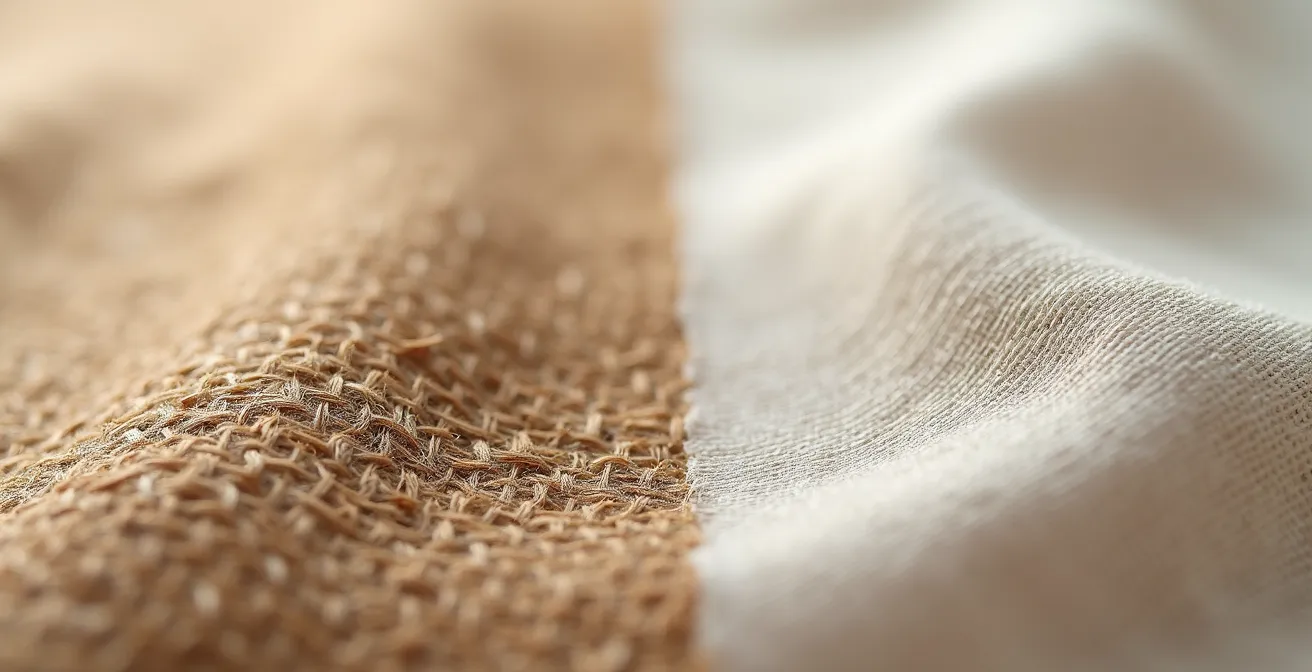
When choosing between these two excellent fabrics, the specific needs of sensitive skin should guide the decision. The following table breaks down their key properties for a clear comparison. Note the difference in texture evolution—what might feel slightly coarser initially in hemp is an investment in future softness.
| Property | Hemp | Linen |
|---|---|---|
| Hypoallergenic | Naturally hypoallergenic & antibacterial | Hypoallergenic & antibacterial |
| Texture Evolution | Starts coarser, dramatic softening with each wash | Softer initially, gradual softening |
| Moisture Management | Superior moisture-wicking, 8x tensile strength of cotton | Good moisture absorption, hollow fiber core |
| Durability | Most durable natural fiber, UV-resistant | Very durable but less than hemp |
| Thermoregulation | Excellent year-round temperature regulation | Good thermoregulation properties |
Ultimately, for maximum durability and superior moisture management to prevent sensory-triggering discomfort, hemp holds a distinct advantage for sensitive sleepers.
Polished vs Raw Stone: Which Feels Warmer to the Touch?
The perception of a material’s temperature is not about its actual temperature, but a property called thermal effusivity. This measures how quickly a material conducts heat away from your body. Materials with high thermal effusivity, like polished marble or granite, feel “cold” because they rapidly pull heat from your hand. Conversely, materials with lower thermal effusivity feel “warmer” or more neutral because they exchange heat more slowly. This is where the difference between polished and raw stone becomes a critical factor in haptic design.
A polished surface is dense and smooth, with minimal air pockets. This high density maximizes surface contact with your skin, leading to a high rate of heat transfer and that characteristic cold shock. For a highly sensitive person, this sudden temperature drop can be jarring and unpleasant. A raw or honed stone surface, on the other hand, has a more textured, porous structure. These microscopic imperfections trap tiny pockets of air, which acts as an insulator. This layer of air slows down the rate of heat transfer, making the raw stone feel significantly warmer and more welcoming to the touch.
This principle extends beyond just feel. The visual texture of raw stone, with its natural imperfections and patterns, connects back to the calming effect of biomorphic shapes. As design research from Stuga Studio notes, these organic forms trigger a sense of comfort because our brains recognize them as part of the natural world. Choosing a raw slate hearth over a polished marble one, or a honed limestone countertop instead of high-gloss granite, is a way to engineer a space that feels both physically and psychologically warmer and more grounding.
Therefore, for creating a haptically warm and inviting environment, raw, textured stone is unequivocally the superior choice over its polished counterpart.
The Seagrass Rug Error in Humid Bathrooms
The bathroom is a uniquely vulnerable space from a sensory perspective. We are often barefoot, wet, and exposed, making us more susceptible to unpleasant tactile experiences. The desire to bring in natural textures often leads people to choose materials like seagrass or jute for bathmats. While beautiful and natural, this is a significant error in haptic design, particularly in humid environments. The core issue is a lack of textural predictability. Seagrass feels coarse and pleasant when dry, but when it becomes damp or wet, its texture changes dramatically. It can become slick, slimy, or unpleasantly mushy, creating a sensory surprise that can be deeply unsettling for an HSP.
This inconsistency violates a fundamental principle of creating a safe sensory space: reliability. An environment that feels stable and predictable allows the nervous system to relax. In a bathroom, this means choosing materials that maintain their textural integrity whether wet or dry. A global study by Human Spaces found that adding natural elements to a workspace resulted in a 15% increase in wellbeing and 6% higher productivity, but this is only true when the elements are appropriate for their context.
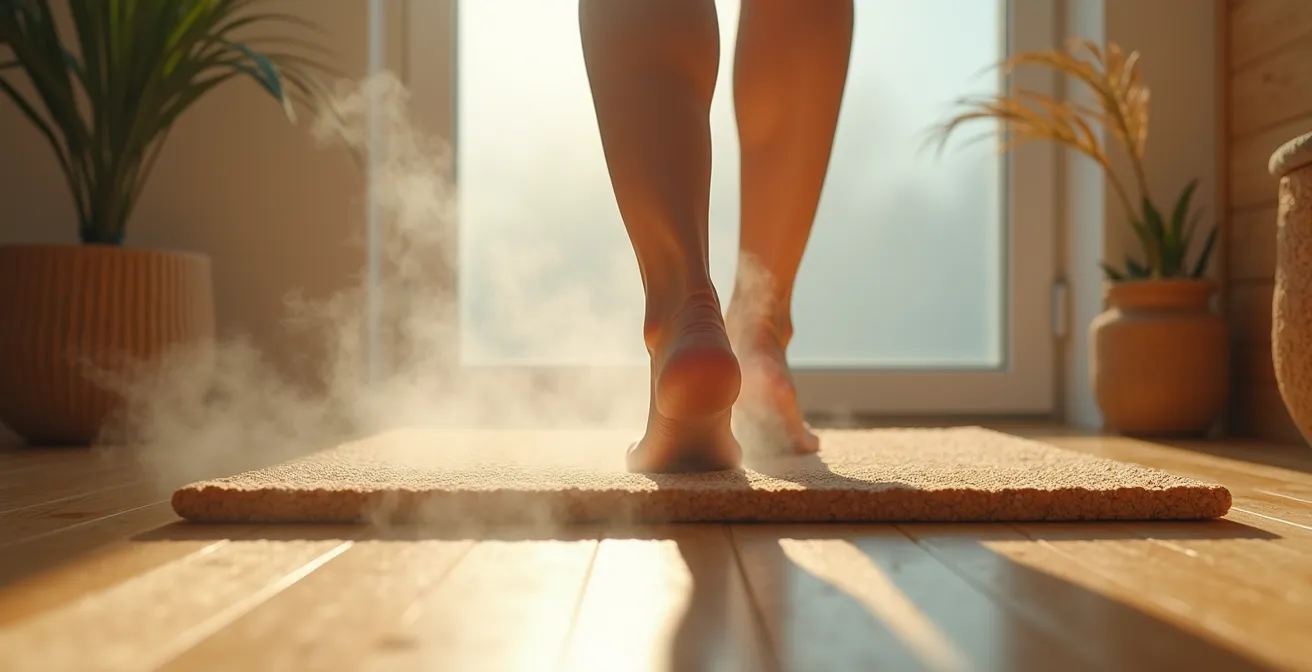
Fortunately, excellent alternatives exist that provide both natural beauty and sensory consistency. Hinoki wood mats, for example, not only feel wonderful underfoot but also release calming aromatic oils when wet. Cork flooring is another superb choice; it is warm, soft, naturally antimicrobial, and its texture remains consistent. For those who prefer a rug, flat-woven polypropylene options designed for outdoor use offer a fabric-like feel but dry almost instantly, preventing that dreaded damp-rug sensation. Prioritizing this predictability is key to making the bathroom a truly restorative retreat.
Action Plan: Selecting Sensory-Friendly Bathroom Materials
- Replace seagrass with Hinoki wood mats that release calming aromatic oils when wet.
- Install cork flooring for a warm, soft, antimicrobial surface that maintains a consistent texture.
- Choose flat-woven polypropylene rugs that dry instantly and maintain their intended feel.
- Ensure all materials provide sensory predictability, testing them for both wet and dry texture consistency before installation.
- Prioritize materials that feel grounding and secure to create a safe sensory anchor in this vulnerable space.
By choosing materials that behave predictably, you transform the bathroom from a potential source of sensory anxiety into a reliable space for grounding and calm.
Oiling vs Varnishing: Preserving Texture While Protecting Wood
The way we finish wood is as important as the wood itself. The choice between a natural oil finish and a synthetic varnish is a critical decision in haptic design, determining whether we experience the authentic texture of the wood or a plastic-like coating. A varnish (including polyurethane and lacquer) works by creating an impermeable film that sits on top of the wood. While durable, this film effectively seals away the natural grain, creating a surface that feels synthetic and cold to the touch. It masks the very qualities that make wood so calming in the first place.
A natural oil finish, such as tung or linseed oil, works entirely differently. It penetrates deep into the wood fibers, hardening within them to protect from the inside out. This leaves the surface texture of the wood intact and accessible. When you run your hand over an oiled tabletop, you are feeling the actual wood grain, with all its subtle, calming fractal patterns. This direct tactile connection is a form of sensory anchor—a small, grounding moment that can help regulate the nervous system throughout the day.
Beyond the tactile experience, these finishes have profoundly different olfactory and environmental impacts. Varnishes are notorious for off-gassing high levels of Volatile Organic Compounds (VOCs), which are respiratory irritants and can be a major trigger for people with chemical sensitivities. Natural oils, in contrast, have low to no VOCs and often impart a subtle, earthy scent that enhances the biophilic experience. This comparative table illustrates the stark differences in their sensory profiles.
| Aspect | Natural Oil Finish | Varnish Finish |
|---|---|---|
| Texture Preservation | Penetrates wood, preserves natural grain feel | Creates plastic-like film on surface |
| Sensory Experience | Feel the actual wood texture | Feel the synthetic coating |
| VOC Emissions | Low to no VOCs (tung/linseed oil) | High VOCs, respiratory irritants |
| Aging Process | Develops patina, adds character | Scratches look damaged |
| Olfactory Impact | Earthy, natural scents | Chemical odors |
For anyone prioritizing a healthy, haptically rich environment, a natural oil finish is the only choice that preserves the true sensory benefits of wood.
How to Identify Low-VOC Flooring to Protect Air Quality?
Flooring is the largest single surface in any room, and its impact on both air quality and sensory experience is immense. For highly sensitive people, particularly those with chemical sensitivities or respiratory issues, identifying low- or no-VOC (Volatile Organic Compound) flooring is non-negotiable. VOCs are chemicals that become a gas at room temperature and are emitted by many building materials, including the adhesives, sealants, and finishes used in flooring. This off-gassing can pollute indoor air and act as a constant irritant to the nervous system. The link is especially strong for those with sensory processing difficulties; in fact, research suggests that up to 69% of children with ADHD also experience sensory processing challenges, making them particularly vulnerable.
Identifying low-VOC options requires looking beyond marketing claims. The most reliable method is to look for third-party certifications like GREENGUARD Gold, FloorScore, or FSC (Forest Stewardship Council) for wood. However, even within certified products, a hierarchy exists for minimizing sensory impact. A good option is a low-VOC certified engineered wood with a water-based finish. A better option is solid hardwood with a factory-applied natural oil finish. The best and purest option is FSC-certified solid hardwood or cork flooring installed without any adhesive (a “floating” or nail-down installation), finished on-site with a natural, no-VOC oil.
Never underestimate your own sensory response. A powerful tool is the “smell test.” If a flooring sample has a strong chemical odor in the store, that smell will be overwhelming in an enclosed room in your home. Trusting your initial sensory reaction is a valid and important part of the selection process. Your body is an excellent detector of potential irritants. Choosing a floor that feels good to touch and does not assault your sense of smell is a foundational step in creating a low-sensory-impact home.
Your 5-Step Audit for a Low-Sensory-Impact Floor
- Points of contact: List all flooring surfaces in your home and how often you make direct contact with them (e.g., barefoot in bedroom).
- Collecte: Inventory existing flooring materials. Identify synthetic carpets, laminates, or vinyl that may be high in VOCs.
- Cohérence: Confront your current flooring with your sensory values. Does it feel good underfoot? Does it have a chemical smell?
- Mémorabilité/émotion: Assess the texture. Is it a generic, repetitive pattern or a natural, grounding one like wood or cork?
- Plan d’intégration: Prioritize replacing the highest-contact, highest-VOC flooring first, using the “Good/Better/Best” hierarchy as a guide.
By prioritizing materials with minimal chemical processing, you are actively curating an environment that supports, rather than taxes, a sensitive nervous system.
How to Create a Morning Routine That Calms the Vagus Nerve?
The morning routine sets the sensory tone for the entire day. For an HSP, a jarring start can lead to a state of heightened alert that is difficult to come down from. A powerful strategy for starting the day grounded is to intentionally incorporate sensory anchors that stimulate the vagus nerve. This nerve is the main component of the parasympathetic nervous system, and stimulating it helps shift the body out of “fight or flight” and into a state of calm. Gentle, predictable sensory input is an effective way to do this.
Instead of being jolted awake by an alarm and stepping onto a cold, hard floor, you can design a “tactile awakening sequence.” This involves consciously choosing the first few textures you interact with. For example, upon waking, you could place your bare feet on a specific natural surface—a soft wool rug, a warm cork mat, or a smooth wooden plank—and simply stand there for 60 seconds, focusing on the sensation. This simple act provides immediate grounding feedback to your nervous system. The experience is similar to the effects studied in ASMR (Autonomous Sensory Meridian Response), where predictable, gentle stimuli can be used to self-regulate and manage sensory overload. Studies have shown that ASMR is associated with significant reductions in heart rate of 3.41 bpm on average, demonstrating a real physiological calming effect.
This principle can be woven throughout your entire morning. Drink your morning water or tea from a heavy, handmade ceramic mug with a rough, interesting glaze. The weight and texture provide grounding proprioceptive input. Use a coarse linen towel for an invigorating friction dry after washing your face, stimulating the skin in a predictable way. While waiting for water to boil, run your hands over a wooden countertop. These are not just random actions; they are deliberate sensory anchors that communicate safety and predictability to your nervous system, gently toning the vagus nerve and preparing you for the day from a place of centered calm.
By curating the first tactile inputs of your day, you can proactively shift your nervous system into a state of regulation before the world’s demands begin.
Key Takeaways
- Prioritize raw, minimally processed materials to leverage the brain’s innate affinity for natural fractal patterns, which reduces cognitive load.
- Consider the entire sensory profile of a material: its feel (haptic), its smell (olfactory), and its perceived temperature (thermal effusivity).
- Aim for “textural predictability,” especially in vulnerable spaces like bathrooms, to reduce the sensory anxiety caused by unexpected changes in feel.
Bamboo vs Oak Flooring: Which Is Truly More Sustainable?
The question of bamboo versus oak flooring is often framed as a simple contest of regrowth speed. Bamboo, a fast-growing grass, is frequently marketed as the more sustainable choice over slow-growing hardwood like oak. However, for a haptic design approach, sustainability must be defined more holistically. It must include the well-being of the inhabitant, which is directly tied to the processing, chemical content, and sensory profile of the material. When viewed through this lens, the answer becomes far more nuanced.
Most bamboo flooring on the market is heavily processed. Strands of bamboo are shredded, boiled, and pressed back together using large amounts of adhesive, which often contains formaldehyde and other high-VOC chemicals. This intensive manufacturing process, combined with the long-distance shipping required for a material grown primarily in Asia, carries a significant environmental and sensory cost. The resulting product, while durable, is often a composite material that lacks the natural grain and haptic richness of solid wood. Its sustainability story is compromised by its industrial lifecycle.
Locally and responsibly sourced oak, on the other hand, can be a superior choice for holistic sustainability. When harvested from an FSC-certified forest, installed without adhesives, and finished with a no-VOC natural oil, its journey from forest to floor is far cleaner. The material remains in its pure, natural state, offering the full biophilic and haptic benefits we’ve discussed. It reflects the local ecology and minimizes the sensory pollution from chemical off-gassing. This approach, which prioritizes a material’s connection with nature and minimal processing, is known to improve comfort and creative performance while lowering physiological stress.
Therefore, start your journey of haptic calibration not with a complete overhaul, but with a single, conscious choice. Audit one room, identify one synthetic surface that causes you sensory friction, and replace it with a natural, minimally processed alternative that feels good to your body and calming to your mind.