
The secret to saving time isn’t just buying smart gadgets; it’s building an integrated ‘culinary ecosystem’ that automates decisions and eliminates errors.
- Smart appliances offer precision cooking that goes beyond simple timers, actively preventing failures like undercooked food.
- Connecting your devices creates a workflow that optimizes everything from grocery shopping to energy consumption, saving both time and money.
Recommendation: Instead of a total overhaul, start by identifying your single biggest kitchen frustration and choose one smart appliance that directly solves it.
The promise of a quick, delicious, home-cooked meal often dissolves into a chaotic reality of juggling timers, managing messy hands, and discovering a key ingredient is missing mid-recipe. For busy home cooks, the dream of kitchen efficiency feels perpetually out of reach. Many hear about smart kitchen technology and think of the common examples, like preheating an oven from the car or asking a virtual assistant for a conversion. While convenient, these features only scratch the surface of what’s possible.
These isolated tricks don’t address the core problem: a disjointed and stressful cooking process. But what if the true revolution wasn’t in individual gadgets, but in how they work together? The real power of a smart kitchen lies in creating a connected, intelligent culinary ecosystem. This system doesn’t just automate tasks; it anticipates needs, prevents common mistakes, and offloads the mental burden of meal preparation, freeing you to actually enjoy the process.
This guide moves beyond the hype to offer a practical look at how to leverage this ecosystem. We will explore how specific appliances solve real-world problems, from guaranteeing a perfectly cooked roast to streamlining your grocery list and even cutting your energy bills. It’s time to stop fighting with your kitchen and start making it work for you.
To help you navigate this exciting new world of culinary technology, we have structured this guide to address the most pressing questions and challenges. Below is a summary of the key areas we will explore, each designed to give you actionable insights for transforming your kitchen workflow.
Summary: Your Guide to a Smarter Kitchen Workflow
- Why Smart Ovens Prevent Undercooked Meals Better Than You?
- How to Use Voice Commands to Manage Timers With Dirty Hands?
- Smart Fridge vs Smart Sous-Vide: Which Changes Your Routine More?
- The Connection Error That Ruins Your Remote Pre-Heating Plan
- Optimizing Grocery Shopping: Fridges That Order Milk for You
- Why Your ‘Cheap’ Takeout Costs You $300 More Monthly Than Prepping?
- When to Run Your Dishwasher: The Smart Plug Strategy
- How to Meal Prep for a 50-Hour Work Week in 2 Hours?
Why Smart Ovens Prevent Undercooked Meals Better Than You?
The fear of serving an undercooked chicken or a raw-in-the-middle roast is a major source of stress for any home cook. We poke, we prod, and we rely on timers that are, at best, an educated guess. A smart oven eliminates this guesswork entirely by shifting the focus from time to temperature. This isn’t just a minor upgrade; it’s a fundamental change in how cooking is controlled, transforming it from an approximation into a science. The growing smart oven market, with a projected $11.12 billion market value in 2024, is a testament to this demand for precision.
The magic lies in features like integrated food probes and intelligent cooking algorithms. Instead of just blasting heat for a set duration, a smart oven monitors the internal temperature of the food in real time. It knows the precise moment your salmon is perfectly flaky or your steak has reached a flawless medium-rare. According to extensive testing, this is the key to consistent results. An in-depth review by America’s Test Kitchen found that smart ovens with built-in food-temperature probes automatically adjust the cooking process to hit the target doneness, effectively ending the era of culinary roulette.
This level of control represents a significant offloading of cognitive work. You are no longer the sole guardian of the meal’s success. The oven becomes an active partner, making micro-adjustments that you couldn’t possibly manage. This allows you to step away, confident that the appliance is handling the most critical part of the process. It’s not about making you a lazy cook; it’s about making you a more effective and less stressed one by providing a foolproof safety net.
How to Use Voice Commands to Manage Timers With Dirty Hands?
Imagine you’re kneading dough, your hands completely covered in flour, and you realize you need to set a timer for the sauce simmering on the stove. This is a classic kitchen friction point. Do you stop, wash your hands, and smudge your phone screen, or do you shout at a family member for help? Voice assistants integrated into a smart home hub like Amazon Alexa or Google Home provide a seamless, hands-free solution, creating a truly frictionless workflow.
Setting this up is surprisingly straightforward. The key is placing your smart speaker in a strategic location—close enough to hear you but away from the roar of a blender or range hood. Once installed, you can move beyond simple commands like “set a 10-minute timer.” The real power comes from creating custom routines and managing multiple, named timers simultaneously. You can say, “Alexa, set a timer for ‘rice’ for 15 minutes” and “Hey Google, set a timer for ‘roasting vegetables’ for 40 minutes.” This ability to track different components of a meal by name eliminates the classic “which timer is that?” confusion.
This hands-free control is more than just a novelty; it maintains your cooking momentum. By removing the need to stop and clean up for minor administrative tasks, you can stay focused and in the zone. This is a prime example of cognitive offloading, where technology handles the mental bookkeeping so you can concentrate on the creative aspects of cooking.

As you can see, the technology is designed to integrate into the natural, and often messy, process of cooking. Building custom routines, such as a “start dinner prep” command that turns on kitchen lights and plays your favorite cooking playlist, further enhances this feeling of a supportive culinary ecosystem. It transforms your kitchen from a collection of tools into a responsive environment that adapts to your needs.
Smart Fridge vs Smart Sous-Vide: Which Changes Your Routine More?
When building a smart culinary ecosystem, it’s easy to get overwhelmed by the options. Two appliances that offer fundamentally different benefits are the smart fridge and the smart sous-vide. While the sous-vide offers reactive cooking precision, the smart fridge provides a proactive approach to resource management. A smart fridge, with its internal cameras and inventory tracking, tackles the problem before you even start cooking. It helps prevent food waste and last-minute grocery runs by keeping a digital log of your supplies. A smart sous-vide, on the other hand, revolutionizes the cooking process itself, guaranteeing restaurant-quality results with minimal active supervision.
Choosing between them depends on your primary pain point. If your week is a scramble of disorganized shopping and wasted produce, the smart fridge has a more significant daily impact. If your goal is to elevate your cooking and eliminate the stress of overcooking expensive cuts of meat, the sous-vide is a game-changer. The initial investment and learning curve also differ dramatically, making the decision a balance of budget and ambition.
As a leading technology review site points out, the integration of AI is pushing these benefits even further. According to GearBrain’s analysis:
Smart appliances now offer detailed nutritional analysis for recipes, helping users maintain specific dietary plans
– GearBrain Technology Review, AI Smart Kitchens Analysis 2025
This shows that the choice isn’t just about convenience but also about aligning with broader health and lifestyle goals. To help clarify the trade-offs, here is a breakdown of how each appliance impacts your routine:
| Feature | Smart Fridge | Smart Sous-Vide |
|---|---|---|
| Initial Investment | $1,500-$4,000 | $100-$300 |
| Routine Impact | Proactive (inventory management) | Reactive (cooking precision) |
| Time Savings | Shopping/planning time | Active cooking supervision |
| Learning Curve | Minimal – passive features | Moderate – requires planning |
| Primary Benefit | Reduces food waste | Restaurant-quality results |
Ultimately, both appliances contribute to a more efficient kitchen but in very different ways. The fridge streamlines the “what’s for dinner?” planning stage, while the sous-vide perfects the execution. The ideal culinary ecosystem might include both, but starting with the one that solves your biggest headache is the smartest move.
The Connection Error That Ruins Your Remote Pre-Heating Plan
The dream of arriving home to a perfectly preheated oven, ready for dinner, is a key selling point of smart technology. But the nightmare scenario is all too common: you walk in the door, ingredients in hand, only to find the oven cold. A Wi-Fi connection error has foiled your plan, and now you’re back to waiting, your carefully planned schedule derailed. This single point of failure can be so frustrating that it undermines a user’s trust in their entire culinary ecosystem.
These connectivity issues are the Achilles’ heel of the smart kitchen. They often stem from mundane problems: your kitchen might be a dead zone for Wi-Fi, the oven’s metal construction could be blocking the signal, or the 2.4GHz band your appliance uses is congested by other devices like your microwave or cordless phone. Sometimes, the problem isn’t even in your home; a server outage at the manufacturer’s end can render your smart features useless.
This unreliability is more than an inconvenience; it breaks the promise of a frictionless workflow. Instead of offloading cognitive work, it adds a new layer of anxiety: “Did my oven actually start?” This forces you to double-check the app, defeating the purpose of “set it and forget it” convenience. The best smart appliances are designed with this reality in mind. They feature robust, intuitive manual controls that allow them to function perfectly as high-quality “dumb” appliances when the network fails. An appliance that becomes a brick without an internet connection is not smart; it’s a liability.
Building a reliable system requires a bit of forethought. It means considering your home’s Wi-Fi layout before you buy, checking user reviews for comments on connectivity, and prioritizing devices that don’t depend solely on the cloud. A truly smart kitchen is a resilient one.
Optimizing Grocery Shopping: Fridges That Order Milk for You
The weekly grocery shop is a major time-sink, filled with list-making, aisle-wandering, and the inevitable forgotten item. Smart refrigerators aim to automate this entire process through intelligent resource optimization. Equipped with interior cameras and AI-powered object recognition, these appliances act as your personal inventory manager. You can pull up a live view of your fridge’s contents on your phone while at the store, instantly answering the question, “Do we need more eggs?”
The most advanced models take this a step further. By integrating with grocery delivery services, they can automatically add items to your shopping cart when they detect you’re running low. Some can even suggest recipes based on the ingredients you already have, tackling both food waste and the “what to cook” dilemma in one go. For example, LG’s AI-powered cooking assistant can provide recipe suggestions and real-time monitoring by integrating with its inventory management systems, creating a seamless loop from pantry to plate.
This technology transforms the chore of shopping into a streamlined, data-driven task. It reduces impulse buys, cuts down on food waste by highlighting items nearing their expiration date, and, most importantly, saves you the mental energy of constant list-making. It’s a powerful example of how a central hub—the fridge—can become the brain of your culinary ecosystem.
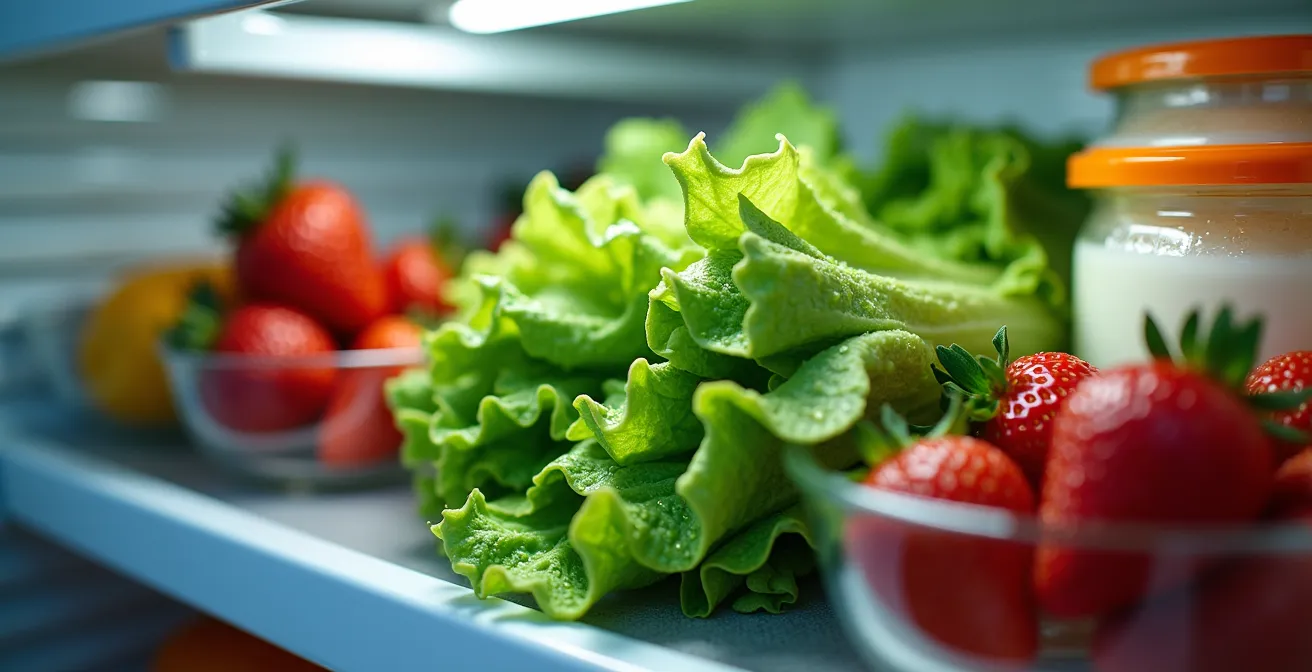
The visual organization and freshness-preserving features of these fridges also contribute to a more efficient kitchen. When you can see everything clearly and your produce lasts longer, meal prep becomes faster and more appealing. The goal is to make the right choice the easy choice, whether it’s grabbing a healthy snack or planning the week’s meals.
Why Your ‘Cheap’ Takeout Costs You $300 More Monthly Than Prepping?
After a long day, the siren song of “cheap” and “easy” takeout is hard to resist. But the perceived savings are often an illusion. When you break down the numbers, ordering in is a significant drain on your finances compared to home cooking, even before factoring in delivery fees and tips. The math is stark: a detailed $13 restaurant meal is 325% more expensive than a comparable $4 home-cooked meal. This difference adds up with startling speed.
Consider a single person ordering takeout three times a week at an average of $20 per meal. That’s $60 a week, or about $240 a month. A family of four doing the same could easily spend over $900 monthly. In contrast, investing a few hours in meal prepping on a Sunday can produce a week’s worth of lunches and dinners at a fraction of the cost. Case studies show that home-cooked meals often cost between $3 to $5 per serving. For an individual, this can translate to monthly savings of over $112, which adds up to more than $1,300 per year. For a family of four, the annual savings can skyrocket past $5,800.
This is where the smart culinary ecosystem pays for itself. By making meal prep faster and more efficient, smart appliances lower the barrier to cooking at home. A smart multicooker can handle your grains while the smart oven roasts your vegetables, all while a sous-vide perfectly cooks your protein. This concurrent cooking strategy drastically cuts down the active time required for prepping, making it a viable option even for those with punishing work schedules. The time you save with technology is money you save by avoiding expensive takeout.
When to Run Your Dishwasher: The Smart Plug Strategy
A dishwasher is already a massive time-saver, but it’s also one of your kitchen’s major energy consumers. With many households running their dishwasher over 200 times a year, optimizing its use can lead to significant savings on your utility bills. The key is not just *what* you wash, but *when* you wash. A simple, inexpensive smart plug can transform your standard dishwasher into an energy-efficient powerhouse by allowing you to control its schedule automatically.
Many energy providers offer Time-of-Use (TOU) rates, where electricity is cheaper during off-peak hours, typically late at night (e.g., 2 AM to 6 AM). A smart plug allows you to load your dishwasher after dinner, and then schedule it to run automatically during this low-cost window. You wake up to clean dishes and a lower energy bill, with zero extra effort. It’s a perfect example of passive resource optimization.
Furthermore, smart plugs with energy monitoring features give you valuable data. You can see exactly how much electricity each cycle uses, helping you identify the most efficient settings. For instance, you might discover that the air-dry mode uses significantly less power than heated drying. This data empowers you to make informed choices that compound over time. To get started on this strategy, you can follow a simple plan.
Action Plan: Smart Energy Management for Your Kitchen
- Schedule your dishwasher for off-peak hours (typically 2 AM – 6 AM) using a smart plug to leverage Time-of-Use rates.
- Use a smart plug with energy monitoring to track the actual kWh consumption of each appliance cycle.
- Coordinate high-draw appliances like the dishwasher and electric oven to avoid running them simultaneously and spiking your energy load.
- Enable the air-dry mode on your dishwasher instead of heated drying to save additional energy on every cycle.
- Monitor your monthly usage patterns through your smart plug’s app to identify new opportunities for optimization.
This strategy extends beyond the dishwasher. You can use smart plugs on other appliances like your coffee maker or electric kettle to ensure they’re only drawing power when needed. It’s a small investment that makes your entire kitchen ecosystem smarter and more cost-effective.
Key Takeaways
- Focus on building a connected ‘culinary ecosystem’ where devices work together, rather than just buying isolated smart gadgets.
- The biggest benefit of smart cooking is precision and error prevention, which reduces stress and guarantees better results.
- Use simple tools like smart plugs to optimize energy consumption and make your entire kitchen more cost-effective.
How to Meal Prep for a 50-Hour Work Week in 2 Hours?
For anyone working a demanding 50-hour week, the idea of spending a large chunk of Sunday meal prepping can feel like trading one job for another. The primary motivation for meal prepping is, ironically, to save time during the week. In fact, research shows that 26.9% of meal preppers cite saving time as their main reason for doing it. The challenge is making the prep session itself hyper-efficient. This is where a smart culinary ecosystem shines, enabling a strategy of concurrent cooking that can compress a full prep session into just two hours.
The traditional, linear approach to prepping—cook the chicken, then the rice, then the vegetables—is what consumes so much time. A smart kitchen allows you to parallel-process your entire menu. You can have your proteins cooking to perfection in a sous-vide circulator, your grains steaming in a smart multicooker, and your vegetables roasting in a smart oven, all at the same time and all managed with minimal intervention. This transforms hours of active cooking into passive waiting time, which you can use for chopping, portioning, or cleaning up.
This method requires a bit of upfront planning but follows a clear, repeatable blueprint. By sequencing your tasks to maximize passive cooking time, you create a powerful and efficient workflow that delivers a week’s worth of meals in a single, focused session. Here’s a sample timeline:
- Minutes 0-15: The “fire and forget” phase. Season your proteins (chicken, fish, steak) and seal them in sous-vide bags. Start the circulator at the target temperature.
- Minutes 16-30: Prep your produce. Chop all vegetables for roasting and for salads, and arrange them on sheet pans.
- Minutes 31-45: Start the passive cookers. Place the vegetables in the preheated smart oven and start your grains (quinoa, rice) in the multicooker.
- Minutes 46-90: The “active wait.” With all your appliances running, use this large block of passive time for kitchen cleanup and preparing your food storage containers.
- Minutes 91-120: Assembly line. As each component finishes cooking, remove it and portion everything into labeled containers for the week.
This two-hour blitz is only possible when you trust your appliances to handle their tasks without constant supervision. It’s the ultimate expression of the smart culinary ecosystem: a synchronized, low-stress process that gives you back your time, both on Sunday and throughout the busy week ahead.
Frequently Asked Questions on Smart Kitchens
Why does my smart oven lose WiFi connection frequently?
Common causes include 2.4GHz band congestion from microwaves, poor router placement relative to steel appliances, and manufacturer app server outages.
Should I choose smart appliances that work without internet?
Yes, the best smart appliances have excellent manual controls and can function perfectly as ‘dumb’ appliances when the network is down.
How can I secure my smart kitchen network?
Use a dedicated guest network for IoT devices, enable two-factor authentication, and regularly update device firmware.