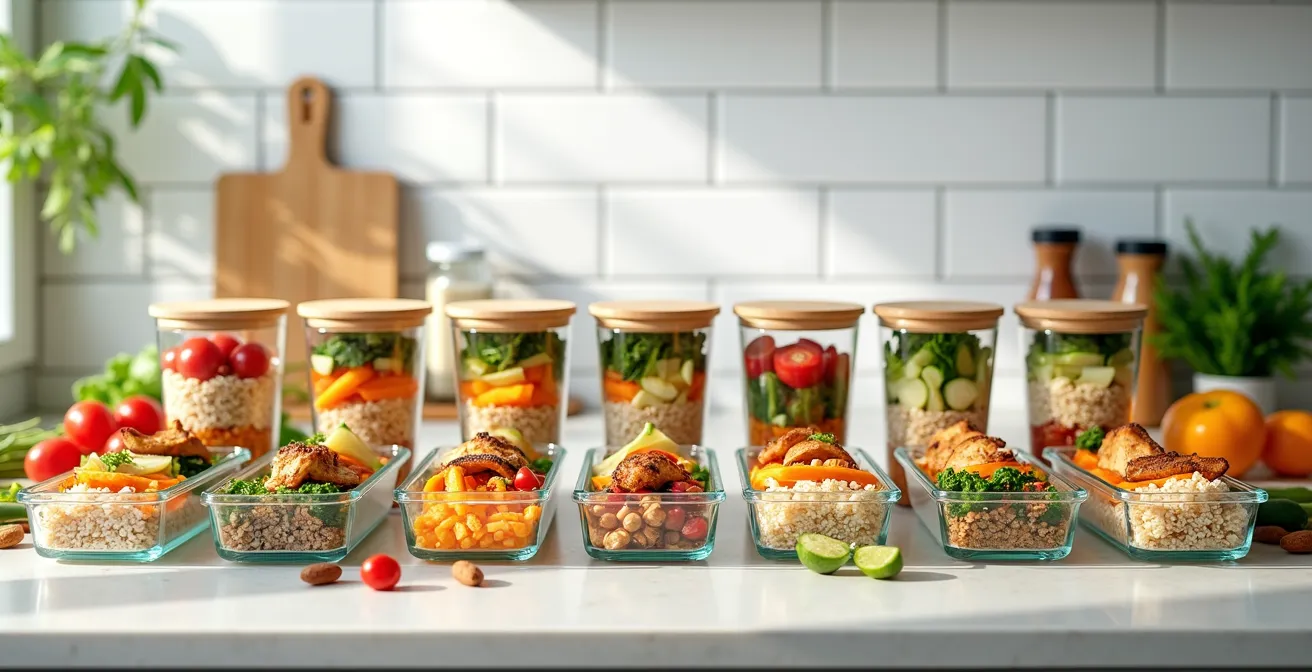
The key to a 2-hour meal prep is treating your kitchen like a high-efficiency production line, not just a place to cook.
- Takeout isn’t just expensive in dollars; it costs you time, energy, and productivity.
- The order of your cooking operations and the type of containers you use are critical system bottlenecks.
- Balancing macronutrients, especially protein, is non-negotiable for preventing afternoon energy crashes.
Recommendation: Audit your current prep process using the 5-point workflow in this guide to immediately identify your biggest time-wasters.
It’s 6 PM on a Tuesday. After a ten-hour workday, the thought of chopping vegetables, seasoning protein, and then facing a pile of dishes feels less like nourishment and more like a second job. The takeout app on your phone beckons, promising a cheap, easy dinner. You give in, telling yourself you’ll cook tomorrow. But for busy professionals, “tomorrow” rarely comes, and the cycle of expensive, unsatisfying, and energy-draining convenience food continues.
The common advice—”cook in bulk,” “make a shopping list”—misses the point entirely. These are tactics, not a strategy. They don’t address the core problem for someone logging a 50-hour week: a lack of an efficient system. When you’re short on time, you don’t need more recipes; you need better logistics. You need a workflow that operates with the precision of a manufacturing plant, turning raw ingredients into a week of high-performance fuel in a minimal amount of time.
But what if the key wasn’t about being a better cook, but a better project manager? This guide reframes meal prep as a logistical challenge. We are not just “making food”; we are designing a 2-hour system to fuel a 50-hour work week. Forget vague tips. We are going to deconstruct the entire process, from the financial drain of your “cheap” takeout habits to the food-science reasons your oatmeal breakfast is sabotaging your morning focus.
By focusing on workflow optimization, strategic equipment choices, and the macronutrient ratios that sustain energy, you will build a repeatable, two-hour Sunday routine that eliminates daily decision fatigue and saves you time, money, and mental bandwidth. This is your blueprint for taking back control of your nutrition, one optimized step at a time.
This article provides a complete logistical framework for reclaiming your time and energy. We will cover the hidden costs of convenience, the science of food storage and energy balance, and a step-by-step workflow to make your meal prep ruthlessly efficient.
Summary: A Professional’s System for 2-Hour Meal Prep
- Why Your ‘Cheap’ Takeout Costs You $300 More Monthly Than Prepping?
- Glass vs Plastic Containers: Which Keeps Greens Fresh Longer?
- Protein vs Carbs: What Ratio Prevents the 3 PM Slump?
- The Rice Reheating Mistake That Causes Food Poisoning
- Cooking Order: Which Ingredients to Chop First to Save 20 Minutes?
- Why Smart Ovens Prevent Undercooked Meals Better Than You?
- Why Your Oatmeal Breakfast Causes a Mid-Morning Crash?
- How to Prevent the 3 PM Energy Crash Through Diet?
Why Your ‘Cheap’ Takeout Costs You $300 More Monthly Than Prepping?
The first step in optimizing any system is understanding its true cost. That $15 lunch special or $25 dinner delivery feels like a small price for convenience, but it’s a classic case of hidden expenses. When you factor in delivery fees, tips, and the sheer frequency of ordering, the numbers quickly escalate. The “takeout tax” isn’t just financial; it’s a levy on your time, health, and productivity. Professionals often fail to account for the 30 minutes spent waiting for delivery or the post-meal lethargy from a nutrient-poor meal that kills afternoon focus.
Let’s break down the real numbers. It’s not just about the sticker price of a meal. Research shows the financial impact is substantial; on average, individuals can save an estimated $2,600 per year by meal prepping instead of buying lunch daily. That’s over $200 per month straight back into your budget. This figure doesn’t even include the cost of food waste from unused groceries that spoil in your fridge while you’re ordering out—an amount that can easily add another $50-$75 per month.
The most overlooked cost for a busy professional, however, is the opportunity cost of time. A daily 30-minute interruption for lunch runs or deliveries adds up to over 125 hours per year—more than three full work weeks. By implementing an efficient meal prep system, you are not just saving money; you are buying back your most valuable asset: time. You eliminate daily decision fatigue about what to eat and free up mental and temporal resources for more critical tasks. The real question isn’t whether you can afford to meal prep, but whether you can afford not to.
Glass vs Plastic Containers: Which Keeps Greens Fresh Longer?
Your meal prep system is only as good as its weakest link, and for many, that link is food storage. Investing two hours in preparation is wasted if your meals are unappetizing or unsafe by Wednesday. The choice between glass and plastic containers isn’t just aesthetic; it’s a critical decision that impacts food longevity, safety, and taste. For professionals who need their food to last a full five-day work week, understanding the material science is key.
Plastic containers, while cheap and lightweight, are porous. They absorb odors and stains, leading to that tell-tale discoloration and lingering smell of last week’s curry. More critically, repeated use and washing create microscopic scratches in the plastic’s surface. As a result, food safety experts warn that micro-scratched plastic can harbor bacteria, which can compromise the safety and freshness of your food. This is particularly problematic for delicate items like leafy greens, which wilt and spoil faster when exposed to trapped moisture and bacteria.
Glass containers, on the other hand, are non-porous. They don’t absorb odors or stains, ensuring that today’s chicken and broccoli doesn’t taste faintly of last week’s salmon. Their smooth, hard surface is resistant to scratching, eliminating the risk of bacteria buildup. This makes them far superior for keeping prepared meals, especially those with fresh components like salads, crisp and fresh for longer. While the initial investment is higher, their durability and safety make them the more cost-effective and reliable choice for any serious meal prep system.
This direct comparison highlights why choosing the right equipment is a fundamental part of a successful meal prep strategy. It’s an investment in the quality and safety of your fuel for the week.
| Feature | Glass | Plastic |
|---|---|---|
| Porosity | Non-porous surface | Porous, absorbs odors |
| Bacteria Risk | No micro-scratches | Develops scratches harboring bacteria |
| Heat Safety | Oven-safe to 425°F | Releases chemicals when heated |
| Longevity | 100s of dishwasher cycles | Degrades over time |
Protein vs Carbs: What Ratio Prevents the 3 PM Slump?
The infamous “3 PM slump” is not a personal failing; it’s a biological response to a flawed fueling strategy. For a busy professional, maintaining high energy and focus throughout the afternoon is non-negotiable. The key to preventing this productivity-killing crash lies in understanding the energy return on investment (ROI) of your macronutrients. A lunch heavy in simple carbohydrates (like white bread, pasta, or sugary drinks) causes a rapid spike in blood sugar, followed by an equally rapid crash, leaving you feeling tired and unfocused.
The solution is to anchor every meal with an adequate amount of lean protein. Protein is digested more slowly than carbohydrates, providing a steady, sustained release of energy. This prevents the dramatic blood sugar fluctuations that lead to energy dips. As Beth Czerwony, a registered dietitian at the Cleveland Clinic, explains:
Sticking to balanced meals with lean proteins and complex carbs can give you energy over a longer period since it takes your body more time to digest them.
– Beth Czerwony, RD, Cleveland Clinic Nutrition Advisory
This isn’t just theory; it has a measurable impact on performance. Some studies show high-protein breakfasts can cause a 15% productivity increase in the hours that follow. The ideal ratio for sustained energy is not a rigid number but a principle: every plate should be built around a primary protein source, complemented by complex carbohydrates (like quinoa, sweet potatoes, or brown rice) and healthy fats. This trifecta ensures both immediate and long-lasting fuel for your body and brain.
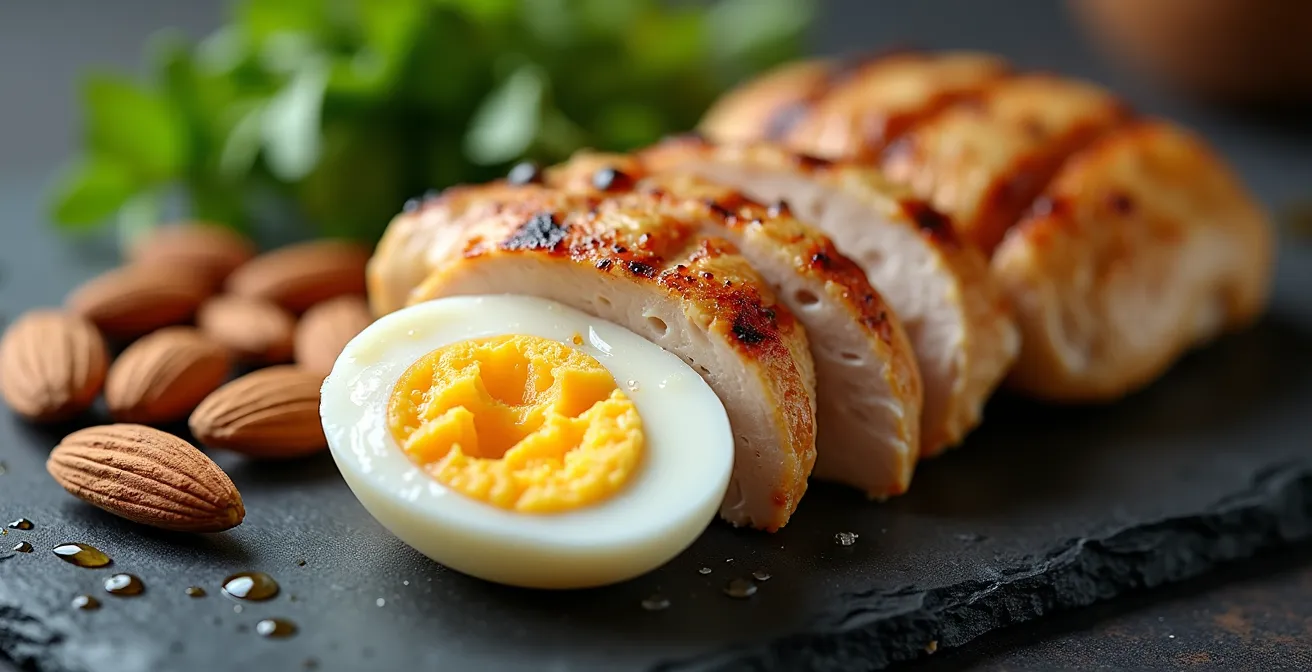
Visually prioritizing protein-dense ingredients like grilled chicken, eggs, and nuts when you build your prep list is the first step. Thinking “protein-first” when planning each meal is the most effective strategy for programming your body to bypass the afternoon slump and maintain peak cognitive function through the entire workday.
The Rice Reheating Mistake That Causes Food Poisoning
In a high-efficiency meal prep system, safety protocols are as crucial as cooking times. One of the most overlooked dangers lies in a common staple: rice. The mistake most people make isn’t in the reheating, but in the cooling. Cooked rice can contain spores of a bacterium called Bacillus cereus. These spores can survive the cooking process, and if the rice is left to cool slowly at room temperature, they germinate and multiply, producing toxins that can cause food poisoning.
Crucially, reheating the rice will kill the bacteria, but it will not destroy the toxins that have already been produced. This is why proper cooling is the most critical food safety step. The “danger zone” for bacterial growth is between 40°F and 140°F (4°C and 60°C). Your goal is to get the cooked rice through this zone as quickly as possible. To ensure safety, adhering to the 90-minute cooling rule is non-negotiable: all cooked foods, especially rice, must be cooled and refrigerated within 90 minutes of being cooked.
A professional kitchen technique, the “sheet pan flash cool,” is the most effective method. Instead of leaving a large pot of hot rice on the counter or putting it directly into the fridge (which raises the internal temperature of the fridge, endangering other foods), spread the hot rice in a thin, even layer on a cold baking sheet. The large surface area allows heat to dissipate rapidly, cooling the rice to a safe temperature in a fraction of the time. Once cool to the touch, it can be portioned into your prep containers and refrigerated. This simple protocol eliminates a major food safety risk and ensures your prepped meals are not just convenient, but safe.
Cooking Order: Which Ingredients to Chop First to Save 20 Minutes?
The difference between a frantic, three-hour cooking marathon and a streamlined, two-hour session comes down to workflow. Professional kitchens don’t operate linearly; they use a system of parallel processing, where multiple tasks are performed simultaneously. Amateur meal preppers often lose significant time by following a one-task-at-a-time sequence: chop all vegetables, then cook all protein, then assemble. This is the biggest bottleneck in the entire system.
To cut your prep time, you must adopt a chef’s mindset, organizing your tasks based on cooking duration. The goal is to have every piece of equipment—your oven, your stovetop, your cutting board—working in concert. A UK study found that strategic meal prep could save individuals over 5 hours per week in shopping, prep, and cooking time, and optimizing the cooking sequence is a primary driver of that efficiency.
Case Study: The 5-Hour Weekly Time Saving of a Strategic Workflow
A UK study of over 1,000 people revealed the average person spends a total of 448 minutes (nearly 7.5 hours) per week on grocery shopping (60 min), meal preparation (64 min), and cooking (324 min). The study found that a strategic meal prep subscription, which provides a structured plan and pre-portioned ingredients, reduced this total time to just 120 minutes. The core principle driving this efficiency is a pre-planned, parallel workflow, a system any home cook can replicate to save over 5 hours weekly.
Start with the items that have the longest cooking time, such as roasting sweet potatoes or cooking a batch of quinoa. While those are in the oven or on the stove, you utilize that “passive” cooking time to perform active tasks like chopping vegetables for your next dish or sautéing aromatics. Fresh, no-cook items like herbs or salad greens should be prepped last, while everything else is cooking or cooling. This overlapping of tasks eliminates downtime and maximizes every minute.
Your 5-Point Meal Prep Workflow Audit
- Map Your Steps: Write down every single action you currently take, from taking ingredients out of the fridge to sealing the final container. Be brutally honest about where you waste time.
- Inventory Your Tools: List your essential equipment (knives, cutting boards, oven, containers). Are they clean, sharp, and ready to go before you start, or are you wasting time searching and washing?
- Benchmark Against Parallel Processing: Compare your current sequence to the professional model. Do you wait for the oven to preheat before you start chopping? Do you stand around while rice cooks? Identify these “dead time” gaps.
- Assess Mid-Week Food Quality: On day 3 or 4, how is your food? Is it mushy, bland, or unappealing? This indicates a flaw in your ingredient choice, cooking method, or storage protocol.
- Create an Optimization Plan: Based on this audit, identify the top 2-3 bottlenecks. Your plan for next week might be: “1. Start longest-cooking grains first. 2. Chop vegetables while grains cook. 3. Switch to glass containers to improve freshness.”
Why Smart Ovens Prevent Undercooked Meals Better Than You?
Human error is an unavoidable variable in any system. For meal prep, this often manifests as undercooked chicken or unevenly roasted vegetables, rendering a portion of your hard work inedible and unsafe. While a good cook can manage this with practice, a busy professional needs a system that is reliable and requires minimal supervision. This is where technology, specifically the smart oven, becomes a powerful upgrade to your meal prep production line.
A traditional oven, even with a separate thermometer, has temperature fluctuations and hot spots. You have to manually rotate pans and constantly check for doneness. A smart oven, by contrast, uses a combination of convection fans, multiple heating elements, and integrated temperature probes to maintain a precise, even temperature throughout the cooking chamber. Many models offer multi-zone cooking, allowing you to roast vegetables at a high temperature on one rack while gently cooking fish on another, all managed automatically.
The most valuable feature for meal prep is the “cook and hold” function. You can set the oven to cook a piece of chicken to a precise internal temperature (e.g., 165°F) and then automatically switch to a low-temperature “hold” mode. This eliminates the risk of overcooking while ensuring food safety, giving you a wider margin of error and freeing you to focus on other prep tasks without constantly monitoring the oven.
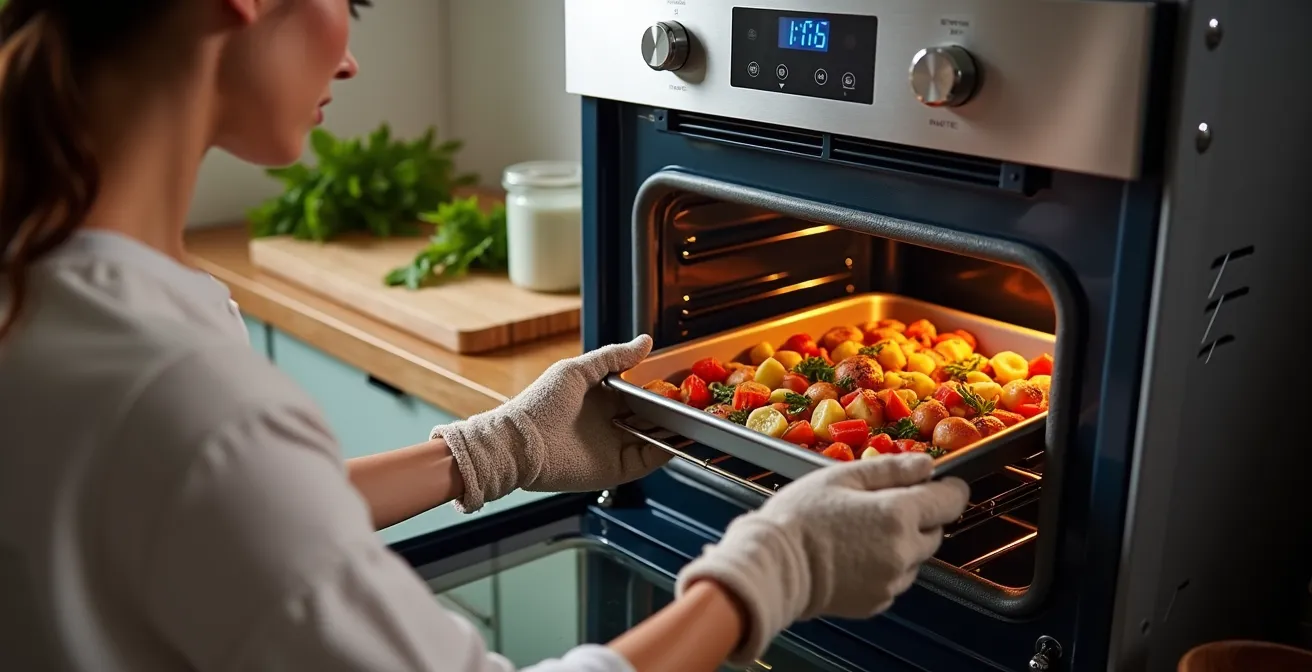
While the initial cost is higher than a simple thermometer, the investment pays off in consistency, safety, and reduced mental load. It transforms the oven from a passive box you have to manage into an active, reliable part of your automated workflow.
| Feature | Smart Oven | Traditional + Thermometer |
|---|---|---|
| Temperature Precision | ±1°F accuracy | ±5°F with probe thermometer |
| Multi-Zone Cooking | Automatic adjustment | Manual rotation needed |
| Cook & Hold Function | Built-in food safety | Requires separate warmer |
| Investment Cost | $300-800 | $20 thermometer solution |
Why Your Oatmeal Breakfast Causes a Mid-Morning Crash?
You start the day with a seemingly “healthy” bowl of instant oatmeal, only to find yourself feeling sluggish and hungry by 10 AM. This common experience isn’t a failure of willpower; it’s a failure of food composition. Most commercial oatmeal, especially the instant, flavored varieties, is highly processed. This processing strips away much of the fiber and increases its glycemic index, meaning it behaves more like a simple sugar in your body, causing a rapid blood sugar spike and subsequent crash.
Even plain rolled oats, if eaten alone, are primarily a source of carbohydrates. Without sufficient protein and healthy fats to slow down digestion, you’re setting yourself up for a mid-morning energy dip. The principle of anchoring your meals with protein is just as critical for breakfast as it is for lunch. Adding protein significantly increases satiety (the feeling of fullness), which helps prevent overeating later. In fact, data shows that people who eat meals with the highest protein percentage consume 55% fewer calories throughout the day compared to those eating low-protein meals.
To transform your oatmeal from a source of a crash into a source of sustained fuel, you must re-engineer it. This means switching to a less-processed base and strategically adding components that balance its macronutrient profile. The goal is to build a breakfast that provides steady energy for hours, not minutes.
Here is a simple formula to upgrade your oatmeal and prevent the mid-morning crash:
- Base: Use steel-cut oats instead of instant. Their lower glycemic index ensures a slower release of energy.
- Protein: Add 1-2 tablespoons of nut butter, a scoop of protein powder, or 1/4 cup of Greek yogurt.
- Healthy Fat: Include 1 tablespoon of ground flaxseed or chia seeds. This also adds fiber.
- Fiber Boost: Top with berries instead of sugar or maple syrup for additional fiber and antioxidants.
- Savory Option: For a more radical upgrade, cook oats in bone broth and top with a fried egg and sautéed vegetables for a powerful protein-and-nutrient-dense meal.
Key Takeaways
- Meal prep success is a function of logistics, not culinary skill. Adopt a “parallel processing” workflow to eliminate downtime.
- Your choice of equipment, particularly non-porous glass containers, directly impacts the longevity and safety of your food.
- Anchor every single meal with a significant source of lean protein to stabilize blood sugar and prevent afternoon energy crashes.
How to Prevent the 3 PM Energy Crash Through Diet?
The 3 PM energy crash is the bane of the modern professional, but it is entirely preventable through strategic nutrition. We’ve established that anchoring meals with protein is the primary defense. However, a truly resilient energy management system looks beyond just one meal. It considers the interplay of all your meals, your sleep quality, and your hydration. The afternoon slump is often the cumulative result of a system-wide failure that began at breakfast.
A study tracking office workers confirmed this definitively. A group eating a high-protein breakfast maintained stable energy and the highest productivity scores throughout the day, while a no-breakfast group saw a 15% productivity decline from 2 PM onwards. Your lunch doesn’t stand alone; it’s either reinforcing the stable energy foundation you built at breakfast or trying to compensate for a morning of poor fueling. Consistency is everything.
Furthermore, your diet and sleep are deeply interconnected. As the National Institutes of Health points out, sleep quality directly influences the hormones that regulate hunger and satiety.
Two hormones that play a major role in appetite regulation—leptin, a satiety hormone, and ghrelin, a hunger hormone—are influenced by sleep.
– National Institute of Health, NIH Sleep and Metabolism Research
Poor sleep leads to hormonal imbalances that increase cravings for high-sugar, high-carb foods—the very things that cause an energy crash. Therefore, preventing the 3 PM slump is not just about what you eat for lunch. It’s about a holistic system: a protein-forward breakfast, a balanced lunch, adequate hydration throughout the day, and prioritizing sufficient sleep. Your meal prep is the logistical foundation that makes this entire system possible, removing the daily friction that leads to poor choices.
Start implementing these logistical principles today. By treating your meal prep as an integrated system, you can reclaim your evenings, your budget, and the consistent, high-level energy required to excel in your demanding career.
Frequently Asked Questions on How to Meal Prep for a 50-Hour Work Week in 2 Hours?
What temperature range is the ‘danger zone’ for bacterial growth?
Between 40°F and 140°F (4°C and 60°C), bacteria can multiply rapidly. To ensure food safety, all cooked foods must be cooled down and moved to the refrigerator within 90 minutes of cooking to pass through this zone as quickly as possible.
Why is cooling more important than reheating for rice safety?
The bacterium Bacillus cereus can form spores that survive the cooking process. If rice is cooled slowly, these spores can germinate and produce heat-stable toxins. Reheating the rice will kill the bacteria but will not destroy these pre-formed toxins, which can still cause food poisoning. Therefore, rapid cooling is the most critical safety step.
What’s the sheet pan flash cool method?
The sheet pan flash cool method is a professional technique to cool hot foods like rice quickly and safely. You spread the hot food in a thin, even layer on a cold metal baking sheet. The large surface area allows heat to dissipate very rapidly, bringing the food’s temperature below the 40°F danger zone threshold much faster than leaving it in a pot or container before refrigerating.