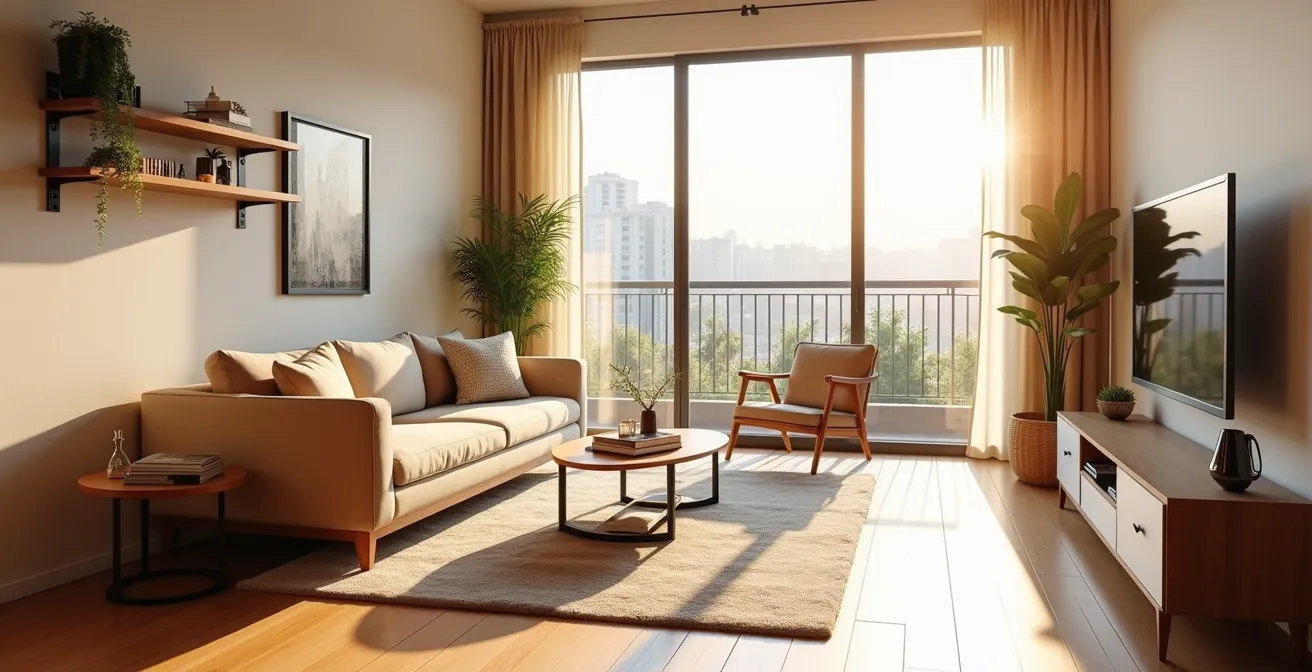
Making a 500 sq ft apartment feel larger isn’t about minimalist purging; it’s about implementing strategic design systems.
- Furniture placement (“floating”) and multi-functionality create usable floor space, not just empty it.
- Manipulating light with mirrors and defining zones with rugs creates perceptual depth that physical size can’t.
Recommendation: Start by auditing your layout for “dead zones” before buying or discarding a single item.
Living in a 500-square-foot apartment presents a unique design challenge. For many city dwellers, the immediate response is to declutter, downsize, and adopt a stark, minimalist aesthetic. We’re told to buy smaller furniture, paint everything white, and simply own less. While there’s wisdom in tidiness, these conventional tips only scratch the surface. They address the symptoms—the feeling of being cramped—but not the root cause.
The real issue isn’t just the quantity of your belongings, but the system in which they exist. A small space feels stressful not just because it’s full, but because its layout creates friction, its lighting is flat, and its functions are undefined. The true art of micro-living is less about subtraction and more about strategic multiplication. It’s a form of architectural psychology where we engineer a system of perception, function, and flow to actively expand our sense of space.
But what if the key wasn’t just using mirrors, but understanding the precise angles that create perceptual depth? What if the most significant layout mistake had nothing to do with furniture size, but everything to do with its relationship to the walls? This guide moves beyond the platitudes to give you an architect’s perspective. We will deconstruct the core elements—from the psychological impact of clutter to the hidden costs of “off” appliances—to build a functional, beautiful, and expansive-feeling home, even within the tightest of footprints.
For those who prefer a visual format, the following video offers a beautiful immersion into a thoughtfully designed micro-apartment, perfectly complementing the practical principles discussed in this guide.
This article provides a structured approach to transforming your space. Each section tackles a specific architectural principle, offering practical solutions and design insights to help you reclaim every square foot. Explore the sections below to build your strategy.
Summary: An Architect’s Guide to Doubling Your Apartment’s Perceived Space
- Why Visual Clutter Increases Stress Levels in Small Homes?
- Convertible vs Stackable Furniture: Which Saves More Space?
- The Layout Mistake That Wastes 20% of Your Floor Plan
- How to Position Mirrors to Double the Natural Light Depth?
- When to Purge Belongings: The 6-Month Usage Rule
- Optimizing Acoustics: Using Rugs to Cover Ugly Rental Floors
- Why Your ‘Off’ Appliances Still Cost You $100 a Year?
- How to Personalize a Rental Apartment Without Losing Your Deposit?
Why Visual Clutter Increases Stress Levels in Small Homes?
Before we move a single piece of furniture, we must address the mind. A small space feels suffocating primarily due to visual clutter. This isn’t just about having too many things; it’s about the constant, low-level cognitive load your brain endures trying to process a disorganized environment. Every item left on a surface is a micro-decision waiting to be made: “Should I put this away? Where does it go? Do I need it?” In a small home, this effect is amplified, leading to elevated cortisol levels and a persistent feeling of stress.
The brain craves order and clear sightlines. When it can’t find them, it perceives the environment as chaotic and unsafe. The solution is not just to “tidy up” but to create a system where every object has a designated home, and surfaces remain clear by default. This reduces the mental bandwidth required to simply exist in your space, freeing up cognitive resources and creating a sense of calm and control. It’s the foundational step upon which all other spatial strategies are built.
Your Action Plan: 5-Step Clutter Assessment for Mental Wellbeing
- Count visible items in your main living space – aim for less than 7 items per surface.
- Identify ‘hot spots’ where clutter accumulates daily (entryway, kitchen counter, coffee table).
- Remove items that don’t serve immediate daily functions from these zones.
- Create designated ‘homes’ for frequently used items within arm’s reach of where they’re used.
- Implement a 10-minute daily reset ritual to maintain clear sightlines.
By systematically addressing the sources of visual noise, you’re not just cleaning your apartment; you’re redesigning your mental environment. This clarity is the true measure of a well-managed small space.
Convertible vs Stackable Furniture: Which Saves More Space?
Once the visual noise is reduced, we can focus on the physical tools: your furniture. For small spaces, the debate often centers on multi-functionality. The two dominant strategies are convertible furniture (a sofa that becomes a bed) and stackable furniture (stools or tables that nest). While both save space, they serve different purposes and come with a hidden metric: daily friction cost. This is the amount of effort required to transform or use the item.
Convertible furniture offers the most dramatic space-saving potential, often reclaiming 70-90% of a footprint when not in use. However, it comes with a high friction cost—the daily chore of folding, unfolding, and rearranging. This makes it ideal for functions that are used less frequently, like a guest bed. Stackable furniture, in contrast, offers a lower space-saving percentage but has a minimal friction cost. It’s perfect for daily needs, like extra seating for guests that can be deployed in seconds. Choosing the right strategy depends entirely on the frequency of use.
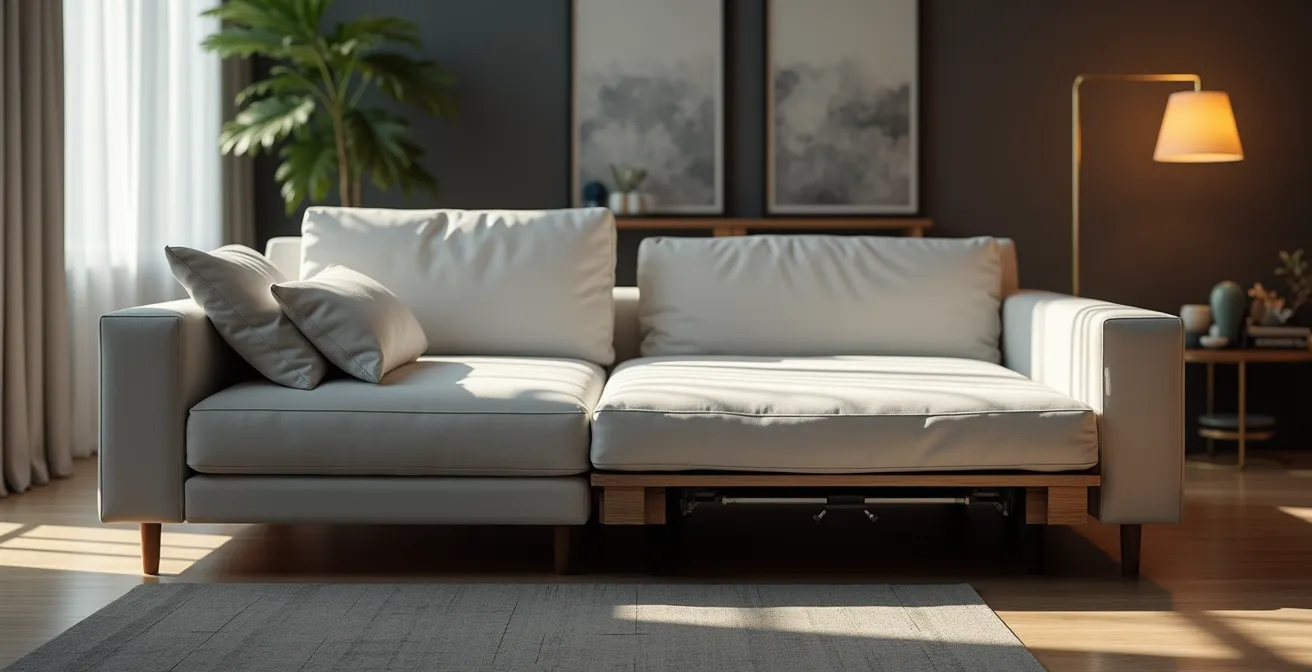
The image above perfectly captures this idea of transformation. It’s a visual metaphor for adaptability, where one object holds the potential for two distinct functions. The key is to analyze your lifestyle honestly. Don’t invest in a complex murphy bed system if the daily effort will lead you to just leave it down, defeating the purpose. A simple stack of elegant stools might be a more practical and effective solution for your day-to-day life.
To make an informed decision, a direct comparison is essential. This matrix breaks down the key factors to consider, and as this thorough analysis of studio apartment strategies shows, the right choice balances investment, durability, and daily convenience.
| Factor | Convertible Furniture | Stackable Furniture |
|---|---|---|
| Daily Friction Cost | High (2-5 min transformation) | Low (30 sec stacking) |
| Space Saved When Not in Use | 70-90% | 40-60% |
| Initial Investment | $800-3000 | $200-800 |
| Best for Use Frequency | Weekly or less | Daily use |
| Durability | 5-10 years with mechanisms | 10-15 years solid construction |
The Layout Mistake That Wastes 20% of Your Floor Plan
You can have the best multi-functional furniture and a clutter-free environment, but still have a space that feels cramped and awkward. The single most common layout mistake in small apartments is pushing all furniture against the walls. It’s an intuitive act—we think that by clearing the center, we are creating more space. In reality, this creates an undefined “dead zone” in the middle of the room and eliminates functional pathways, wasting up to 20% of your usable floor plan.
The solution is a counter-intuitive architectural principle: “floating” your furniture. This involves pulling pieces away from the walls to create distinct zones and clear circulation paths. A sofa pulled a few feet from the wall can create a “hallway” behind it. A desk placed in the open can define a workspace separate from the living area. This technique uses furniture to sculpt the space, rather than just occupy it. As the Transformer Table Design Team explains in their guide:
Floating furniture means to place them in the center of the room instead of pushing them against the walls. It divides your bedroom space and the living room or kitchen.
– Transformer Table Design Team, Maximizing Space in a Studio Apartment Guide
By creating these intentional arrangements, you give every square foot a purpose. The “negative space” around the furniture becomes as important as the furniture itself, serving as pathways that make the entire apartment feel more logical and expansive.
Case Study: The 500 sq ft Hollywood Apartment Transformation
In a project featured on a leading design blog, a 500 sq ft studio was transformed by floating furniture. By creating a breakfast nook away from the walls, the designer was able to create a social hub that could comfortably seat over seven people. According to the breakdown of the Hollywood-inspired studio, this would have been impossible with a traditional wall-hugging layout, proving that strategic placement creates far more usable space than simply clearing a central area.
How to Position Mirrors to Double the Natural Light Depth?
With a functional layout established, the next layer of design is manipulating perception. Natural light is the most powerful tool for making a space feel larger, and mirrors are its amplifiers. However, the common advice to simply “hang a big mirror” is incomplete. The goal is not just to reflect an image, but to create perceptual depth and bounce light into the darkest corners of your apartment. This requires strategic, almost surgical, placement.
The most effective technique is to place a primary mirror on a wall adjacent to your main window, not directly opposite it. At a roughly 45-degree angle to the window, the mirror will catch the light and project it deeper into the room, creating an illusion of a continuing space rather than just reflecting the window itself. Think of it as bending light around a corner.

Other advanced techniques can further enhance this effect. Installing a series of narrow, vertical mirrors between two windows can trick the eye into seeing additional windows. Mirrored furniture, like a coffee table or credenza, is also highly effective as it bounces light upwards, illuminating the ceiling and making the room feel taller. In the kitchen, a mirrored backsplash can work wonders, reflecting under-cabinet lighting and creating a sense of openness. The key is to think of mirrors not as decoration, but as architectural elements for light distribution.
A gallery wall that mixes mirrors of various sizes with artwork is another sophisticated strategy. This scatters light more dynamically than a single large mirror, creating pockets of brightness and visual interest that keep the eye moving and prevent the space from feeling static.
When to Purge Belongings: The 6-Month Usage Rule
Even with a perfect layout and brilliant lighting, a small space can be defeated by an excess of belongings. Decluttering is essential, but it can be an emotional and overwhelming process. To make it objective, we need a clear system. The first step is to quantify the problem: unused items are not just taking up space; they are costing you money. A financial analysis of small-space living reveals that just 3 square feet of storage for unused items in an apartment with rent equivalent to $5/sq ft costs you $180 annually. That unused guitar in the corner isn’t just dusty; it’s a recurring expense.
To decide what stays and what goes, adopt the simple but ruthless 6-Month Usage Rule: if you haven’t used a non-sentimental item in the last six months, it’s a candidate for purging. This rule forces an honest assessment of your actual lifestyle, not the one you aspire to have. That pasta maker you used once? The box of cables for electronics you no longer own? They fail the test.
For items that are harder to decide on, a more nuanced framework can help. The Joy + Function Matrix allows you to categorize items based on how much you enjoy them and how often you use them. This moves beyond a simple “keep or toss” binary and provides a clear path for each category of possession.
This matrix helps you prioritize what to keep, what to upgrade, and what to get rid of immediately. It’s a strategic tool for curating your home so that every object either serves a critical function or brings you genuine joy.
| Category | High Joy | Low Joy |
|---|---|---|
| High Function | KEEP: Daily essentials you love | OPTIMIZE: Replace with items you enjoy |
| Low Function | CURATE: Seasonal/sentimental items | PURGE: Immediate donation candidates |
Optimizing Acoustics: Using Rugs to Cover Ugly Rental Floors
A common challenge for renters in small apartments is dealing with ugly or worn-out flooring. Since replacing it is not an option, the go-to solution is an area rug. But a rug’s function extends far beyond aesthetics; it is a powerful tool for functional zoning and acoustic optimization. In a studio apartment, a large rug can visually anchor the “living room” area, while a different runner can define the “bedroom” space, creating distinct zones without putting up walls that would block light and make the space feel smaller.
This technique is about suggesting division, not enforcing it. The strategic use of rugs provides psychological cues that help organize the space in our minds, making a single room feel like a multi-room home. As demonstrated in one New York apartment, this can be incredibly effective. The designer of a 500 sq ft rental studio used area rugs to create a clear delineation between living and sleeping areas, enhancing the apartment’s functionality without sacrificing its open, airy feel.
Beyond zoning, rugs are crucial for managing acoustics. Hard surfaces in small spaces can create a harsh, echo-filled environment. A plush rug absorbs sound, reducing echo and making the apartment feel quieter, cozier, and more luxurious. To maximize this effect, consider layering a small, thick-pile rug over a larger, flat-weave base. You can further improve acoustics by hanging fabric tapestries or canvas art prints, which trap sound waves, and by adding upholstered furniture that absorbs mid-frequency sounds. These elements work together to soften the space both visually and sonically.
This multi-layered approach turns a simple decorative choice into a sophisticated design strategy. You simultaneously hide a floor you dislike, define functional areas, and create a more comfortable acoustic environment.
Why Your ‘Off’ Appliances Still Cost You $100 a Year?
Maximizing a small space also means optimizing its hidden systems, including energy consumption. In an apartment where every dollar counts, “phantom load” or “vampire power” is a significant and often-overlooked drain on resources. This is the electricity consumed by your appliances even when they are turned “off” but remain plugged in. Devices in standby mode—showing a clock, waiting for a remote signal, or maintaining settings—are constantly drawing power.
The cumulative cost is staggering. According to the Department of Energy, standby power can account for 5-10% of a home’s total residential electricity use. For a small apartment, this can easily add up to over $100 per year in wasted money. The top offenders are often the most common household items: your television, cable box, game console, microwave, and coffee maker are all silently adding to your utility bill 24/7.
Tackling this “energy clutter” is a simple way to optimize your home and your budget. The most effective solution is to connect clusters of devices (like your entire entertainment center) to a smart power strip. These strips can automatically cut off power to all connected devices when the primary device (e.g., the TV) is turned off. For individual appliances like a coffee maker or microwave, a simple smart plug with a scheduling function can ensure they only draw power when you’re likely to use them.
By performing a quick audit of your appliances and implementing these low-cost solutions, you can eliminate a significant source of waste. It’s an invisible optimization that has a very visible impact on your monthly expenses, freeing up funds that are better spent elsewhere.
Key Takeaways
- Strategic Layout is Paramount: Floating furniture away from walls creates more usable space than simply clearing the center.
- Perception is Reality: Manipulate light with strategically angled mirrors and define zones with rugs to make the space feel larger than its physical dimensions.
- Reversible Impact is Key for Renters: Focus on high-impact, non-permanent upgrades like hardware, lighting, and window treatments to personalize your space without risking your deposit.
How to Personalize a Rental Apartment Without Losing Your Deposit?
The final, and perhaps most important, layer of designing a small space is making it feel like your own. For renters, this is often a source of anxiety, as the fear of losing a security deposit can lead to living in a sterile, impersonal environment. The solution lies in the principle of Reversible Impact: focusing on upgrades that are high-impact visually but completely non-permanent.
Forget about painting or making structural changes. The most effective rental-friendly transformations come from swapping out the cheap, standard-issue fixtures that come with the apartment. Replacing generic plastic blinds with stylish bamboo roman shades, for instance, can instantly elevate the entire feel of a room. Swapping out basic cabinet knobs and drawer pulls in the kitchen and bathroom for more unique hardware is another low-cost, high-impact change. Just be sure to store the original fixtures in a labeled bag to reinstall before you move out.
Lighting is another area ripe for personalization. Change out the generic “boob light” fixture for a stylish pendant or chandelier (again, saving the original). Even simpler, replace all the standard bulbs with smart bulbs, allowing you to completely customize the color temperature and ambiance of your apartment from your phone. For dividing spaces, instead of drilling into walls or ceilings, use floor-to-ceiling tension rods to hang curtains, creating a soft and elegant room divider that can be removed without a trace.
Case Study: Damage-Free Rental Personalization
One renter, Courtney, completely transformed her 500 sq ft apartment with clever, reversible changes. By replacing the standard plastic shades with bamboo ones and swapping out light fixtures, she added immense style. She also used carefully selected furniture, like a half-round entry table that fit the tiny space perfectly. All modifications were easily undone, allowing her to create a deeply personal home while protecting her deposit, a strategy that proves personalization and responsible renting can go hand-in-hand.
These strategies empower you to take ownership of your space. By focusing on reversible upgrades, you can create a home that reflects your personality and style without making a single permanent mark.
Start applying these architectural principles today. By shifting your focus from a lack of space to an opportunity for a better system, you can transform your 500 square feet into a home that is not only functional and beautiful, but feels twice as big.