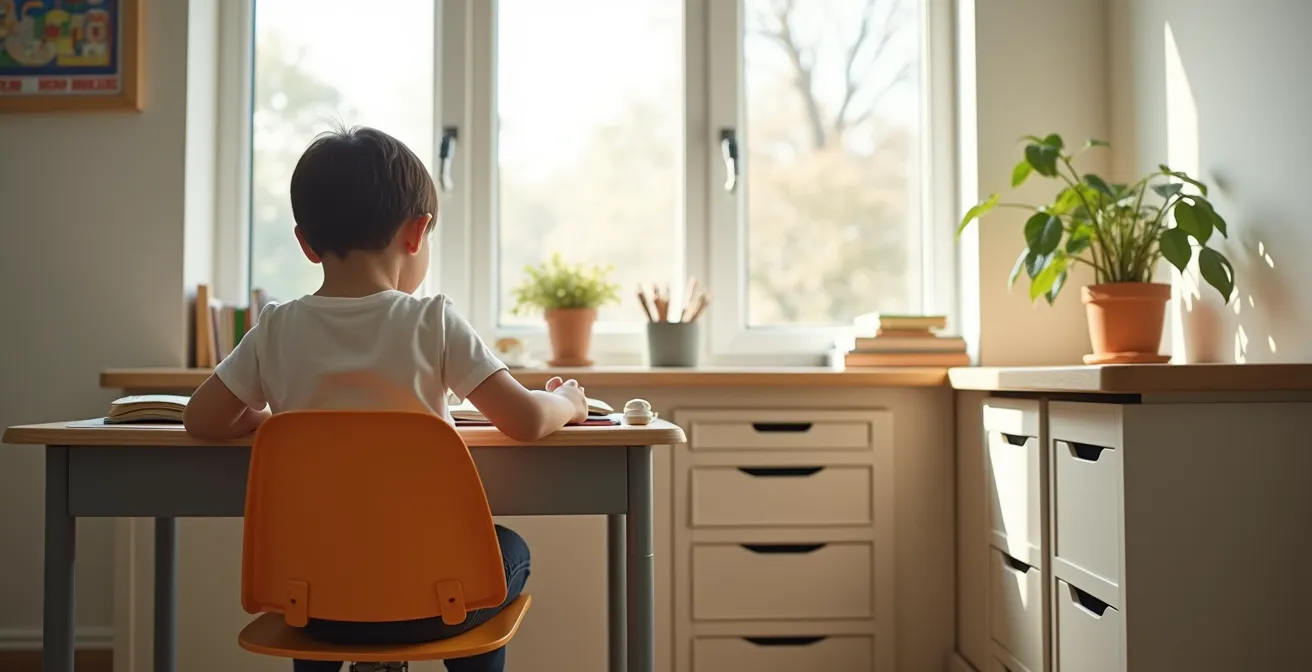
Contrary to popular belief, a fancy desk and a quiet room aren’t the keys to homeschool focus; the secret is proactively engineering a learning ecosystem that manages your child’s cognitive load.
- Effective learning spaces are built on ergonomic principles that can be applied to any furniture, not just expensive chairs.
- True focus comes from managing energy with brain-friendly schedules and building “attention rituals,” rather than just eliminating distractions.
Recommendation: Shift your goal from just creating a “school zone” to designing an environment that actively builds your child’s ability to concentrate as a skill.
The shift to homeschooling or hybrid learning has turned countless kitchen tables and living room corners into makeshift classrooms. As a parent, you’ve likely followed the standard advice: find a quiet spot, gather the supplies, and hope for the best. Yet, you still find your child slumping over their books, getting distracted by a passing shadow, or constantly fighting the lure of a nearby screen. The frustration is real, and it often feels like a battle against your child’s willpower. Common solutions revolve around stricter rules or more educational apps, treating the symptom rather than the cause.
But what if the problem isn’t a lack of discipline, but a poorly designed environment? What if the “comfy” sofa is actually a cognitive trap and the “organized” desk is still creating distracting visual noise? The key to unlocking your child’s focus isn’t about demanding it more forcefully. It’s about fundamentally re-thinking the learning space as an ecosystem. This is where we move beyond decoration and into the realm of environmental engineering—shaping your child’s surroundings to proactively support their attention span, energy levels, and even their posture.
This guide will walk you through the principles of creating a high-focus home classroom. We’ll deconstruct the common pitfalls of makeshift setups, explore how to manage digital and physical distractions without conflict, and provide concrete strategies for structuring lessons that work with your child’s brain, not against it. Prepare to become the architect of your child’s concentration.
To help you navigate these concepts, this article is structured to build your expertise step by step. Below is a summary of the key areas we will cover to transform your home into a powerhouse of learning.
Summary: Building a High-Focus Home Learning Environment
- Why Kitchen Tables Are Ruining Your Child’s Posture and Focus?
- How to Lock Down Devices During School Hours Without Conflict?
- Visual Schedules vs Apps: Which Keeps Kids on Track?
- The Social Skill Deficit That Affects 30% of Homeschooled Kids
- Sequencing Lessons: The Pomodoro Technique for 8-Year-Olds
- Eliminating Visual Noise: A Desk Setup for ADHD Minds
- Why Your ‘Comfy’ Sofa Is Destroying Your Lower Back?
- How to Restore Deep Focus in an Era of Constant Notifications?
Why Kitchen Tables Are Ruining Your Child’s Posture and Focus?
The kitchen table often becomes the default command center for homeschooling, but it’s an ergonomic minefield for a growing child. Adult-sized furniture forces children into unnatural positions—feet dangling, shoulders hunched, and necks craned. This isn’t just a matter of comfort; it’s a direct assault on their ability to focus. Poor posture creates physical stress and discomfort, sending a constant stream of distracting signals to the brain. When the body is busy struggling, the mind can’t engage in deep learning.
The core issue is a mismatch between the child’s body and the environment. The ergonomic gold standard for seated work, recommended by occupational therapists, involves maintaining 90-degree angles at the ankles, knees, and hips, with feet flat on the floor. At a standard kitchen table, a child’s legs often don’t reach the floor, their elbows are too low, and their gaze is directed downward at a screen or book. This posture not only strains the musculoskeletal system but also restricts breathing and circulation, further reducing alertness.
You don’t need to buy a specialized desk to fix this. The solution lies in adapting what you have. Use a stack of sturdy books or a small box as a footrest to ensure their feet are flat and their knees are at a 90-degree angle. If the table is too high, a firm cushion on their chair can elevate them. The goal is to stabilize their body, which in turn stabilizes their attention. By engineering this physical foundation, you eliminate a major source of subconscious distraction and free up their cognitive resources for learning.
How to Lock Down Devices During School Hours Without Conflict?
In a home classroom, the line between learning tool and entertainment device is dangerously thin. A tablet used for a math lesson is just one tap away from YouTube or a favorite game. Simply demanding your child stay on task often leads to power struggles and resentment. The key to managing technology isn’t about exerting more control, but about creating clear, pre-negotiated boundaries that are enforced by technology itself, removing you from the role of “screen police.”
You are not alone in this struggle; a 2023 Pew Research study found that 66% of U.S. parents use parental controls to manage their children’s screen time. The most effective approach is collaborative. Sit down with your child outside of school hours and create a “digital agreement.” This document outlines when devices can be used for fun and when they are strictly for school. This turns the process from a unilateral command into a mutual understanding. When rules are co-created, children are far more likely to respect them.
Modern devices have built-in tools designed specifically for this purpose. Apple’s “Schooltime” and Android’s “Focus Mode” allow you to designate specific hours where only approved educational apps are accessible. These tools are not just about blocking; they are about creating a distraction-free digital environment. As the following comparison shows, each platform offers robust features to support this goal.
This table, based on an analysis of digital wellbeing tools, breaks down the key features of the native controls available on most devices today.
| Feature | Apple Schooltime | Android Focus Mode |
|---|---|---|
| Setup Location | Watch app on parent’s iPhone | Digital Wellbeing settings |
| Schedule Flexibility | Multiple schedules per day | Custom time blocks |
| Emergency Override | Crown button exit (tracked) | Temporary pause option |
| Parent Monitoring | Detailed exit reports | Usage statistics |
| Best For Ages | 8+ years | All ages |
By using these tools, the device itself becomes the enforcer of the rules you created together. This depersonalizes the restrictions and preserves your relationship with your child, focusing your energy on encouragement rather than enforcement.
Visual Schedules vs Apps: Which Keeps Kids on Track?
Keeping a child on task throughout the school day requires a clear structure. While digital calendar apps and reminders seem like a modern solution, they can often fall short for elementary-aged children. The abstract nature of a notification or a digital checklist lacks the tangible feedback that many young learners need to stay motivated and understand the flow of their day. The debate isn’t just about analog versus digital; it’s about how a child’s brain processes progress.
For many children, especially kinesthetic learners who learn by doing, a physical schedule is far more powerful. The act of physically moving a task from a “To-Do” column to a “Done” column on a whiteboard or velcro chart provides a satisfying sense of accomplishment that a simple screen tap cannot replicate. This tangible interaction reinforces progress and makes the concept of time visible and manageable.
Case Study: The Power of Physical Task Management
In a study of its online students, Connections Academy found that younger children (ages 5-10) demonstrated significantly higher task completion rates when using physical visual schedules. The tactile experience of manipulating task cards provided a stronger psychological reward and clearer sense of progress than digital notifications, confirming the importance of physical interaction in building executive function skills.
This doesn’t mean technology has no role. The most effective approach is often a hybrid one. Use a digital calendar for the big picture—setting the main “blocks” of the day like “Math Block (9-10 AM)” or “Reading Time (11-11:30 AM).” Within those blocks, use a physical task board with specific, smaller activities. You can even use a simple phone timer to signal transitions between blocks, freeing you from having to be the timekeeper. At the end of the day, reviewing both the digital overview and the physically completed tasks provides a comprehensive sense of achievement.
The Social Skill Deficit That Affects 30% of Homeschooled Kids
While a home classroom can be optimized for academic focus, it can inadvertently create a deficit in a crucial area of development: social skills. Traditional schools are messy, chaotic environments where children constantly practice negotiation, turn-taking, conflict resolution, and reading social cues. Without this built-in social gymnasium, homeschooled children can miss out on vital practice. While not a universal experience, research indicates that approximately 30% of homeschooled children face social skill challenges if socialization is not intentionally cultivated.
The stereotype of the “socially awkward” homeschooled child is unfair, but the risk is real if parents don’t proactively create opportunities for social learning. This goes beyond just arranging playdates or joining a local homeschool co-op. It requires creating structured scenarios where specific social skills can be taught and practiced, just like any academic subject. The solution isn’t to replicate a noisy classroom, but to find or create environments that facilitate quality interaction.
Technology, often blamed for social isolation, can be a powerful tool when used correctly. Virtual clubs and collaborative projects can provide the structured interaction needed to build these skills in a safe, moderated environment. This allows children to practice communication without the overwhelming sensory input of a large group.
Case Study: Building Social Skills Through Virtual Collaboration
The organization Kingdom First Homeschool documented a successful program involving virtual book clubs and collaborative YouTube channel projects for homeschooled children aged 8-12. Within these moderated video calls, students learned and practiced essential communication skills like active listening, respectful disagreement, and taking turns. The structured format provided a scaffold for social interaction that was less intimidating than unstructured group settings, leading to measurable improvements in their conversational confidence.
The goal is to be an architect of your child’s social life, not just a facilitator. Seek out activities—both online and offline—that require teamwork, communication, and shared goals. This intentional approach ensures that your child develops the social fluency they need to thrive in any environment.
Sequencing Lessons: The Pomodoro Technique for 8-Year-Olds
A child’s ability to focus isn’t a constant resource; it ebbs and flows throughout the day. A common mistake in homeschooling is to schedule long, monolithic blocks for difficult subjects, leading to burnout and frustration. A more effective strategy is to engineer the schedule around the brain’s natural rhythms, using techniques like the Pomodoro method, adapted for a younger audience. This approach breaks work into short, focused intervals, making learning feel less like a marathon and more like a series of fun sprints.
The standard adult Pomodoro is a 25-minute work session followed by a 5-minute break. For an 8-year-old, this is often too long. A “Pomodoro Junior” might consist of a 15 to 20-minute focused interval followed by a 5-minute “brain break.” These breaks are not for checking devices; they are for activities that reset the brain, like stretching, doing jumping jacks, or simply looking out the window. This regular cadence of intense focus followed by a brief rest prevents cognitive fatigue and keeps engagement high.
Action Plan: Implementing the Pomodoro Junior Method
- Set a timer for 15-20 minute work intervals, adjusting based on your child’s stamina.
- Schedule 5-minute, brain-friendly breaks: think stretching, looking out the window, or doing star jumps.
- Alternate subjects that use different parts of the brain (e.g., analytical math followed by creative art).
- Place the most demanding subjects, like math or writing, in the morning when focus is typically highest.
- Save creative, hands-on activities for the natural energy dips in the afternoon.
This method works best when combined with an understanding of your child’s daily energy levels. As this energy-based schedule model illustrates, matching the subject to the child’s alertness is a powerful way to maximize learning and minimize frustration.
| Time Block | Energy Level | Recommended Subject | Break Activity |
|---|---|---|---|
| 9:00-9:20am | Peak | Mathematics | 5 jumping jacks |
| 9:25-9:45am | High | Writing/Language | Window gazing |
| 10:00-10:20am | Moderate | Science/Reading | Stretching |
| 11:00-11:20am | Declining | Art/Music | Dance break |
| 2:00-2:20pm | Low | Hands-on Projects | Outdoor walk |
By structuring the day this way, you teach your child how to manage their own energy and focus. They learn that concentration isn’t an infinite resource but a wave to be ridden. This meta-skill is one of the most valuable lessons homeschooling can offer.
Eliminating Visual Noise: A Desk Setup for ADHD Minds
For any child, a cluttered desk is a distraction. But for a child with ADHD or other attention challenges, it’s a constant, overwhelming drain on their cognitive resources. Every visible object—a stray crayon, a stack of books, a half-finished project—competes for their attention. This phenomenon, known as visual noise, forces their brain to work overtime just to filter out irrelevant stimuli, leaving less mental energy for the actual task at hand. Creating a focused learning space for them isn’t about tidiness; it’s about radically minimizing this noise.
The guiding principle is “out of sight, out of mind.” This doesn’t mean a sterile, empty desk. It means that anything not immediately required for the current task should be stored in closed containers. Open shelving, pen cups, and clear bins are often counterproductive. Instead, opt for drawers, lidded boxes, and cabinets. The goal is to create a calm, neutral visual field that allows the brain to lock onto the primary task without a constant battle against peripheral distractions.
Case Study: The Impact of Closed Storage on Focus
A 2025 study by Connections Academy directly compared the performance of students with ADHD using open versus closed storage solutions. The results were striking: students who worked in a “calm visual field” created by hiding supplies in drawers and lidded boxes showed a 40% improvement in sustained attention tasks. Reducing visual noise was directly correlated with increased task completion and reduced frustration.
This setup should also include designated spots for “fidgets” or sensory tools. Providing a quiet, tactile outlet like putty or a resistance band attached to a chair leg can help channel excess energy and improve focus, as long as these tools don’t add to the visual clutter. By thoughtfully curating a low-noise environment, you give your child’s brain a fighting chance to stay on track, turning their workspace from a source of distraction into a sanctuary for focus.
Why Your ‘Comfy’ Sofa Is Destroying Your Lower Back?
On days when focus is low, letting your child work from the “comfy” sofa can seem like a harmless compromise. In reality, you’re trading short-term comfort for long-term physical strain and a further-depleted attention span. Sofas are designed for relaxing, not for the engaged, upright posture required for learning. When a child slumps into a soft couch with a laptop or book, their spine curves into a C-shape, putting immense pressure on their lower back.
The science is clear. Biomechanical studies demonstrate a 50% greater load on the lower back when sitting in a slouched position compared to standing. This strain isn’t just a future health risk; it’s a present-day distraction. The physical discomfort, even if subconscious, constantly diverts cognitive resources away from learning. The “comfort” of the sofa is a cognitive trap that makes sustained focus nearly impossible.
While a dedicated desk and chair are always the best option, there are times when sofa-schooling is unavoidable. In these moments, your role as an environmental engineer is to modify the space to minimize the damage. The goal is to recreate an ergonomic setup as closely as possible, even on a couch. This “Sofa Survival Kit” can make a significant difference:
- Place a firm cushion or rolled-up towel behind their lower back to provide lumbar support and prevent slouching.
- Use a laptop stand, a stack of books, or a firm pillow to raise the screen or book to eye level, preventing neck strain.
- Use a footstool or ottoman to elevate their feet so their knees are roughly level with their hips, mimicking the 90-degree rule.
- Set a timer for every 20 minutes as a reminder to stand up, stretch, and move around to reset their posture.
These small adjustments can transform a posture-destroying environment into a workable temporary learning space. It reinforces the principle that the learning environment must always be adapted to the child, and never the other way around.
Key Takeaways
- Ergonomics is the foundation: A stable body supports a focused mind. Adapt any chair and table to fit your child’s body using simple props.
- Engineer your child’s schedule: Use short, focused work intervals (like Pomodoro) and match demanding subjects to your child’s peak energy times.
- Control the environment, not the child: Use technology’s built-in tools and create low-distraction physical spaces to make focus the path of least resistance.
How to Restore Deep Focus in an Era of Constant Notifications?
We’ve engineered the physical space, managed the digital world, and structured the day for optimal energy. The final piece of the puzzle is to treat focus not just as a state to be protected, but as a skill to be actively cultivated. In our world of constant notifications, a child’s attention is fragmented before it even has a chance to deepen. Restoring the ability to concentrate for extended periods requires creating deliberate, consistent routines that signal to the brain that it’s time for deep work. These are “focus rituals.”
A focus ritual can be a simple, multi-sensory routine performed at the start of every learning block. It could be lighting a specific “focus lamp,” taking three deep breaths, and starting a particular playlist of ambient sounds. The specific actions matter less than their consistency. This routine acts as a powerful psychological trigger, transitioning the brain from a state of passive distraction to one of active engagement. As Camilla Ejsing, an Occupational Therapist in the FLEXA Study, notes, movement is also a key component:
Children should never be sitting still for a long amount of time without being able to switch position and move their body
– Camilla Ejsing, Occupational Therapist, FLEXA Study
Integrating brief movement breaks between focus sessions honors this principle and is essential for maintaining concentration. The ritual isn’t just about starting; it’s also about a clean finish. Ending a session with a specific action—turning off the lamp, closing the book, and stretching—helps the brain disengage cleanly, making it easier to re-engage later.
Case Study: Building Attention with Focus Rituals
The homeschooling resource The Happy Housewife documented families who implemented simple attention rituals. By consistently using routines like lighting a “focus lamp” and playing specific background nature sounds at the start of each lesson, children showed a remarkable improvement. On average, their sustained, unprompted focus duration increased from just 10 minutes to over 25 minutes within two weeks of practice, demonstrating that focus is a trainable skill.
By teaching your child to use these rituals, you are giving them a tool for life. You are showing them how to take control of their own attention, a skill far more valuable than any single academic subject. You are transforming them from a passive recipient of information into a proactive, focused learner.
By applying these principles of environmental and energetic engineering, you can create a home learning space that doesn’t just demand focus but actively cultivates it. Start with one small change today to begin building a more effective and harmonious learning environment for your child.