In summary:
- A panic attack is a physiological event, not a personal failure. Your racing heart is a real, measurable response.
- Use the 5-4-3-2-1 method to ground yourself discreetly, even during a video call. This is your primary sensory anchor.
- For a faster reset, cold water on your face triggers a “vagal reset” more quickly than breathing exercises alone.
- After an attack, taking a sick day requires setting firm digital boundaries to prevent a cycle of “return anxiety.”
- Proactively script your professional boundaries to reduce the chronic stress that triggers panic in the first place.
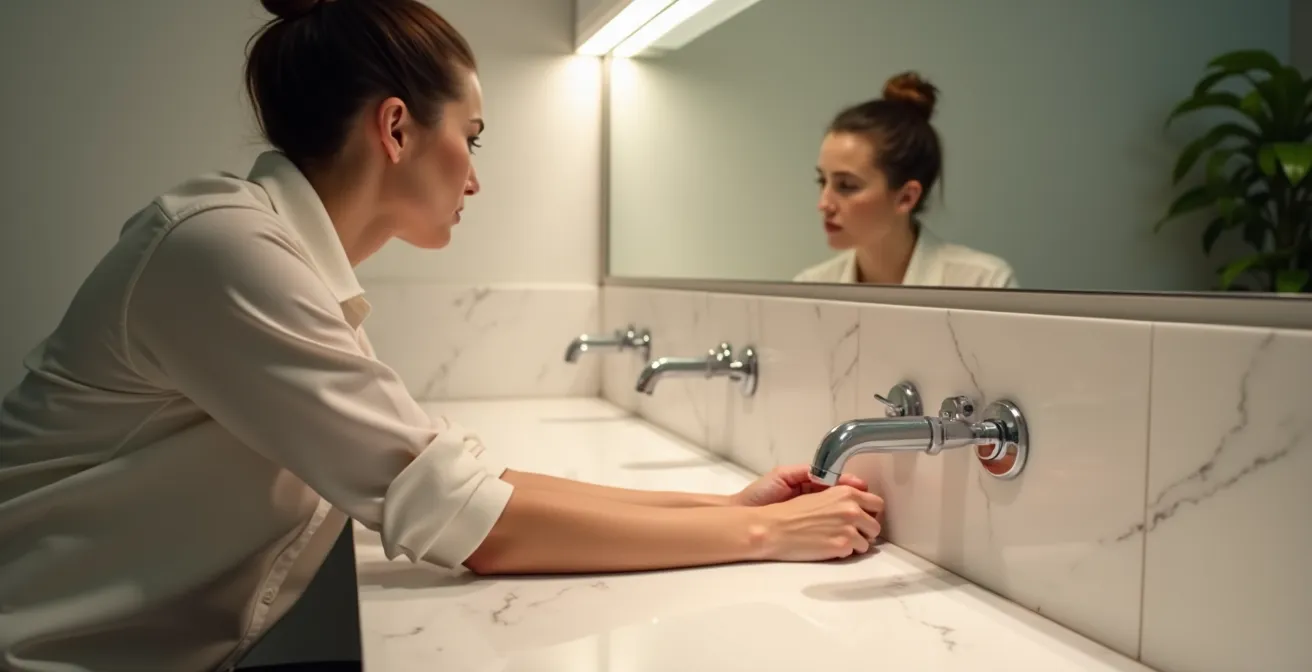
The feeling is unmistakable. The conference room walls feel like they’re closing in. Your heart hammers against your ribs, even though you’re sitting perfectly still. Your mind, which was just tracking quarterly projections, is now screaming a single, silent word: “Escape.” You excuse yourself, a polite smile plastered over a rising tide of terror, and make a beeline for the one private space available: the restroom. This is not just stress; it’s a panic attack, and you need a solution that is immediate, discreet, and effective.
Many will offer generic advice: “just breathe,” “think positive thoughts,” or “talk to your manager.” While well-intentioned, these suggestions fail to address the acute, physiological reality of what’s happening. Your body’s fight-or-flight system has been hijacked. You are not experiencing a failure of character; you are experiencing a biological cascade that requires a targeted, physical intervention. This isn’t about long-term wellness strategies; it’s about executing a physiological override in the next five minutes.
But what if the key isn’t to “calm your mind” but to first reclaim your body? This guide is designed for that urgent, private moment. It provides a tactical, step-by-step protocol to de-escalate a panic attack using the tools available to you right now, within the four walls of an office restroom. We will move from understanding the physiological alarm, to deploying immediate circuit-breakers, and finally, to setting the boundaries that prevent the next one.
This article provides a structured approach to managing acute workplace anxiety. The following sections offer a complete toolkit, from understanding the physical symptoms to implementing practical, preventative strategies in your daily professional life.
Summary: A Professional’s Guide to Managing Acute Workplace Anxiety
- Why Your Heart Races During a Meeting When You Aren’t Running?
- How to Use the 5-4-3-2-1 Method During a Zoom Call?
- Breathing vs Cold Water: Which Resets the Vagus Nerve Faster?
- The Sick Day Mistake That Increases Return Anxiety
- Scripting Your Boundaries: How to Say No to Overtime Without Guilt?
- Why Your Open-Space Office Drains Your Energy Faster?
- Ashwagandha or Magnesium: Which Is Better for Evening Anxiety?
- How to Use Mindfulness to De-escalate Family Arguments?
Why Your Heart Races During a Meeting When You Aren’t Running?
That sudden, violent heart-pounding during a presentation isn’t your imagination; it’s a primal survival mechanism called the fight-or-flight response. Your brain’s threat-detection center, the amygdala, has incorrectly identified the high-stakes meeting or critical feedback as a life-threatening danger. It floods your body with adrenaline, preparing you to either fight a predator or flee. This causes your heart to race, your breathing to become shallow, and your muscles to tense—all physical preparations for an action you cannot take while seated at a conference table.
This is not simply “stress.” The physical symptoms are real and can be terrifyingly intense. Research on emergency room visits confirms this, showing that nearly 24% of visitors with symptoms like chest pain and palpitations actually meet the criteria for a panic attack. The experience is so profoundly physical that many believe they are having a heart attack. Understanding this is your first step toward control: you are not losing your mind; your body’s ancient alarm system has been falsely triggered by a modern, corporate “threat.”
The pervasiveness of this issue is staggering. The pressure of modern work environments means that these false alarms are becoming more common. In fact, research from the Anxiety and Depression Association of America reveals that 72% of people with daily stress and anxiety say it significantly interferes with their life and work performance. Recognizing your racing heart as a physiological signal, rather than a sign of weakness, is the critical mindset shift needed to begin de-escalation.
How to Use the 5-4-3-2-1 Method During a Zoom Call?
The 5-4-3-2-1 method is an anxiety circuit-breaker designed for maximum discretion. Its purpose is to pull your focus away from the internal storm of panic and anchor it to the external, neutral environment. It forces your brain to perform a series of low-demand sensory tasks, interrupting the feedback loop of catastrophic thoughts. You can perform this entire exercise without anyone on a Zoom call noticing a thing. Your hands can remain on your desk, and your gaze can appear focused on the screen.

This technique works by systematically engaging each of your senses, a process known as sensory anchoring. It’s a powerful way to signal to your nervous system that you are safe and that there is no immediate physical threat. Here is the exact, silent protocol to follow:
- Acknowledge 5 things you can see: Let your eyes scan your periphery without moving your head. Notice the corner of your monitor, a book on your shelf, the pattern of the wood grain on your desk, a pen, the light from your window. Simply name them silently to yourself.
- Acknowledge 4 things you can feel: Focus on tactile sensations. The smooth, cool surface of your desk under your palm. The texture of the fabric on your chair. The slight tension in your watchband. The solid feel of your feet on the floor.
- Acknowledge 3 things you can hear: Tune your hearing past the voice on the call. Listen for the subtle sounds. The low hum of your computer’s fan. The distant sound of traffic. The soft click of your own mouse.
- Acknowledge 2 things you can smell: This requires a subtle inhale. Can you detect the faint scent of your morning coffee? The aroma of hand soap or lotion? Even the neutral smell of the air in the room is a valid anchor.
- Acknowledge 1 thing you can taste: Focus on your mouth. Can you still taste the remnants of coffee, mint, or lunch? If not, simply notice the neutral taste of your own mouth. This final step brings your awareness fully back into your own body.
Breathing vs Cold Water: Which Resets the Vagus Nerve Faster?
When you’re in the throes of a panic attack, you need a rapid vagal reset. The vagus nerve is the main brake on your fight-or-flight response, and stimulating it directly tells your body to stand down. Both controlled breathing and cold water exposure are effective vagal stimulants, but they work on different timelines and offer different levels of intensity. The choice depends on the severity of your panic and how quickly you need a “hard reset.”
Controlled breathing, like the 4-7-8 method, is a gradual and discreet tool. It works by slowing your heart rate and activating the parasympathetic (rest-and-digest) nervous system. It’s an excellent first line of defense that you can do anywhere. As one practitioner described its effectiveness to U.S. News Health:
Breathe in for four seconds, hold it for seven seconds, then exhale for eight seconds. This can help bring your heart rate down and make your body relax. It has worked for me every single time I’ve tried it.
– Ligris, U.S. News Health Report
However, for a faster and more powerful intervention, cold water is the superior choice. Splashing cold water on your face, particularly the area around your eyes and below your nose, triggers the “mammalian dive reflex.” This is a profound, hardwired physiological response that instantly slows the heart rate and redirects blood flow to the brain and heart. It’s the body’s emergency response to being submerged in cold water, and it acts as an immediate circuit-breaker for panic. In the context of the office restroom, it’s your most potent tool for a rapid reset. Breathing calms the system; cold water shocks it back into regulation.
The Sick Day Mistake That Increases Return Anxiety
You’ve survived the panic attack, made it through the day, and rightly decided to take a sick day to recover. The single biggest mistake you can make now is to remain digitally tethered to the office. Checking emails, responding to Slack messages, or “just keeping an eye on things” does not allow your nervous system to fully stand down and repair. It creates a state of low-grade hypervigilance that prevents recovery and, worse, dramatically increases the anxiety you’ll feel about returning to work.
The statistics on mental health-related absences are revealing; workplace mental health data shows that employees take an average of 18 days off per year for stress and anxiety, more than for any physical illness. This highlights the critical need to make that time off truly restorative. A sick day spent monitoring work is not a day off; it’s a day of remote anxiety. To break the cycle, you must communicate a clear, firm, and professional boundary. You do not need to over-explain; “health reasons” is sufficient and professional.
Here are three clear, professional email templates to use when taking a mental health day. They establish a boundary while maintaining your professionalism:
- The Minimalist Approach: “Taking a sick day today for health reasons. I will be offline but will check for true emergencies once this afternoon.” (This provides a small window for urgent matters, giving you a sense of control).
- The Delegation Approach: “I need to take today off for medical reasons. I’ve updated [Colleague’s Name] on urgent items and will address all other matters upon my return tomorrow.” (This clearly designates a point person and sets the expectation that you are unavailable).
- The Hard Boundary Approach: “Taking today to address a health matter. My out-of-office is on, with [Colleague’s Contact] listed for any urgent needs.” (This is the most effective for a full nervous system reset).
Scripting Your Boundaries: How to Say No to Overtime Without Guilt?
Panic attacks are often the culmination of chronic stress, not a single trigger. A primary source of this chronic stress is a lack of clear, enforced boundaries, particularly around workload and hours. The guilt associated with saying “no” to extra work often traps high-performers in a cycle of over-commitment that leads directly to burnout. The solution is to move from a reactive “yes” to a proactive, scripted “no.” Having pre-prepared, professional phrases removes the emotional calculus from the moment and reframes your boundary as a commitment to long-term quality and productivity.

Saying no is not a rejection of teamwork; it is a strategic management of your personal capacity. A burned-out employee is a liability. A well-rested, focused employee is an asset. Your boundaries protect your value to the company. The key is to communicate this professionally, without apology, and often with a collaborative alternative.
Here are professional scripts to protect your time and energy:
- The Helpful No: “I’m at my capacity today to ensure the quality of my current work doesn’t suffer. I can dedicate my full attention to this first thing tomorrow morning when I’m fresh.”
- The Policy Shield: “To prevent burnout and maintain high performance long-term, I make it a policy to log off by 6 PM. Can we schedule this task for tomorrow?”
- The Collaborative Alternative: “I don’t have the bandwidth to take that on right now. Could we re-evaluate priorities, or is there a possibility [Colleague’s Name] could assist with this piece?”
- The Pre-emptive Boundary: (In a team meeting) “Just to manage expectations for the team, I’m fully focused and available from 9 to 5, but I disconnect completely after that to recharge for the next day. Please plan requests with that in mind.”
Your 5-Step Boundary Audit
- Points of Contact: List every channel where after-hours requests arrive (email, Slack, text, calls).
- Collect Evidence: For one week, inventory all requests that fall outside your core hours. Note the sender and the stated urgency.
- Assess Coherence: Compare this inventory to your job description and stated company values on work-life balance. Where is the disconnect?
- Identify Emotional Triggers: Note which requests or senders generate the most guilt or pressure. This pinpoints your emotional weak spots.
- Create an Integration Plan: Choose one boundary script from the list above and commit to using it for one specific channel (e.g., late-night emails) for the next week.
Why Your Open-Space Office Drains Your Energy Faster?
If you feel uniquely exhausted and on-edge in an open-plan office, you are not alone. The design, intended to foster collaboration, often creates a perfect storm for nervous system overload. The constant low-level noise, visual distractions, and lack of privacy mean your brain is forced to expend significant energy just to maintain focus. This state of constant, low-grade sensory monitoring leads to a phenomenon known as “Attention Residue.”
Attention Residue is the cognitive cost of interruption. Even if you aren’t directly interrupted, your brain is constantly on alert, monitoring the environment *for potential interruptions*. It never fully settles into a state of deep focus. This background process of filtering out conversations, movements, and ambient noise is incredibly draining, depleting your mental reserves far faster than in a private setting. For someone prone to anxiety, this environment keeps the nervous system in a sustained state of low-level alert, making it much easier to be tipped into a full-blown fight-or-flight response.
The data clearly supports this experience. Workplace environment research demonstrates that 67% of front-line workers in open offices experience negative impacts from stress, compared to a lower 54% for upper-level employees who are more likely to have private offices. Your environment is not a neutral backdrop; it is an active participant in your mental state. The lack of a physical “off-switch” from social and sensory input means your brain is always on, leading to faster exhaustion and heightened anxiety.
Ashwagandha or Magnesium: Which Is Better for Evening Anxiety?
After a high-stress day, evening anxiety can prevent the deep rest needed for your nervous system to recover. Two of the most discussed natural supplements for managing this are Ashwagandha and Magnesium. They are not interchangeable. Choosing the right one depends on whether your anxiety is primarily mental (racing thoughts) or physical (tension, restlessness). One is a long-term adapter; the other is a short-term relaxer.
Ashwagandha is an adaptogen, meaning it helps your body adapt to and manage stress over time. Its primary mechanism is regulating cortisol, the main stress hormone. If your evening anxiety manifests as endless, looping thoughts and a feeling of being “wired,” Ashwagandha can be beneficial. However, it is not a quick fix; it builds resilience over weeks of consistent use. Magnesium, specifically in the form of Magnesium Glycinate, works much more quickly. It helps calm the nervous system by supporting the function of GABA receptors, which are the brain’s primary “off” switches. It is particularly effective for physical symptoms like muscle tension, a feeling of restlessness, and an inability to physically relax.
This table breaks down the key differences to help you match the supplement to your symptoms:
| Supplement | Mechanism | Best For | Time to Effect |
|---|---|---|---|
| Ashwagandha | Cortisol regulation | Racing thoughts, mental anxiety | 4-8 weeks for full effect |
| Magnesium Glycinate | GABA receptor activation | Physical tension, restlessness | 30-60 minutes |
| L-Theanine | Alpha wave promotion | Pre-sleep calming | 30-45 minutes |
As confirmed by recent clinical research findings on mental health, Magnesium can offer acute relief within an hour, while Ashwagandha builds systemic resilience over several weeks. It’s about targeting your specific symptom profile for the most effective relief.
Key takeaways
- A panic attack is a physiological event demanding a physical response; mental tactics alone are often insufficient in the moment.
- Your most effective, discreet tools are sensory anchoring (5-4-3-2-1 method) and a vagal reset (cold water on the face).
- True recovery and prevention depend on setting firm boundaries, both digitally after an event and proactively in your daily workload.
How to Use Mindfulness to De-escalate Family Arguments?
The powerful emotional regulation skills you cultivate to survive a high-pressure workplace are not just for the office. They are life skills, and they are never more tested than in the emotional crucible of a family argument. The same physiological hijacking that occurs during a work crisis—the racing heart, the tunnel vision, the urge to flee—is at play. A mindfulness technique like R.A.I.N. can be a powerful tool to de-escalate conflict by managing your own internal reaction first.
R.A.I.N. is an acronym for a four-step process that creates a crucial pause between an emotional trigger and your reaction. It moves you from a state of reactive defense to one of responsive awareness. While often taught in a professional context, its true power lies in its universal application to any high-stakes emotional encounter.
- Recognize: In the heat of the argument, simply notice what is happening inside you. Silently state, “Anger is here,” or “I feel defensive.” This simple act of labeling creates a sliver of separation from the emotion itself.
- Allow: This is the hardest step. Give the feeling permission to be there for a moment, without judgment and without needing it to go away. Stop fighting the internal sensation. This is not agreement with the other person; it is a truce with yourself.
- Investigate: With curiosity, not judgment, ask yourself: “What is this feeling trying to protect?” or “What is at stake for me right now that feels so important?” This shifts your focus from the other person’s “attack” to your own underlying vulnerability or values.
- Nurture: Respond to that vulnerable part of yourself with a moment of self-compassion. Then, you can choose a professional, constructive response instead of a reactive one. Phrases like, “Help me understand your perspective better,” or “That’s a strong point, let me think about that for a second,” can completely change the dynamic of the conversation.
By applying this structured mindfulness practice, you take ownership of your emotional state. You cannot control the other person, but by refusing to let your own fight-or-flight response take the wheel, you can single-handedly de-escalate the situation and steer it toward a more constructive outcome.
Your next step is not just to read these techniques, but to rehearse them. Choose one, like the 5-4-3-2-1 method, and practice it today when you’re calm. Building this muscle memory is the key to taking back control when you need it most.