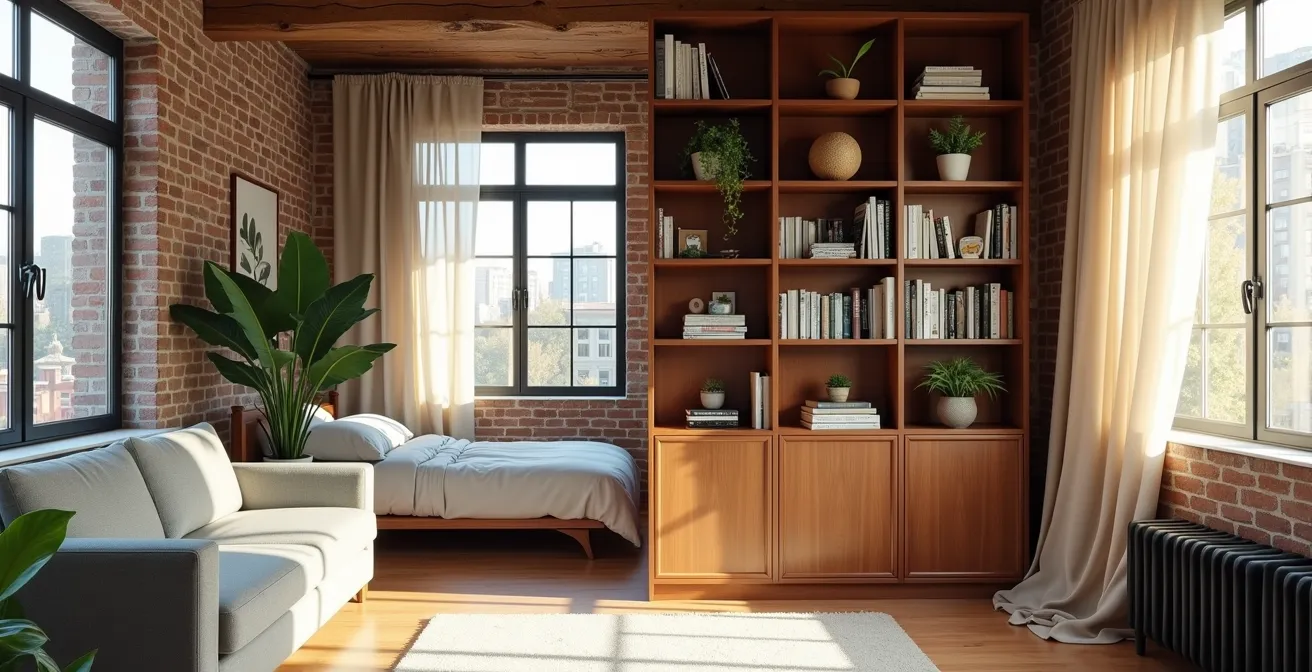
Creating true bedroom privacy in a loft is not about walls; it’s an act of spatial choreography that uses dividers, light, and texture to sculpt separate functional volumes within a single space.
- Effective division prioritizes acoustic and psychological separation over simple visual screening.
- Non-structural solutions like intelligent furniture, high-end textiles, and flooring transitions can create powerful, functional boundaries.
Recommendation: Shift your focus from “hiding the bed” to “crafting a sleep sanctuary” by managing sensory inputs like light, sound, and even airflow.
For couples sharing a studio loft, the open-concept dream can quickly become a compromise. The lack of separation between work, life, and rest creates a space that is functionally blended but psychologically draining. The constant visual presence of a work desk from the bed or the kitchen clatter echoing through the sleeping area blurs boundaries and erodes the sense of sanctuary a bedroom should provide. This challenge isn’t just about a lack of walls; it’s about a lack of distinct, purpose-driven zones.
The common advice often circles around simple, decorative solutions: a flimsy folding screen, a row of plants, or a basic bookshelf. While these might offer a visual break, they fail to address the deeper needs for acoustic dampening, light control, and true psychological separation. They are bandages on a spatial problem that requires a more architectural approach. The goal is not merely to hide the bed but to carve out a genuine, multi-sensory private volume within the larger loft.
But what if the key wasn’t in building barriers, but in orchestrating a sophisticated spatial choreography? This guide moves beyond the platitudes. We will explore how to manipulate light, sound, texture, and perception to construct a private bedroom that feels intentional, luxurious, and truly separate, all without a single permanent wall. It’s about understanding the science of separation and applying it with design intelligence.
This article provides a complete blueprint, examining everything from the cognitive impact of visual clutter to the acoustic properties of different materials. We will deconstruct common solutions to reveal what truly works, identify critical errors to avoid, and introduce advanced techniques for defining space. Follow this structured approach to transform your open loft into a harmoniously zoned home.
Summary: A Strategic Guide to Zoning Your Studio Loft
- Why Seeing Your Desk From Your Bed Ruins Your Sleep?
- Bookcase vs Wardrobe: Which Divider Blocks Sound Better?
- Curtains vs Sliding Panels: Which Looks Less Like a Hospital?
- The Partition Error That Blocks Airflow and Causes Mold
- Defining Spaces: Transitioning From Tile to Wood Without a Door
- Convertible vs Stackable Furniture: Which Saves More Space?
- Why Your Industrial Apartment Echoes Like a Parking Garage?
- How to Make a 500 Sq Ft Apartment Feel Twice as Big?
Why Seeing Your Desk From Your Bed Ruins Your Sleep?
The fundamental problem with a bed in sight of a workspace is not just aesthetic; it’s biological. Your brain forms powerful associations between environment and function. When your bed—a space for rest and intimacy—shares a visual field with your desk—a space for stress and cognitive labor—it sends conflicting signals. This constant visual cue prevents your mind from fully “clocking out,” leading to a state of low-grade cognitive arousal that interferes with the deep relaxation necessary for restorative sleep.
This issue is compounded by the physiological effects of light. The blue light emitted by screens is a well-known disruptor of our circadian rhythm. When your work setup is visible, the temptation to check one last email or the ambient glow from a monitor can have a significant impact. In fact, research published in Scientific Reports demonstrates that indoor light exposure before bed can suppress the onset of melatonin, the key sleep hormone, and shorten its duration by as much as 50%. Creating a physical barrier is therefore a non-negotiable first step in reclaiming your sleep cycle.
The goal is to create a “visual shutdown” that signals to your brain that the workday is over. This requires more than just willpower; it demands a spatial intervention. The ideal solution establishes a clear, opaque boundary that not only blocks the line of sight to your desk but also dims ambient light from the rest of the loft. By doing so, you are not just hiding clutter; you are curating a micro-environment—a sleep sanctuary—optimized for melatonin production and psychological peace. This is the foundational principle of sensory zoning: controlling what you see, hear, and feel to dictate the function of a space.
Bookcase vs Wardrobe: Which Divider Blocks Sound Better?
Once the need for a physical barrier is established, the next question is material. Bookcases are the default choice for loft dividers, but their acoustic performance is often misunderstood. A standard, open-backed bookshelf does very little to block sound. However, a bookcase filled with a dense, irregular collection of books can become an effective sound diffuser and absorber. The varied shapes and materials of the books scatter sound waves, while the paper itself absorbs mid-to-high frequency sounds. A wardrobe, on the other hand, presents a completely different acoustic profile.

A solid wardrobe acts as a mass-loaded barrier, reflecting some sound, but its true power is revealed when filled with soft materials. Clothing, linens, and textiles are excellent at absorbing a broad spectrum of sound frequencies. A densely packed wardrobe with its doors left slightly ajar or even removed can act as a surprisingly effective bass trap and sound absorber, significantly muffling conversations and ambient noise from the living area. The choice between the two is therefore a choice between diffusion and absorption.
Case Study: DIY Bookshelf Acoustic Treatment
An audio enthusiast documented their experiment using two-foot wide bookcases to treat their room’s acoustics. By filling the shelves with a scattered arrangement of books and strategically placed acoustic foam panels, they significantly improved bass control and the overall soundstage. The key finding was that books are more absorptive than diffusive, meaning a wall of books can “deaden” a space if not balanced with some reflective surfaces, highlighting the need for a mixed-material approach for optimal acoustic ecology.
To make an informed decision, you must assess your primary need. Is it to reduce echo and create a lively but controlled acoustic environment? A well-stocked bookcase is superior. Is it to maximize sound blocking and create a quiet, muffled sanctuary for sleep? A wardrobe filled with clothes is the clear winner.
This table summarizes the core acoustic differences, with data drawn from an analysis of everyday soundproofing materials.
| Feature | Bookcase (with books) | Wardrobe (with clothes) |
|---|---|---|
| Sound Absorption | Moderate – books absorb mid-high frequencies | High – soft clothes absorb broad spectrum |
| Sound Reflection | High – hard book surfaces reflect sound | Low – fabric materials minimize reflection |
| Best For | Creating diffusion, visual appeal | Maximum absorption, muffling conversations |
| Effectiveness | Better with acoustic backing material | Excellent when doors removed, exposing clothes |
Curtains vs Sliding Panels: Which Looks Less Like a Hospital?
Textile dividers like curtains are a versatile and cost-effective way to create privacy, but they carry a significant risk: the “hospital look.” This clinical aesthetic arises from specific, avoidable choices. Flimsy polyester fabrics, hung on sagging tension rods, and in sterile shades of white or beige, immediately evoke an institutional feel. To elevate a curtain divider to a piece of intentional architecture, the focus must be on materiality, mounting, and volume.
Sliding panels, often seen as a more modern alternative, offer a cleaner, more structured look. They operate on tracks and present a flat, taut surface. However, they can also feel impersonal and corporate if not handled with care. The key to a successful residential application for both curtains and panels lies in the details that signal “home” rather than “office” or “clinic.” This means choosing rich textures, warm colors, and robust hardware.
As one expert notes in an Apartment Therapy studio tour, the solution is about upgrading every component of the system.
The ‘hospital look’ comes from cheap polyester and flimsy tension rods. Heavy linen, velvet, or textured bouclé with ceiling-mounted tracks creates a high-end residential feel.
– Interior Design Expert, Apartment Therapy Studio Tour
Achieving this high-end feel involves a few key strategies. Firstly, ceiling-mounted tracks are non-negotiable. They make the divider look like an integrated part of the architecture, drawing the eye upward and making the ceiling feel higher. Secondly, fabric choice is paramount. Heavy, natural materials like linen, velvet, or a textured bouclé not only look more luxurious but also offer superior acoustic absorption. Finally, using two to three times the fabric width of the opening creates deep, rich folds that add a sense of permanence and substance. These small but critical details are what transform a simple curtain into a sophisticated act of volumetric division.
The Partition Error That Blocks Airflow and Causes Mold
In the quest for privacy, it’s easy to make a critical mistake: creating a completely sealed-off “room” with a floor-to-ceiling divider. While this might seem like the ultimate solution for visual and acoustic separation, it can create a dangerous microclimate. By blocking natural air circulation, you trap moisture from breathing and body heat, creating a pocket of stagnant, humid air. Ventilation studies show that such blocked circulation can increase localized humidity by 20-30%, creating the perfect breeding ground for mold and mildew.
This is especially problematic in lofts, which often rely on a single HVAC system designed for an open plan. A solid partition can block vents or return grilles, disrupting the entire system’s ability to heat, cool, and dehumidify the space evenly. The result is a bedroom that is stuffy, uncomfortable, and potentially unhealthy. The architectural solution is not to build a wall, but to use a partition that divides without isolating.
This means engineering “breathability” into your divider. This can be achieved in several ways. Using slatted wood panels, perforated metal screens, or even fabric dividers allows air to pass through while still providing a strong sense of visual separation. Another crucial technique is to leave intentional gaps. A space of a few inches at the top and bottom of a solid partition can be enough to allow for convective airflow, letting warm air rise and escape while cool air flows in at the bottom. This maintains the health of the building’s ecosystem while still achieving the desired privacy.
Your Partition Airflow Audit: 5 Points to Check
- Air Vents: Identify all HVAC vents, supplies, and returns. Ensure your divider will not block any of them.
- Material Porosity: Inventory the proposed divider material. Is it solid (glass, solid wood) or breathable (slatted wood, fabric, perforated panel)?
- Engineered Gaps: Confront your design. Have you planned for a 2-3 inch gap at both the floor and ceiling to encourage air circulation?
- Local Codes: Check local fire and building codes. Many jurisdictions have specific regulations about non-structural partitions that impede egress or ventilation.
- Integration Plan: Create a plan to use a “breathable” divider or modify a solid design to include necessary gaps before you build or buy.
Defining Spaces: Transitioning From Tile to Wood Without a Door
The most sophisticated zoning techniques are often the most subtle. Beyond vertical dividers, the floor itself offers a powerful canvas for creating separation. A change in flooring material acts as a psychological threshold, signaling a transition from one functional zone to another without any physical barrier. In a studio loft, transitioning from a durable, practical surface like tile in the kitchen/entry area to a warm, soft material like wood or carpet in the living/sleeping area creates an incredibly strong, albeit invisible, boundary.
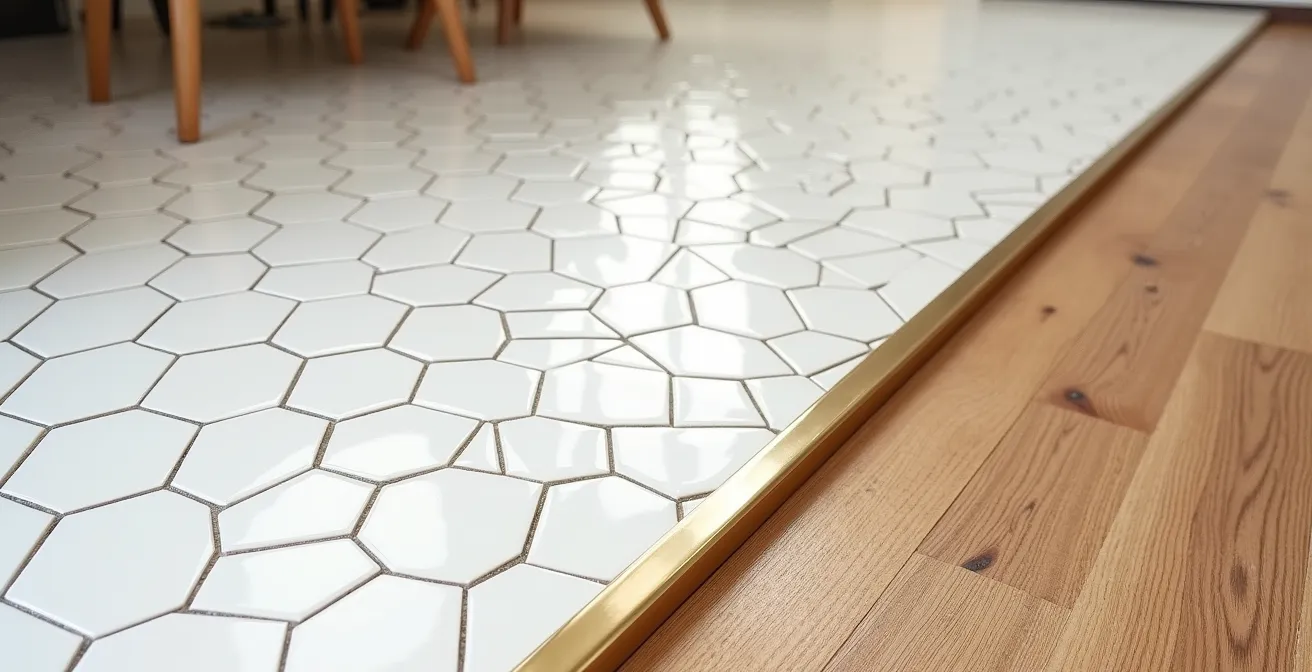
The execution of this transition is critical. A simple, straight line is effective, but more dynamic approaches can enhance the spatial choreography of the loft. A diagonal transition line, for example, can create longer sightlines and make the space feel less boxy and more expansive. An organic, curved transition or one where hexagonal tiles seem to “bleed” into the wood planks can become an artistic focal point in its own right.
The physical transition strip—the metal or wood piece that covers the seam—also plays a key role. Choosing a material that contrasts with both floors, like a thin brass or matte black bar, elevates the transition from a practical necessity to a deliberate design statement. It becomes a line drawn on the floor plan, consciously guiding both the eye and the foot.
Design Study: Visual Floor Transitions
A study of open-plan apartments on Houzz revealed the power of distinct flooring. The most successful designs used clear transition strips (often brass or black metal) to create powerful psychological boundaries. A key insight was that diagonal or curved transition lines were more effective than straight ones at making a space feel dynamic and less rigid, subtly directing foot traffic and breaking up the “box” of a standard studio layout.
Convertible vs Stackable Furniture: Which Saves More Space?
Furniture itself can be the most dynamic and intelligent room divider. The debate often falls between two philosophies: convertible and stackable. Convertible furniture offers active space saving—it transforms to serve multiple functions, like a Murphy bed that becomes a desk or a sofa that becomes a bed. Stackable furniture, such as nesting tables or stackable stools, offers passive space saving—its core function is to reduce its own footprint when not in use.
Convertible furniture is ideal for spaces where functions must radically change throughout the day. A single room can be an office by day and a bedroom by night. The trade-off is often a larger deployment footprint (a sofa bed needs significant clearance to open) and higher daily effort. Converting a heavy Murphy bed or sofa bed every day can become a chore. It’s a high-impact, high-effort solution.
Stackable furniture is a lower-effort, more consistent approach. It doesn’t change the primary function of the space, but it keeps it clear and flexible. Nesting tables can be expanded for guests and contracted for daily life. Stackable chairs can be stored away, leaving the floor plan open. This strategy is less about radical transformation and more about maintaining a constant state of minimalist readiness. The choice depends entirely on your lifestyle and tolerance for daily reconfiguration.
This comparison, based on a Redfin analysis of small-space solutions, clarifies the strategic differences.
| Aspect | Convertible Furniture | Stackable Furniture |
|---|---|---|
| Space Saved | Active (transforms function) | Passive (constant reduction) |
| Deployment Footprint | Can be larger when open | Minimal when in use |
| Daily Effort | High (heavy lifting/conversion) | Low (simple stacking) |
| Best For | Multi-function needs | Consistent space saving |
| Example | Murphy bed, sofa bed | Nesting tables, stackable stools |
Why Your Industrial Apartment Echoes Like a Parking Garage?
Industrial lofts, with their high ceilings, concrete floors, and exposed brick walls, are visually stunning but often acoustically hostile. These large, parallel, hard surfaces create an environment ripe for reverberation, or echo. Sound waves bounce between the walls, floor, and ceiling with little to absorb them, creating a long “reverberation time.” According to acoustic measurements, industrial spaces can have reverberation times of 2-3 seconds, compared to the comfortable 0.5 seconds of a well-furnished room. This is what creates that “parking garage” effect, making the space feel cold, loud, and public.
Simply adding a single room divider will not solve this systemic issue. Tackling the acoustic ecology of the entire loft requires a multi-layered strategy that introduces soft, absorptive surfaces at every level: floor, walls, and even in mid-air. This is not about soundproofing (blocking sound from entering or leaving) but sound treatment (controlling how sound behaves within the space).
The strategy involves deploying a variety of materials to absorb different frequencies. Large, thick area rugs are the first line of defense, absorbing reflections from the floor and taming low-frequency rumble. On the walls, traditional solutions like curtains and tapestries are effective, but more creative options like large, unframed canvas art or fabric-wrapped acoustic panels can be integrated as design elements. Even the strategic placement of a large, full bookcase against a parallel wall can work wonders to break up standing waves and eliminate “flutter echo.”
Case Study: Multi-Layer Acoustic Treatment
An Atlanta loft owner successfully reduced echo by over 70% using a layered approach. They started with a large area rug to absorb low frequencies. On the walls, they used a combination of canvas art and curtains to handle mid-range sounds, while decorative elements like macrame wall hangings and clusters of house-plants helped diffuse high-frequency chatter. Finally, the strategic placement of a tall bookcase served to break up the long, parallel walls, completely eliminating the distracting flutter echo that had plagued the space.
Key Takeaways
- True privacy is multi-sensory, requiring control over not just sight, but also sound and light.
- The most effective dividers are often not solid walls but intelligent systems like acoustically-optimized furniture or ceiling-mounted, high-quality textiles.
- Successful zoning is a balancing act; you must create separation without compromising critical building functions like airflow and ventilation.
How to Make a 500 Sq Ft Apartment Feel Twice as Big?
Once your loft is successfully zoned into functional areas, the final layer of spatial choreography is to maximize the perception of space. A small, well-defined area can feel more generous and luxurious than a large, undefined one. The key is to employ visual strategies that trick the eye, creating an illusion of depth, height, and light. These techniques work to erase visual boundaries and create long, uninterrupted sightlines.
One of the most powerful tools is the strategic use of mirrors. A large mirror placed opposite a window doesn’t just reflect the view; it multiplies the natural light and doubles the perceived depth of the room. In fact, interior design research shows that this specific placement can make a room appear up to 40% larger. The goal is to create a “virtual window” that extends the space beyond its physical confines.

Color and furniture choice are also critical. A monochromatic color scheme (using varying shades and tints of a single color) on walls, furniture, and textiles helps to blur the lines where one surface ends and another begins, making the space feel more cohesive and expansive. Furthermore, choosing furniture with exposed legs—sofas, consoles, and chairs “on stilts”—allows the eye to travel underneath, creating an unbroken view of the floor and enhancing the sense of flow and openness. These are not just decorative choices; they are calculated optical maneuvers designed to expand the perceived volume of the space.
Finally, emphasizing verticality is essential. By hanging curtains from floor to ceiling, even if the window itself is smaller, you draw the eye upward and create an illusion of greater height. The combination of these techniques—light multiplication, monochromatic palettes, elevated furniture, and vertical emphasis—can make a 500 sq ft zoned apartment feel far more spacious and breathable than its footprint would suggest.
Now that you have a comprehensive understanding of the principles of no-wall division, the next step is to apply them. Begin by auditing your own space: identify the primary sources of sensory disruption and choose the strategies that will have the most significant impact on your quality of life.