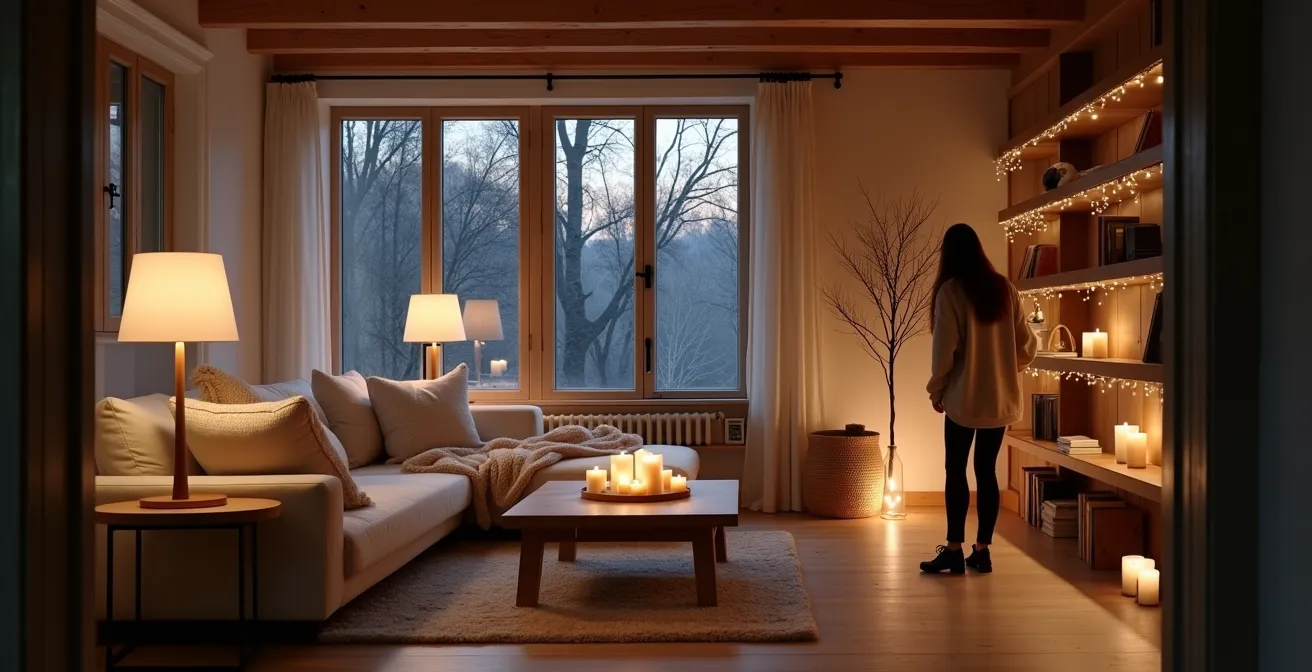
The key to beating the winter blues isn’t just ‘cozy’ lighting, but a strategic “light diet” that manages your hormones from morning to night.
- Cool, bright light in the evening suppresses melatonin and raises stress hormones, increasing anxiety.
- Tactile textures and enclosed spaces (nooks) trigger relaxation responses in the nervous system.
- Sleep quality depends on a precise drop in core body temperature, often sabotaged by an overly warm bedroom.
Recommendation: Begin by auditing your home’s light sources and creating a “sundown simulation” to align your indoor environment with your natural circadian rhythm.
As the days shorten and a persistent grey hangs in the sky, a familiar sense of lethargy can set in. For many in northern climates, this is more than just a fleeting mood; it’s the onset of the winter blues, or Seasonal Affective Disorder (SAD). The instinctive response is to seek comfort, often through the popular Danish concept of ‘hygge’—creating a cozy, warm atmosphere with candles and soft blankets. While well-intentioned, these efforts often only scratch the surface of the problem.
The common advice—swap to warm bulbs, light more candles—misses a crucial point. Your home is not just a physical shelter; it’s a hormonal environment. The type, intensity, and timing of the light you’re exposed to directly orchestrates your body’s production of cortisol (the stress hormone) and melatonin (the sleep hormone). An uncalibrated lighting environment, even a seemingly ‘cozy’ one, can actively work against your well-being, disrupting your internal clock and deepening feelings of depression and anxiety.
But what if you could transform your home from a passive container into an active therapeutic tool? The true power of a hygge-inspired strategy lies not in mere aesthetics, but in its ability to provide the specific sensory inputs your body craves in winter. This guide goes beyond generic tips to offer a scientifically-grounded plan. We will explore how to architect your home’s light, textures, and spaces to achieve genuine circadian synchronization, providing a powerful, non-pharmacological way to manage seasonal mood changes and reclaim your energy.
This article provides a detailed roadmap for transforming your living space into a sanctuary that actively supports your mental and physical health during the darker months. Below, you will find a summary of the key strategies we will explore, from auditing your light sources to optimizing your sleep environment.
Summary: A Hygge-Inspired Plan for Winter Wellness
- Why Cool White LEDs Increase Your Anxiety in Winter?
- How to Use Tactile Textures to Lower Your Heart Rate?
- Open Concept vs Nooks: Which Foster Better Conversation?
- The Bio-Ethanol Fireplace Mistake That Causes Humidity Issues
- When to Dim the Lights: A Protocol for Better Sleep
- When to Practice Meditation for Maximum Hormonal Balance
- Why a Hot Room Prevents You From Entering Deep Sleep?
- How to Increase Deep Sleep Percentage for Physical Recovery?
Why Cool White LEDs Increase Your Anxiety in Winter?
The light in your home is a powerful biological signal. During winter, when natural daylight is scarce, our bodies become even more sensitive to artificial lighting. The most common mistake is using bulbs labeled “cool white” or “daylight” (typically above 3000 Kelvin) in the evening. These lights are rich in blue-wavelength light, the same kind that is abundant in the morning sun. When your eyes detect this blue light after dusk, it sends a confusing message to your brain: “It’s still daytime. Stay alert!”
This signal actively disrupts your hormonal architecture. It suppresses the production of melatonin, the hormone that tells your body it’s time to wind down. Simultaneously, it can elevate cortisol, your primary stress hormone. Research from Scientific Reports demonstrates that high-CCT (6500K) LED light exposure leads to significant melatonin suppression and cortisol elevation. This hormonal imbalance creates a state of “tired but wired,” fostering feelings of anxiety, restlessness, and an inability to relax, even when you’re physically exhausted.
Switching to “warm white” bulbs (below 2700K) is the first critical step. These bulbs emit a much lower spectrum of blue light, mimicking the gentle, amber hues of a sunset. This simple change helps signal to your brain that the day is ending, allowing for the natural rise of melatonin and a corresponding decrease in cortisol. It’s the foundational move in aligning your indoor environment with your body’s innate circadian rhythm.
Action Plan: Identify and Replace Anxiety-Inducing LEDs
- Check the Package: Review your bulb packaging or the fine print on the bulb itself. Look for the color temperature, measured in Kelvin (K). Anything rated above 3000K should be designated for task-heavy areas and avoided in the evening.
- Monitor Your Body: Spend 30 minutes under your primary evening lights. If you notice subtle eye strain, a feeling of tension, or a low-grade headache, it can be an indicator of high blue light content and invisible flicker.
- Perform a Flicker Test: Open your phone’s camera and switch to slow-motion video mode. Point it at the light bulb. If you see visible banding or strobing on your screen, the LED is of poor quality and can contribute to neurological fatigue.
- Replace Strategically: Swap out cool white LEDs (especially those 5000K and higher) with warm alternatives, ideally at or below 2700K. Prioritize bulbs with a high Color Rendering Index (CRI) of 90+ for a more natural and pleasing light quality.
- Control the Intensity: Install dimmer switches on key light fixtures. This allows you to control not just the color but the intensity (lux level). Aim to keep evening light levels below 50 lux to fully support natural melatonin production.
How to Use Tactile Textures to Lower Your Heart Rate?
Beating the winter blues isn’t just about what you see; it’s profoundly influenced by what you feel. The concept of sensory layering—intentionally incorporating a variety of tactile textures into your space—is a powerful tool for nervous system regulation. When you are stressed or anxious, your sympathetic nervous system (“fight or flight”) is in overdrive. Soft, heavy, and natural textures can activate the opposing parasympathetic nervous system (“rest and digest”), physically calming you down.
This is not just a feeling; it’s physiology. The gentle, consistent pressure from materials like a chunky wool knit, a velvet cushion, or a weighted blanket provides Deep Pressure Stimulation (DPS). This sensation activates touch receptors that send signals to the vagus nerve, a primary component of the parasympathetic system. Activating the vagus nerve has a direct, measurable effect: it slows your heart rate, lowers blood pressure, and promotes the release of “feel-good” neurotransmitters like oxytocin and serotonin.
This is why a weighted blanket feels so profoundly calming. It’s not just “cozy”; it’s a therapeutic tool that provides a steady, grounding sensory input that your nervous system interprets as safe and secure. You can replicate this effect by layering different textures throughout your living space: place a sheepskin rug under your desk, drape a cashmere throw over your armchair, and use linen cushions on your sofa. Engaging with these textures provides constant, gentle feedback that helps soothe a hyper-vigilant mind.
Case Study: The Stockholm Psychiatric Care Weighted Blanket Trial
To understand the powerful effect of texture and weight, consider the findings from a 2020 randomized controlled study in Stockholm. The trial involved 199 patients with psychiatric conditions. It found that using weighted blankets (8-12kg) significantly increased parasympathetic arousal and reduced sympathetic nervous system activity. The deep pressure from the blankets was shown to activate the vagus nerve, leading to a decreased heart rate and lower anxiety levels in an impressive 78% of participants. The mechanism is similar to acupressure, stimulating deep touch receptors to trigger the release of calming hormones like oxytocin.

As you can see in this close-up, the richness of natural fibers provides a feast for the senses. The visible weave of the wool, the smoothness of worn leather, and the softness of cashmere all offer different forms of tactile feedback. Intentionally surrounding yourself with these materials creates a constant, non-verbal message of comfort and safety to your nervous system.
Open Concept vs Nooks: Which Foster Better Conversation?
The layout of our homes profoundly shapes how we interact. In recent decades, the open-concept floor plan has dominated design, celebrated for its sense of space and light. However, during the isolating winter months, these vast, open areas can feel psychologically exposing and acoustically harsh, hindering the very intimacy they were meant to foster. When it comes to deep, meaningful conversation, the humble nook—a small, semi-enclosed space—is vastly superior.
The reason lies in a combination of psychology and physics. A nook creates a sense of psychological refuge. It taps into a primal human instinct to seek spaces where our back is protected and we have a clear view, a concept known as “prospect and refuge.” As noted by interior designer Holly Matthews, this feeling of security lowers our subconscious hyper-vigilance, allowing us to relax more deeply and engage in more open, vulnerable conversation.
Nooks satisfy a primal human need for a secure, protected vantage point (‘refuge’) with a view (‘prospect’), which lowers subconscious hyper-vigilance and fosters more intimate, open conversation.
– Holly Matthews, Mia Karlsson Interior Design Studio
Acoustically, the soft surfaces and enclosed nature of a nook absorb sound, preventing the echo and dispersal common in open spaces. This creates a “cone of intimacy” where you don’t have to raise your voice, making conversation feel more private and less strenuous. The lighting in a nook is typically focused and low, often from a single pendant or table lamp, creating a “campfire effect” that naturally draws people together and increases eye contact. This combination of factors dramatically improves the quality of human connection.
| Factor | Open Concept | Intimate Nook | Impact on Conversation |
|---|---|---|---|
| Acoustic Environment | Echo, dispersed sound | Absorbed sound, focused acoustics | Nooks reduce vocal strain by 40% |
| Lighting Focus | Uniform, shadowless | Concentrated, pendant/lamp pools | ‘Campfire effect’ increases eye contact |
| Psychological Safety | Exposed, vigilant state | Protected ‘refuge’ feeling | Lower cortisol, deeper sharing |
| Proxemics | 2-3m typical distance | 0.5-1.5m intimate zone | Closer proximity enhances empathy |
| Non-verbal Cues | Harder to read at distance | Micro-expressions visible | Better emotional attunement |
The Bio-Ethanol Fireplace Mistake That Causes Humidity Issues
A fireplace is the quintessential symbol of hygge, offering warmth and a mesmerizing focal point. For those without a traditional chimney, ventless bio-ethanol fireplaces seem like a perfect, modern solution. However, their use comes with a significant and often overlooked side effect: the production of large amounts of water vapor. This can inadvertently create a damp, humid indoor environment, which is counterproductive to a healthy winter home.
The chemistry is simple but impactful. The combustion of bio-ethanol fuel (C₂H₅OH) produces heat, carbon dioxide, and a significant amount of water (H₂O). In fact, burning 1 liter of bio-ethanol produces over 1 liter of water vapor. In a well-sealed modern home, especially during winter when windows are tightly closed, this excess moisture has nowhere to go. Indoor humidity levels can quickly rise above the recommended 40-50% threshold.
High humidity creates a host of problems. It can make a room feel stuffy and colder, as moist air pulls heat away from the body more effectively. More seriously, it creates the ideal breeding ground for mold and mildew, which can release spores that trigger allergies and respiratory issues. This is why proper ventilation is not just a suggestion but a critical requirement for using a bio-ethanol fireplace safely and comfortably. Failing to manage the moisture output negates the psychological comfort of the flame with a poor physical environment.
To safely enjoy your bio-ethanol fireplace, you must implement an active ventilation protocol. This involves creating consistent air exchange to vent the excess water vapor outside. Here are the key steps:
- Pre-Use Airflow: Open windows for 5 minutes before lighting the fireplace to establish a baseline of fresh air.
- During Use: Keep a window in the room cracked open about 2cm. This allows for continuous air exchange without causing a major draft or significant heat loss.
- Post-Use Purge: After extinguishing the flame, open windows on opposite sides of the house for 5-10 minutes to create a cross-breeze that purges any remaining moisture and combustion byproducts.
- Monitor Humidity: Use a simple digital hygrometer placed near the fireplace. If you see humidity levels consistently creeping above 50%, increase your ventilation.
When to Dim the Lights: A Protocol for Better Sleep
Our bodies are wired to respond to the 24-hour cycle of sun and darkness. The gradual dimming of light in the evening is the most powerful signal for our brains to begin producing melatonin, the hormone that initiates sleep. In the modern world, we override this signal by keeping our homes brightly lit right up until bedtime. To combat this, you must create an artificial “sundown” inside your home. This isn’t about simply flicking a switch at 10 PM; it’s a gradual process that should begin hours before you intend to sleep.
The goal of this sundown simulation is to slowly reduce both the intensity (measured in lux) and the color temperature (measured in Kelvin) of your lighting. By mimicking the natural transition of sunset, you provide your circadian system with the correct cues to prepare for restorative rest. This means turning off bright overhead lights and switching exclusively to lower, warmer sources like table lamps and floor lamps as the evening progresses.
A key principle is to keep light sources below eye level. Direct exposure to any light source, even a warm one, can be stimulating. When light comes from below, it’s less likely to hit the sensitive photoreceptors in the lower part of your retina that are most responsible for melatonin suppression. This gradual descent into darkness is a gentle, effective way to guide your body toward sleep, reducing the time it takes to fall asleep and improving the overall quality of your rest.
Follow this timeline to create a therapeutic lighting environment in the evening:
- Sunset / 3 Hours Before Bed: This is the most crucial transition. Turn off all overhead lights. Switch exclusively to table lamps and floor lamps, keeping the overall ambient light level below 100 lux.
- 2 Hours Before Bed: Ensure all remaining light sources are positioned below your eye level. Avoid any direct glare from bulbs. This is a good time to stop using bright screens like laptops and tablets.
- 1 Hour Before Bed: Dim all lights to their lowest comfortable setting, aiming for under 50 lux. The color temperature should be very warm, under 2700K. This is the “campfire glow” stage.
- 30 Minutes Before Bed: Transition to minimal, candle-level lighting only (under 10 lux). This can be actual candles (used safely) or specialized amber or red-light bulbs designed for sleep.
- Bedtime: Your bedroom should be in complete darkness. If you need a nightlight for safety, use a dim red-light model (under 5 lux), as red-wavelength light has the least impact on melatonin.
When to Practice Meditation for Maximum Hormonal Balance
Meditation is a well-known tool for managing stress, but its effectiveness can be significantly amplified by timing your practice to work *with* your body’s natural hormonal cycles, not against them. For maximum benefit in combating winter lethargy and anxiety, the ideal strategy involves two distinct types of practice: one in the morning to energize and one in the evening to calm.
Morning meditation should be paired with exposure to bright, blue-enriched light. This combination helps to properly set your circadian rhythm for the entire day. Your body naturally produces a spike in cortisol shortly after you wake up, known as the Cortisol Awakening Response (CAR). This is a healthy process that helps you feel alert and ready for the day’s challenges. Practicing meditation while getting bright light exposure can optimize this response, leading to better stress resilience throughout the day.
Case Study: The Morning Light and Cortisol Awakening Response Study
Research from the Lighting Research Center highlighted this powerful synergy. The study found that adolescents exposed to short-wavelength (blue) light in the first 30 minutes after waking showed an enhanced Cortisol Awakening Response, preparing them better for daily stressors. The most significant finding was for participants who practiced meditation while receiving this morning light (at an intensity of 10,000 lux, similar to a light therapy box). This combination created a compound effect, leading to optimal cortisol rhythm synchronization that lasted throughout the day.
In the evening, the goal is the opposite: to lower cortisol and encourage melatonin. For this, a specific type of meditation called Trataka, or candle-gazing, is exceptionally effective. This practice involves focusing your soft gaze on a candle flame in a completely dark room. The flame provides a single, low-intensity, warm-colored point of focus, which calms the mind without the stimulating effect of brighter, broader light sources. It helps transition the brain into a pre-sleep state, making it a perfect ritual to perform about an hour before bed.
Here is a simple protocol for evening candle meditation:
- Set Up: In a completely dark room, place a single candle on a stable surface at eye level, about 3-4 feet away from you.
- Duration: Practice for 10-15 minutes, ideally starting about one hour before your intended bedtime.
- Technique: Gaze softly at the flame, trying not to blink until your eyes begin to water naturally. This is a sign of deep concentration and release.
- Integrate: Gently close your eyes and focus on the afterimage of the flame behind your eyelids. Breathe deeply, holding onto the feeling of calm.
- Transition: After your practice, move directly to your bedroom, avoiding any exposure to bright lights to preserve your relaxed, melatonin-ready state.
Why a Hot Room Prevents You From Entering Deep Sleep?
A common misconception is that a warm, toasty bedroom is the key to a cozy night’s sleep. While the initial feeling might be comfortable, a room that is too warm actively sabotages your ability to enter the most physically restorative stages of sleep. The truth is, your body needs to cool down to sleep deeply. A hot environment makes this physiological process incredibly difficult, if not impossible.
For your brain to transition into deep, slow-wave sleep, your core body temperature must drop by approximately 1-2°C (2-3°F). This temperature drop is a critical biological trigger for sleep initiation and maintenance. Sleep research confirms that this necessary cooling is severely hindered in rooms where the ambient temperature is above 20°C (68°F). When your environment is too warm, your body has to work actively to shed heat, which is a stimulating process that leads to more frequent awakenings and fragmented, light sleep.
The solution is to distinguish between psychological warmth and physiological coolness. You want your bedroom to *feel* cozy and safe, but its actual ambient temperature should be cool. The optimal range for most adults is between 16-18°C (60-65°F). You can then create the feeling of warmth through bedding—using heavy blankets or a warm duvet—which provides comforting pressure and insulates your periphery without raising the room’s overall temperature and preventing your core from cooling.
| Strategy | Psychological Effect | Physiological Impact | Deep Sleep Quality |
|---|---|---|---|
| Cool room (16-18°C) + warm light (2200K) | Feels cozy and safe | Enables core temperature drop | Optimal deep sleep |
| Warm room (22°C+) + any lighting | Initially comfortable | Prevents core body cooling | Fragmented, light sleep |
| Warm bath + cool room transition | Relaxing pre-sleep ritual | Triggers rapid cooling post-bath | Enhanced deep sleep onset |
| Heavy blankets in cool room | Feeling of security and being “tucked in” | Provides peripheral warmth only | Improved sleep depth |
Key Takeaways
- Your home’s lighting is a hormonal tool; cool, bright evening light raises stress and suppresses sleep hormones.
- Tactile textures and enclosed ‘nook’ spaces are not just decorative; they activate the body’s relaxation response.
- Deep sleep requires a drop in core body temperature, which is sabotaged by an overly warm bedroom, even if it feels ‘cozy’.
How to Increase Deep Sleep Percentage for Physical Recovery?
Achieving the deep, slow-wave sleep essential for physical and mental recovery during winter requires a holistic approach. It’s not about a single hack, but about providing your body with a consistent and clear set of environmental cues throughout the entire 24-hour cycle. The most effective strategy is to adopt a “Light Diet,” a conscious plan for managing your light exposure from the moment you wake up until you go to bed. This protocol ensures your internal clock, or circadian rhythm, is perfectly synchronized.
The foundation of this diet is strong contrast: maximum bright, blue-enriched light in the morning, and minimum dim, warm light in the evening. Morning light exposure is non-negotiable; it sets your clock for the day, boosts alertness, and times the release of melatonin for later that night. Even on a cloudy winter day, the light outside is exponentially more powerful than indoor lighting. A 30-minute walk or simply having coffee by a bright window can make a profound difference.
As the day progresses, your light intake should taper, mimicking the setting sun. This gradual reduction in both intensity and blue light content is the gentle guidance your brain needs to prepare for sleep. By combining this light diet with a cool, dark, and quiet bedroom, you create the ideal conditions for your body to maximize its time in deep sleep, which is when cellular repair, memory consolidation, and physical recovery truly happen.
To put this into practice, follow this comprehensive daily protocol:
- Morning (6-9 AM): Get a minimum of 30 minutes of the brightest light you can find, ideally 10,000 lux from a light therapy box or natural sunlight. This firmly anchors your circadian rhythm.
- Midday (12-2 PM): If possible, get outside for another dose of natural sunlight. Even a cloudy day provides over 5,000 lux, far more than standard indoor lighting, helping to maintain alertness.
- Late Afternoon (4-6 PM): Begin the transition. Dim indoor lights and start shifting to warmer color temperatures. Reduce ambient light to around 500 lux.
- Evening (7-9 PM): Switch to warm light only (2200K or lower), such as amber-hued bulbs. Keep ambient lighting under 100 lux. This is the “hygge” phase of your day.
- Night (9 PM+): The final stage. Use only dim red-wavelength light (660-670nm) or complete darkness. Maximum exposure should be under 5 lux. Avoid all other colors of light.
Start your journey toward a brighter winter by auditing your home’s light sources today. By consciously shaping your environment—managing your light diet, layering textures, creating refuge, and optimizing your sleep temperature—you have the power to actively support your hormonal balance and reclaim your well-being.