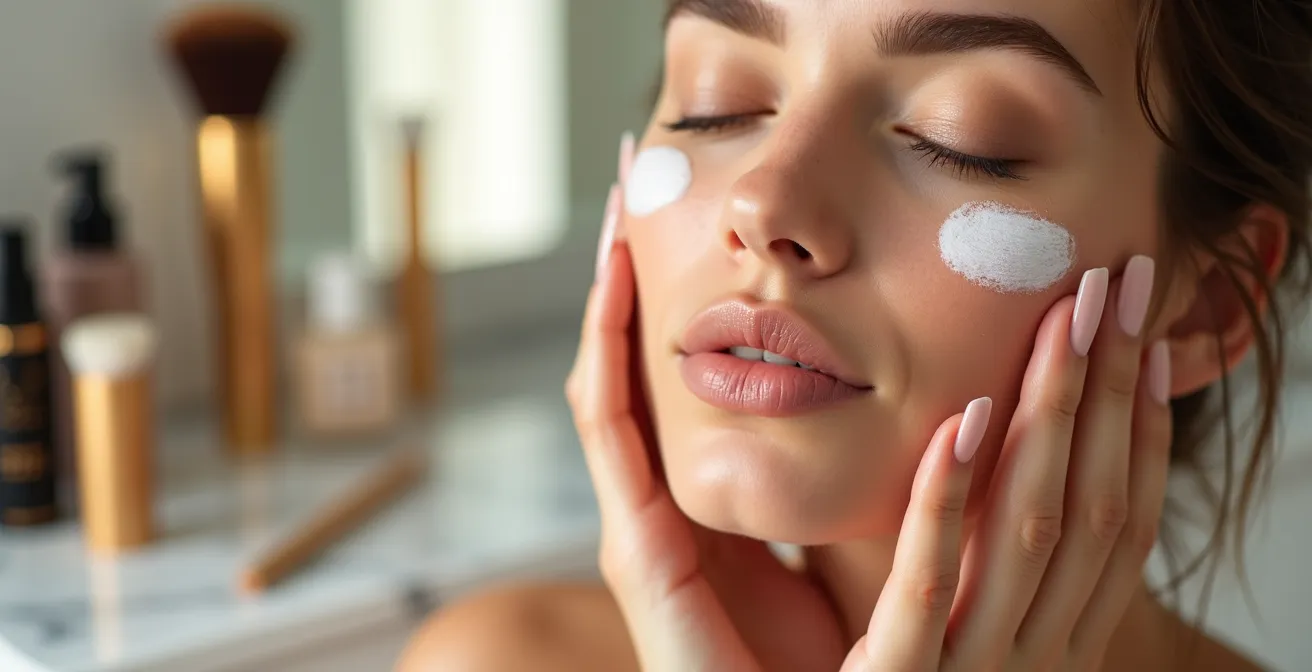
The frustrating pilling of sunscreen under makeup is not a product flaw, but a preventable chemistry problem caused by incompatible layers and incorrect application.
- Pilling happens when products with different bases (e.g., oil vs. water) or pH levels (e.g., acids vs. minerals) are layered too quickly, causing them to repel each other.
- Proper application—allowing full absorption and patting instead of rubbing—is crucial for creating a stable, even film that won’t break apart.
Recommendation: Audit your skincare routine for ingredient clashes, allow at least 60-90 seconds between each layer, and apply sunscreen by gently patting it into the skin to create a perfect, pill-proof canvas.
We’ve all been there. You meticulously apply your serums and moisturizer, follow up with a generous layer of sunscreen for that vital anti-aging protection, and then, the moment of truth: you start blending your foundation, and it all falls apart. Tiny, frustrating balls of product appear, ruining your smooth canvas and making you question the entire process. For many makeup wearers who care about preventing photo-aging, this pilling is the number one reason they’re tempted to skip SPF, a choice that leaves skin vulnerable.
The common advice is often generic: “wait longer” or “use less product.” But these tips miss the fundamental issue. The secret to a flawless, pill-proof application isn’t just about patience; it’s about understanding the science of what’s happening on your skin. Think of your routine not as a series of steps, but as a recipe. When the ingredients don’t mix, the recipe fails. Pilling is simply a sign of formula incompatibility or a breakdown in what we call film-forming integrity.
But what if you could become a master of your own skincare recipe? What if, instead of fighting with your products, you could make them work in perfect harmony? This guide will move beyond the basics and dive into the chemistry of layering. We will explore why broad-spectrum protection is non-negotiable, how to measure the correct dose without causing a mess, and how the very ingredients in your skincare can make or break your SPF application. By understanding the *why* behind the pilling, you’ll gain the power to stop it for good, ensuring your skin is both beautifully made up and fully protected.
This article will provide a clear, step-by-step roadmap to achieving a seamless, long-lasting finish. We’ll cover everything from application science to the critical role of your skin’s own barrier function. Let’s build your perfect, pill-proof routine together.
Summary: How to Apply Sunscreen Under Makeup Without Pilling?
- Why You Need Broad Spectrum to Prevent Wrinkles (Not Just Burns)?
- How to Measure the ‘Two Finger Rule’ for Face Protection?
- Chemical vs Mineral SPF: Which Is Better for Sensitive Eyes?
- The UVA Danger That Penetrates Clouds and Windows
- Optimizing Reapplication: Sprays vs Powders for Mid-Day Touch-Ups
- The Acid Mistake That Destroys Your Acid Mantle
- The Early Detection Gap That Increases Cancer Treatment Costs by 400%
- Chemical Peel vs Laser: Which Is Best for Acne Scars?
Why You Need Broad Spectrum to Prevent Wrinkles (Not Just Burns)?
The first step in committing to daily sunscreen is understanding what you’re truly fighting against. Many people associate SPF with preventing sunburns, which are caused by UVB rays. While important, this is only half the story. The silent aging of your skin—fine lines, wrinkles, and loss of elasticity—is primarily driven by UVA rays. These longer-wavelength rays penetrate deeper into the skin, degrading collagen and elastin over time. This is why a “Broad Spectrum” label is non-negotiable; it signifies protection against both UVA and UVB radiation.
However, this protection is only effective if the sunscreen forms an even, unbroken shield across your skin. This is the concept of film-forming integrity. When you aggressively rub in your sunscreen, or layer products on top of it too quickly, you disrupt this delicate film before it has a chance to set. This not only leads to pilling but also creates microscopic gaps in your sun protection, leaving you vulnerable to UVA damage even if you can’t see it.
Achieving this even film is an art of patience and technique. Instead of thinking of it as another skincare step to rush through, treat it like applying a primer. You’re creating a base that needs to be perfect. The goal is a uniform layer that feels integrated with your skin, not a thick coating sitting on top. This is the foundational secret to ensuring your makeup applies smoothly and your skin stays protected from premature aging.
- Step 1: Pat sunscreen gently into skin rather than rubbing to maintain even film formation.
- Step 2: Wait a full 60-90 seconds for the sunscreen film to set before applying makeup.
- Step 3: Focus on high-exposure zones (cheeks, nose, forehead) with the full amount, using slightly less in movement-prone areas like around the mouth to prevent creasing.
Mastering this gentle application is the first victory in the war against pilling and, more importantly, against wrinkles.
How to Measure the ‘Two Finger Rule’ for Face Protection?
One of the most common pieces of advice that leads to pilling is the vague instruction to “use less product.” While applying too much can indeed cause issues, applying too little renders your sunscreen ineffective, drastically reducing the labeled SPF value. The expert-approved standard for the face and neck is the “Two-Finger Rule”: dispensing a line of sunscreen along the length of your index and middle fingers. This provides the 2 milligrams per square centimeter of skin used during SPF testing, ensuring you get the protection you’re promised.
But what if your sunscreen is a watery fluid, or a thick mineral cream? The “Two-Finger Rule” is a brilliant guideline, but its success depends on understanding product viscosity. A thin, fluid SPF will spread more easily, while a heavy cream provides more coverage with a smaller-looking amount. The key is not to abandon the rule, but to adapt it with precision. The goal is always to apply the correct volume—roughly 1/4 teaspoon for the face alone—and adjust the finger measurement based on the product’s texture.
This is where dosage precision becomes critical. You might only need 1.5 fingers of a thick cream to get the same volume as 2 full fingers of a watery lotion. Applying this measured dose in thin, even layers is also far more effective than trying to slather it all on at once. This layering technique gives each application a moment to begin setting, significantly improving absorption and reducing the likelihood of a pilling disaster when you apply your foundation.
| Sunscreen Type | Two-Finger Equivalent | Actual Volume | Wait Time Between Layers |
|---|---|---|---|
| Watery/Fluid SPF | 2 full fingers | ~1.25ml | 60 seconds |
| Lightweight Lotion | 1.75 fingers | ~1.25ml | 90 seconds |
| Thick Mineral Cream | 1.5 fingers | ~1.25ml | 2 minutes |
By treating sunscreen application with this level of accuracy, you ensure maximum protection without overloading the skin, setting the stage for a flawless makeup look.
Chemical vs Mineral SPF: Which Is Better for Sensitive Eyes?
The choice between chemical and mineral sunscreen isn’t just a matter of preference; it’s a strategic decision that directly impacts both application and performance, especially around the delicate eye area. Mineral sunscreens, which use zinc oxide and titanium dioxide, work by forming a physical barrier that sits on the skin’s surface to reflect UV rays. Chemical sunscreens, with ingredients like avobenzone and octocrylene, are absorbed into the skin and convert UV radiation into heat.
This fundamental difference is key to understanding pilling and sensitivity. As board-certified dermatologist Dr. Macrene Alexiades notes, “Mineral sunscreens lay on the surface of the skin and can lead to pilling—especially when excessively rubbed, whereas chemical formulas are absorbed into the skin.” Because they don’t fully absorb, mineral formulas are more prone to pilling if over-manipulated. However, this same quality makes them far less likely to migrate into the eyes and cause stinging, a common complaint with chemical filters. For this reason, mineral formulas are often the superior choice for the sensitive eye area.
The solution for many makeup wearers is a hybrid approach: using a gentle mineral sunscreen (often in a stick format for precision) around the orbital bone, and a lightweight, fast-absorbing chemical sunscreen for the rest of the face. When applying around the eyes, the “pat, don’t rub” rule is paramount. Use your ring finger to gently tap the product onto the skin, avoiding any dragging motions that could disturb the product and lead to both pilling and irritation.
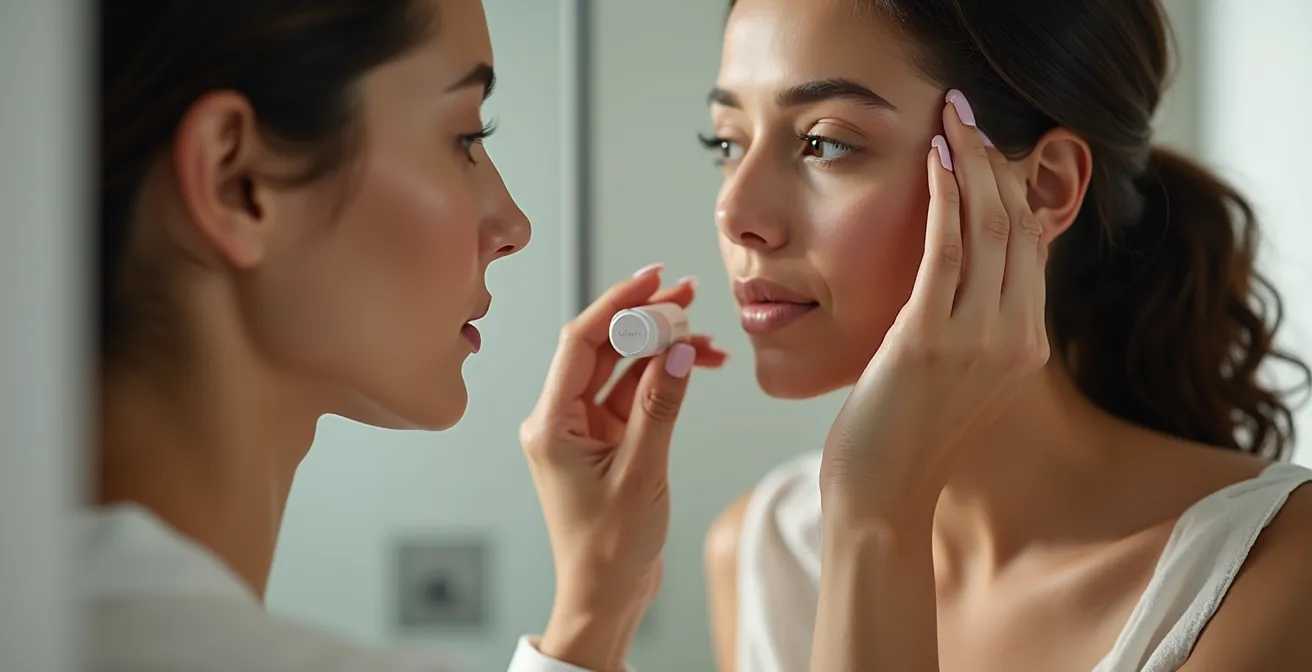
As you can see, the application requires care and precision. This targeted approach leverages the strengths of each sunscreen type, providing comfortable, effective protection without compromising your eye comfort or your makeup finish. It turns the choice from “either/or” into a smart, customized strategy.
By tailoring your sunscreen choice to different facial zones, you can prevent both stinging eyes and pilling around them.
The UVA Danger That Penetrates Clouds and Windows
A common misconception is that sunscreen is only for sunny days at the beach. This dangerous belief ignores the persistent nature of UVA rays, the primary driver of photo-aging. Unlike UVB rays, which are largely blocked by clouds, UVA radiation is present with relatively equal intensity during all daylight hours, year-round, and can easily penetrate cloud cover. This means your skin is exposed to its collagen-degrading effects on overcast days, during your morning commute, and even while you’re indoors.
The most overlooked threat is exposure through glass. Whether you’re driving your car or sitting near a window in your office or home, you are not safe from UVA rays. Studies have confirmed that more than 50% of UVA rays can penetrate glass windows, silently contributing to wrinkles, dark spots, and loss of firmness on the exposed side of your face over years. This is why dermatologists often observe more signs of aging on the left side of the face in countries where the driver’s seat is on the left.
This reality makes daily sunscreen application a non-negotiable part of any anti-aging strategy, not just a vacation accessory. The protection must be as routine as brushing your teeth. Pilling can undermine this daily defense by creating an uneven shield, leaving skin vulnerable to this invisible onslaught. A smooth, well-applied sunscreen ensures that your indoor and outdoor hours are equally protected, safeguarding your long-term skin health and appearance against the relentless exposure to UVA radiation.
Making peace with your sunscreen and learning to apply it flawlessly under makeup is therefore not just a cosmetic goal, but a critical health habit.
Optimizing Reapplication: Sprays vs Powders for Mid-Day Touch-Ups
Sunscreen is not a “one and done” application. Its protection degrades over time, especially with sun exposure, sweating, and the natural oils your skin produces. The official recommendation is to reapply every two hours, but for makeup wearers, this poses a significant challenge. How do you reapply without destroying the carefully crafted makeup you applied hours earlier? The answer lies in choosing the right product and mastering the right technique.
Two main options dominate the reapplication market: SPF sprays and powders. Powders, often mineral-based with a brush applicator, are excellent for mattifying and adding a sheer layer of protection. Their main drawback is that it’s difficult to know if you’ve applied enough for adequate coverage. Sprays offer broader, more reliable coverage but can disrupt makeup if applied incorrectly. The pro move is to never spray an SPF mist directly onto your face. This leads to an uneven application and can make your makeup run.
Instead, the key to a seamless reapplication is using a tool. Before adding more product, gently blot any excess oil from your face with blotting papers. This creates a fresh canvas. For a spray SPF, spray it generously onto a makeup sponge or a cushion puff first, then gently press and roll it onto your skin over your makeup. This technique deposits an even layer of sunscreen without disturbing the foundation underneath. For a powder SPF, use a light dusting motion, focusing on the T-zone, and avoid any harsh rubbing that could cause the powder to mix with your foundation and create a paste.

These methods transform reapplication from a dreaded chore into a simple touch-up. Using tools like a sponge allows for precision and control, ensuring your protection is reinforced while your makeup stays flawless. SPF-infused cushion compacts also offer an elegant and highly effective all-in-one solution for this mid-day refresh.
With the right protocol, you can maintain both your sun protection and your confidence throughout the day.
The Acid Mistake That Destroys Your Acid Mantle
If you’ve tried all the application tricks and your sunscreen still pills, the culprit may lie deeper in your routine: a clash of chemistry. Your skin is protected by a delicate, slightly acidic film called the acid mantle, which has a natural pH of around 4.7 to 5.75. This barrier is crucial for keeping skin hydrated and healthy. When it’s compromised, products don’t absorb properly, causing them to sit on the surface and ball up with friction. This is where formula incompatibility becomes a major issue.
The most common pilling-inducing mistake is layering products with conflicting pH levels. For example, many Vitamin C serums (L-ascorbic acid) are formulated at a very low pH (around 3.5) to remain stable and effective. If you immediately apply a mineral sunscreen, which has a much higher, more alkaline pH, you can trigger a chemical reaction. Skincare chemistry research shows that low-pH acids combined with higher-pH minerals can cause immediate product destabilization, leading directly to pilling.
Another clash occurs between product bases. Layering a water-based serum or moisturizer under a heavy, silicone-based primer or sunscreen without adequate wait time is a recipe for disaster. Like oil and water, they repel each other, and the friction from your fingers or a brush will cause the top layer to roll right off. An analysis of user experiences confirms this; a damaged acid mantle prevents proper product absorption, causing sunscreen to sit on top and pill. Repairing the barrier with ingredients like ceramides and allowing proper wait times creates a smooth, receptive canvas.
Your 5-Step Pilling Audit Plan
- Product Inventory: List every product in your morning routine from cleanser to foundation. Note their key active ingredients (e.g., Vitamin C, Hyaluronic Acid) and base (e.g., water, silicone, oil).
- Ingredient Check: Identify potential conflicts. Are you using a low-pH acid (like L-Ascorbic Acid) right before a high-pH mineral sunscreen (Zinc Oxide)? Are you layering a water-based gel under a silicone-heavy primer?
- Application Analysis: Honestly assess your technique. Are you rubbing products in aggressively? Are you waiting at least 60 seconds between each and every layer to allow for absorption and film-setting?
- Feel & Finish Test: After your routine, how does your skin feel? Tacky, greasy, or tight? These are signs of poor absorption. Does it look smooth or slightly uneven even before makeup? This indicates a poor canvas.
- Action Plan: Based on your findings, decide on one change. This could be swapping your Vitamin C to your nighttime routine, waiting an extra minute after your moisturizer, or switching from rubbing to patting your SPF on.
By respecting your skin’s natural barrier and the chemistry of your products, you can eliminate pilling at its source.
The Early Detection Gap That Increases Cancer Treatment Costs by 400%
While preventing wrinkles and achieving a flawless makeup application are powerful motivators for daily sunscreen use, it’s crucial to remember the most important reason: skin cancer prevention. The link between cumulative sun exposure and the risk of developing skin cancers like basal cell carcinoma, squamous cell carcinoma, and melanoma is undisputed. The daily, incidental exposure we get through windows and on cloudy days adds up significantly over a lifetime.
This is not just about a worst-case scenario. It’s about preventing pre-cancerous lesions known as solar keratosis. These rough, scaly patches are a direct result of chronic sun exposure and are a key indicator of significant sun damage. The good news is that daily diligence pays off. For instance, a landmark randomized controlled trial found a 24% lower rate of solar keratosis development with daily sunscreen use. This demonstrates that a consistent habit provides measurable, clinical protection.
The title of this section refers to a stark reality: when skin cancers are detected later, they are far more difficult and expensive to treat. The effort it takes to find a sunscreen you love and learn how to apply it without pilling is minuscule compared to the physical, emotional, and financial cost of treating advanced skin disease. By committing to this daily practice, you are not just investing in your appearance; you are investing in your long-term health and closing the gap on preventable risk.
Therefore, solving the pilling problem isn’t trivial. It’s the key to unlocking a consistent, life-long health habit that protects your most vital organ.
Key Takeaways
- Sunscreen pilling is primarily a chemistry issue, caused by incompatible product formulas (e.g., water vs. silicone, low vs. high pH) and improper application techniques.
- Mastering a “pat, don’t rub” application and waiting 60-90 seconds between layers are critical for creating a stable, even “film” of protection that won’t break apart.
- Daily, year-round use of broad-spectrum SPF is non-negotiable for preventing UVA-induced wrinkles and reducing skin cancer risk, even indoors or on cloudy days.
From Everyday to Post-Procedure: Proving the Pill-Proof Technique
The ultimate test of any application technique is how it performs on compromised skin. After professional treatments like chemical peels or laser resurfacing, the skin’s barrier is temporarily impaired, making it incredibly sensitive and prone to irritation. In this state, a gentle, non-pilling sunscreen application is not just a cosmetic preference—it is a clinical necessity for proper healing and protection against post-inflammatory hyperpigmentation.
The principles for applying SPF to post-procedure skin are the same ones that guarantee a pill-proof finish for daily makeup wear, just amplified. The first rule is to choose a formula specifically designed for sensitive skin, almost always a mineral-based sunscreen, as it is less likely to cause irritation. The second, and most critical, rule is to avoid friction at all costs. You must never rub or drag the product across healing skin.
The protocol taught by dermatologists for this delicate situation is the gold standard we should all aspire to. It involves applying the sunscreen in thin layers, pressing or patting it gently with clean fingers or a soft cosmetic sponge. It is essential to wait several minutes between each thin layer to allow it to set without disturbance. This method ensures complete, even coverage without stressing the skin or causing any product to ball up. If this technique works on the most sensitive, compromised skin, it is guaranteed to work on healthy skin for a flawless daily makeup application.
Post-Procedure SPF Application Protocol
To ensure optimal healing and prevent pilling on sensitive, post-procedure skin, professionals recommend the following:
- Choose a mineral-based, non-pilling formula specifically for sensitive skin.
- Press sunscreen gently with clean fingers—never rub or drag across healing skin.
- Use a soft cosmetic sponge to pat product in if fingers cause too much friction.
- Apply in thin layers, waiting 2-3 minutes between each application.
- Avoid any products with alcohol or fragrances that could irritate compromised skin.
Mastering this gentle, patient application transforms your daily routine, guaranteeing a perfect, protected canvas every single time.
Frequently Asked Questions About Sunscreen and Makeup Pilling
Do I need sunscreen indoors near windows?
Yes, UVA rays can pass through window glass and cause premature aging of the skin, including wrinkles and age spots. Daily protection is recommended even if you spend most of your day inside.
How does pilling affect UVA protection?
Pilled sunscreen creates uneven coverage with gaps, leaving skin vulnerable to UVA penetration even when you think you’re protected. A smooth, even application is crucial for effective defense.
What percentage of UV radiation is UVA?
UVA comprises about 95% of the UV radiation that reaches the Earth’s surface. Because it is so prevalent and penetrates deep into the skin, protecting against it is key to preventing long-term skin aging.