
The biggest myth in smart home energy savings is that buying individual gadgets is enough; the real 20% reduction comes from engineering an integrated, data-driven system.
- Parasitic loads from “off” devices are a primary, invisible cost that must be actively eliminated.
- Coordinating high-draw appliances with your utility’s Time-of-Use (ToU) rates provides the highest return on investment.
- True efficiency lies in data-driven automation, not just remote control or minor convenience features.
Recommendation: Before buying any new device, use a single energy-monitoring smart plug to conduct an audit of your home’s top three “vampire” appliances. This data is your starting point.
With utility costs continuing to rise, the promise of a “smart home” that cuts your energy bill is more appealing than ever. The common advice is predictable: buy a smart thermostat, swap your lights for Wi-Fi bulbs, and use a few smart plugs. While these are components of an efficient home, this gadget-focused approach often misses the most significant source of savings and fails to deliver a substantial return on investment (ROI). Many homeowners end up with a collection of expensive, disconnected devices that offer more novelty than tangible financial benefit.
The fundamental flaw in this approach is treating symptoms instead of engineering a solution. True energy efficiency doesn’t come from a single device, but from creating a coordinated, automated ecosystem. It’s about shifting your mindset from a consumer to a systems engineer for your own home. The real question isn’t *what* to buy, but *how* to integrate technology to make intelligent, data-driven decisions on your behalf. It’s about understanding the financial impact of standby power, the strategic value of utility rate schedules, and the crucial difference between a “connected” appliance and an “efficient” one.
This guide moves beyond the platitudes. We will dissect the key subsystems of your home—power delivery, heating, lighting, and appliances—from a technical, ROI-focused perspective. You will learn how to identify and eliminate parasitic loads, optimize your energy use around peak and off-peak rates, and make informed decisions about which technologies provide a measurable financial return. The goal is to build a system that actively works to lower your bill by 20% or more, transforming your home into a genuinely smart asset.
This article provides a detailed roadmap for engineering your home for maximum energy efficiency. The following sections break down the core strategies, from tackling hidden costs to optimizing your largest appliances for a significant return on investment.
Summary: A Tech Engineer’s Guide: Cut Your Energy Bill by 20% With a Smart Home System
- Why Your ‘Off’ Appliances Still Cost You $100 a Year?
- How to Schedule a Smart Thermostat for Winter Savings?
- Wi-Fi vs Zigbee Bulbs: Which Consumes Less Standby Power?
- The Storage Mistake That Wastes 40% of Solar Production
- When to Run Your Dishwasher: The Smart Plug Strategy
- Why Imported Bamboo Might Be Less Green Than Local Oak?
- Smart Fridge vs Smart Sous-Vide: Which Changes Your Routine More?
- How to Save Time Cooking With Smart Kitchen Appliances?
Why Your ‘Off’ Appliances Still Cost You $100 a Year?
The most significant and often-overlooked source of household energy waste is not from devices that are running, but from those that are supposedly “off.” This phenomenon, known as parasitic load or “vampire power,” refers to the electricity consumed by electronics in standby mode. Your television, game console, coffee maker, and computer chargers all continue to draw a small but constant stream of power, 24/7. While each device’s draw is minimal, their cumulative effect is a major drain on your finances.
From an engineering perspective, this is a baseline inefficiency that must be eliminated before any other optimizations can be effective. This wasted energy serves no purpose other than to keep a device ready for instant use. Studies have shown that targeting these vampire devices using smart plugs can save households $100 to $200 annually. This represents a direct, high-ROI starting point for any smart home energy strategy. The goal is to completely cut power to device clusters when they are not in use.
The solution is the strategic deployment of advanced power strips. Unlike simple surge protectors, these devices are designed to automate power cutoff. Current-sensing strips, for example, can detect when a primary device (like a TV) enters standby and automatically cut power to all associated peripherals (like a soundbar or Blu-ray player). A case study on the ‘Integration of Expert and End-User Insights’ confirmed the real-world benefits of this technology for lowering utility expenses. By grouping devices by function and using smart power strips to enforce a true “off” state, you can eliminate this parasitic load entirely and capture immediate, measurable savings.
How to Schedule a Smart Thermostat for Winter Savings?
A smart thermostat is often the first step in smart home automation, but its true value lies in dynamic, data-driven scheduling, not just remote access. The basic principle is to lower the temperature when you’re away or asleep. However, advanced scheduling goes far beyond a simple day/night cycle. To maximize winter savings, you must leverage features like geofencing and learning algorithms. Geofencing uses your smartphone’s location to automatically lower the heat when the last person leaves home and begin warming it up as the first person returns, eliminating the waste of heating an empty house.
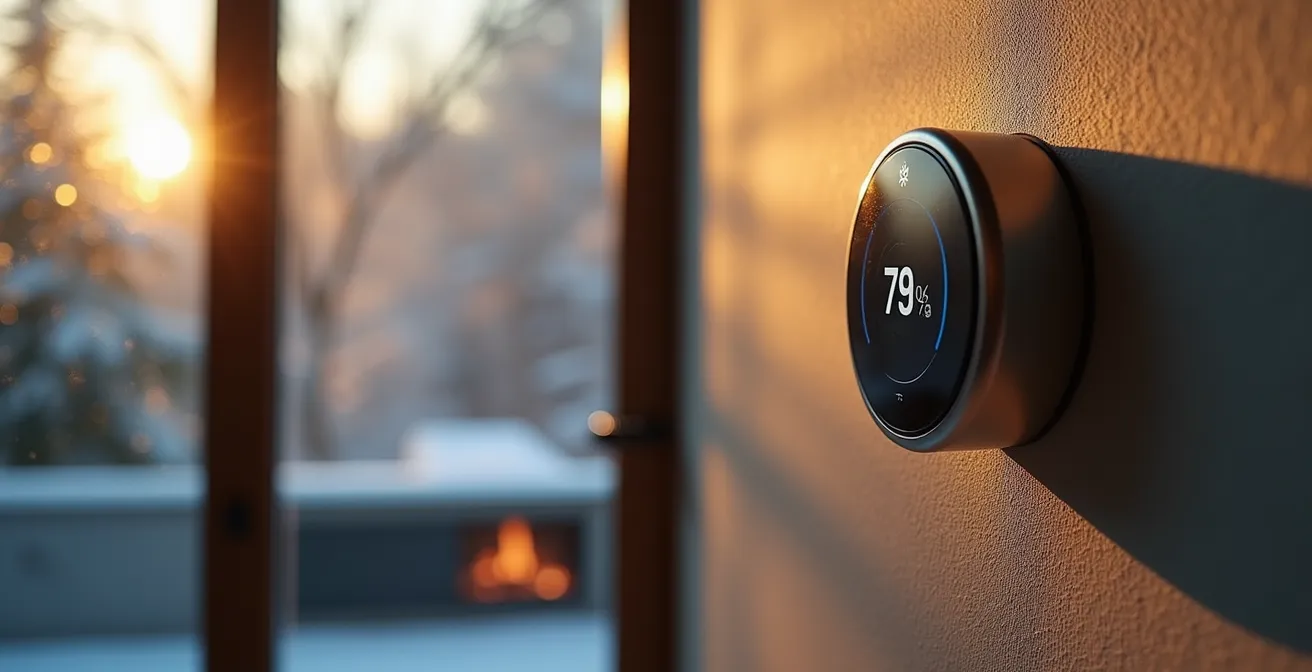
As the image suggests, the technology allows for a precise, automated response to your household’s unique patterns. Learning algorithms take this a step further by analyzing your manual adjustments over time, learning your preferences, and building a custom schedule that balances comfort and efficiency. A landmark Nest Labs study found that households can save 10-12% on heating costs by properly utilizing these features. This saving is not theoretical; it’s the measured result of replacing a static schedule with an adaptive one.
When selecting a device, a critical factor for ensuring ROI is third-party verification. Look for devices that have earned the ENERGY STAR label. According to the certification body, smart thermostats that have earned the ENERGY STAR go through an independent process that verifies savings based on extensive field data. Certified models from brands like Nest and ecobee have demonstrated proven performance. Investing in a certified device ensures that the features advertised, from learning algorithms to detailed energy reports, are backed by real-world data and will deliver a quantifiable reduction in your heating bill.
Wi-Fi vs Zigbee Bulbs: Which Consumes Less Standby Power?
Replacing incandescent bulbs with smart LEDs is a clear energy win, but the analysis doesn’t stop there. As a systems engineer, you must also account for the standby power consumption of the smart bulbs themselves. This is where the communication protocol—typically Wi-Fi or a mesh network protocol like Zigbee/Z-Wave—becomes a critical factor in your ROI calculation. Each “off” but connected bulb is a small parasitic load, and in a home with dozens of bulbs, the cumulative draw can negate some of your savings.
The choice between protocols involves a trade-off between infrastructure cost, network stability, and per-device efficiency. As a study from the Center for Energy and Environment highlights, the energy profile of each technology is distinct. The following data provides a clear technical breakdown for making an informed decision.
| Feature | Wi-Fi Bulbs | Zigbee/Z-Wave Bulbs |
|---|---|---|
| Standby Power per Bulb | 0.5-1W | 0.15-0.3W |
| Hub Required | No (uses router) | Yes (adds 2-3W) |
| Network Impact | Can congest Wi-Fi with many devices | Separate mesh network |
| Response Time | Variable (depends on router load) | Typically faster for group commands |
| Break-even Point | Better for <10 bulbs | Better for >15 bulbs |
The data from the comparative analysis shows that while Wi-Fi bulbs are simpler to set up (no hub required), their higher standby power makes them less efficient at scale. For a small deployment of fewer than 10 bulbs, their simplicity wins out. However, for a whole-home system (>15 bulbs), the lower per-bulb consumption of Zigbee/Z-Wave, even factoring in the hub’s power draw, results in lower overall standby consumption and a better long-term ROI. As the Lawrence Berkeley National Laboratory points out, this is a critical consideration:
Standby power consumption in an average home ranges from five to 10 percent of household energy consumption
– Lawrence Berkeley National Laboratory, What is Smart Energy Organization Report
The Storage Mistake That Wastes 40% of Solar Production
For homeowners with solar panels, a battery storage system seems like the logical next step. However, a critical and costly mistake is to treat the battery as a passive backup device that simply stores excess energy and discharges when the sun goes down. This “dumb” approach can waste up to 40% of your potential savings by failing to integrate external data. True ROI comes from an active storage strategy that uses smart home technology to make intelligent decisions based on weather forecasts and utility rates.
An intelligent system does more than just store and release. It should integrate with real-time weather forecasting services. If the system knows a cloudy day is coming, it can choose to fully charge the battery from the grid during overnight off-peak hours when electricity is cheapest. Conversely, on a brilliantly sunny day, it can prioritize sending excess power back to the grid to maximize sell-back credits. This transforms the battery from a simple reservoir into a dynamic energy-trading asset. With Parks Associates research revealing that more than 30% of homeowners now prioritize energy efficiency in renovations, understanding these advanced strategies is crucial.
The core principle is optimization. A smart battery system should constantly be solving an equation: what is the most financially advantageous action to take *right now*? Charge from solar, charge from the grid, discharge to power the home, or sell to the utility? Without smart integration, your battery is only guessing. By using weather and utility rate data, the system can make the optimal choice every minute of the day, ensuring that every kilowatt-hour generated or stored is used to its maximum financial potential and dramatically accelerating the system’s ROI.
When to Run Your Dishwasher: The Smart Plug Strategy
Large appliances like dishwashers, washing machines, and dryers are among the biggest energy consumers in any home. While you can’t reduce the energy a cycle requires, you can drastically reduce its cost by controlling *when* it runs. Many utility providers have moved to Time-of-Use (ToU) rates, where the price of electricity changes throughout the day. Power can be two or three times more expensive during peak-demand hours (e.g., 4-9 PM) than during off-peak hours (e.g., overnight).
A smart plug with energy monitoring is the key to unlocking this saving. By connecting your dishwasher to one, you can automate its operation to run exclusively during the cheapest energy periods. This strategy isn’t about just delaying the start; it’s about creating a data-driven rule that guarantees the lowest possible cost for every cycle. For example, you can set an automation that says, “Run the dishwasher cycle only between 12 AM and 5 AM, when the utility rate is below $0.10/kWh.” This ensures you never accidentally run a high-draw appliance during a price surge.
Implementing this strategy requires a systematic approach. You must first identify your utility’s specific ToU schedule and then configure your smart home automations to align with it. The following checklist provides a step-by-step engineering plan to implement this high-ROI optimization.
Action Plan: Implementing Time-of-Use Optimization
- Install & Track: Connect an energy-monitoring smart plug to your dishwasher to track its real-time and cyclical consumption.
- Integrate Rate Data: Connect your smart plug’s app or smart home hub to your utility provider’s Time-of-Use rate schedule.
- Set Automation Thresholds: Create a rule or automation to permit the dishwasher to run only when electricity rates fall below a specific price threshold (e.g., $0.10/kWh).
- Coordinate Resources: If you have a smart water heater, create a secondary automation to ensure it has pre-heated water available just before the dishwasher’s off-peak cycle begins.
- Audit & Refine: Monitor the monthly energy reports from your smart plug to verify the savings and adjust the schedule to further optimize cost reduction.
Why Imported Bamboo Might Be Less Green Than Local Oak?
In the pursuit of a “green” home, material choices are as important as energy consumption. A common assumption is that rapidly renewable materials like bamboo are always a more sustainable choice than slow-growth hardwoods like oak. However, from a systems engineering perspective, this view is overly simplistic. The true environmental impact of a material can only be determined through a Life Cycle Assessment (LCA), which analyzes the total energy and carbon footprint from sourcing to installation.
The critical factor often ignored is embodied carbon, specifically the emissions generated during transportation. Bamboo may grow incredibly fast in Southeast Asia, but it must be harvested, processed, and shipped thousands of miles to reach a home in North America or Europe. This transportation process, typically involving container ships and diesel trucks, carries a massive carbon footprint. This is a perfect example of a system with a hidden cost.
In contrast, oak sourced from a local, sustainably managed forest just 50 miles away has a negligible transportation footprint. While the tree itself took decades to grow, the embodied carbon from transport is a fraction of the bamboo’s. Therefore, depending on your location, the slow-growth local oak could be the more environmentally sound choice. The “greenest” option isn’t about a single attribute like renewability; it’s about the total impact of the entire supply chain system. This requires a shift in thinking from “what is the material?” to “what is the material’s journey to my home?”
Smart Fridge vs Smart Sous-Vide: Which Changes Your Routine More?
Not all “smart” appliances are created equal when it comes to energy ROI. A critical part of a systems approach is to differentiate between features that add convenience at an energy cost and those that provide efficiency and savings. The modern kitchen is a perfect laboratory for this analysis, with the smart refrigerator and the smart sous-vide cooker representing two opposing ends of the spectrum. A smart fridge with an interactive screen and internal cameras is a 24/7 energy consumer, while a sous-vide is an energy-saving tool used only on demand.
The technical data reveals a stark contrast in their net energy impact. A smart fridge’s display and connectivity features add a continuous parasitic load, increasing the appliance’s overall energy consumption without reducing the primary function’s cost (cooling). A sous-vide, however, offers a more energy-efficient cooking method than a traditional oven for many tasks. A 1000W sous-vide running for two hours uses significantly less energy than preheating and running a 5000W oven for one hour. In fact, a 1000W sous-vide uses approximately 80% less energy than a conventional oven for a similar task.
The following table breaks down the ROI calculation for these devices, clearly showing that one is an energy liability and the other is a high-efficiency asset.
| Appliance | 24/7 Power Draw | Active Use Power | Net Energy Impact | ROI Period |
|---|---|---|---|---|
| Smart Fridge Display/Camera | 5-10W continuous | 150-400W when cooling | Negative (adds 40-80 kWh/year) | Never (energy negative) |
| Smart Sous-Vide | 0W (unplugged when not in use) | 800-1000W for 2-4 hours | Positive (saves vs 5000W oven) | 1-2 years |
| Energy Monitor on Old Freezer | 1-2W for monitoring | Identifies 200W+ continuous draw | Highly positive (identifies issues) | 2-3 months |
This analysis proves that the “smart” label is irrelevant without an ROI assessment. The smart fridge adds to your routine by offering recipes and remote viewing, but at a net energy cost. The sous-vide fundamentally changes the cooking process to be more precise and far more energy-efficient, offering a clear financial return.
Key Takeaways
- The highest and fastest ROI comes from identifying and eliminating parasitic “vampire” power loads with smart power strips.
- True optimization requires coordinating high-draw appliance schedules with your utility’s Time-of-Use (ToU) rates to ensure you always pay the lowest price.
- Evaluate every “smart” feature based on its net energy impact and financial ROI, not just its convenience or novelty.
How to Save Time Cooking With Smart Kitchen Appliances?
The final frontier for home energy optimization is the kitchen, where a combination of smart scheduling and right-sizing your tools can yield significant savings in both time and electricity. The engineering principle here is to match the energy output precisely to the task at hand. Using a large, 5000-watt oven to reheat a small meal is incredibly inefficient. Smart countertop appliances like multicookers and air fryers allow you to apply heat in a much more contained and efficient manner.
Smart multicookers, for example, are exceptionally efficient for batch cooking. They use a fraction of the energy of a stovetop, with some studies showing that smart multicookers can achieve up to a 70% reduction in energy use for similar tasks. By programming one to handle batch cooking during off-peak hours on a Sunday, you can prepare a week’s worth of meals at the lowest possible energy cost. Similarly, using a smart air fryer, which preheats almost instantly, instead of a large conventional oven for smaller items can reduce energy consumption for that task by as much as 75%.
The “smart” component ties it all together. By using smart plugs or native app features, you can schedule these cooking processes to align perfectly with your life and your utility’s ToU rates. A slow cooker can be programmed to start while you’re at work and finish just as you get home. An instant pot can be set to run a pressure-cooking cycle during an afternoon low in energy prices. By building a system of right-sized, efficiently scheduled appliances, you create a kitchen that saves you time while actively working to reduce your energy bill, representing the ultimate synthesis of smart home technology.
To begin implementing these strategies, the first and most logical step is to conduct a thorough energy audit of your own home. Use an energy-monitoring smart plug to identify your top three parasitic loads and start building your ROI-focused plan from there.